FILM
- AS A -
SUBVERSIVE ART
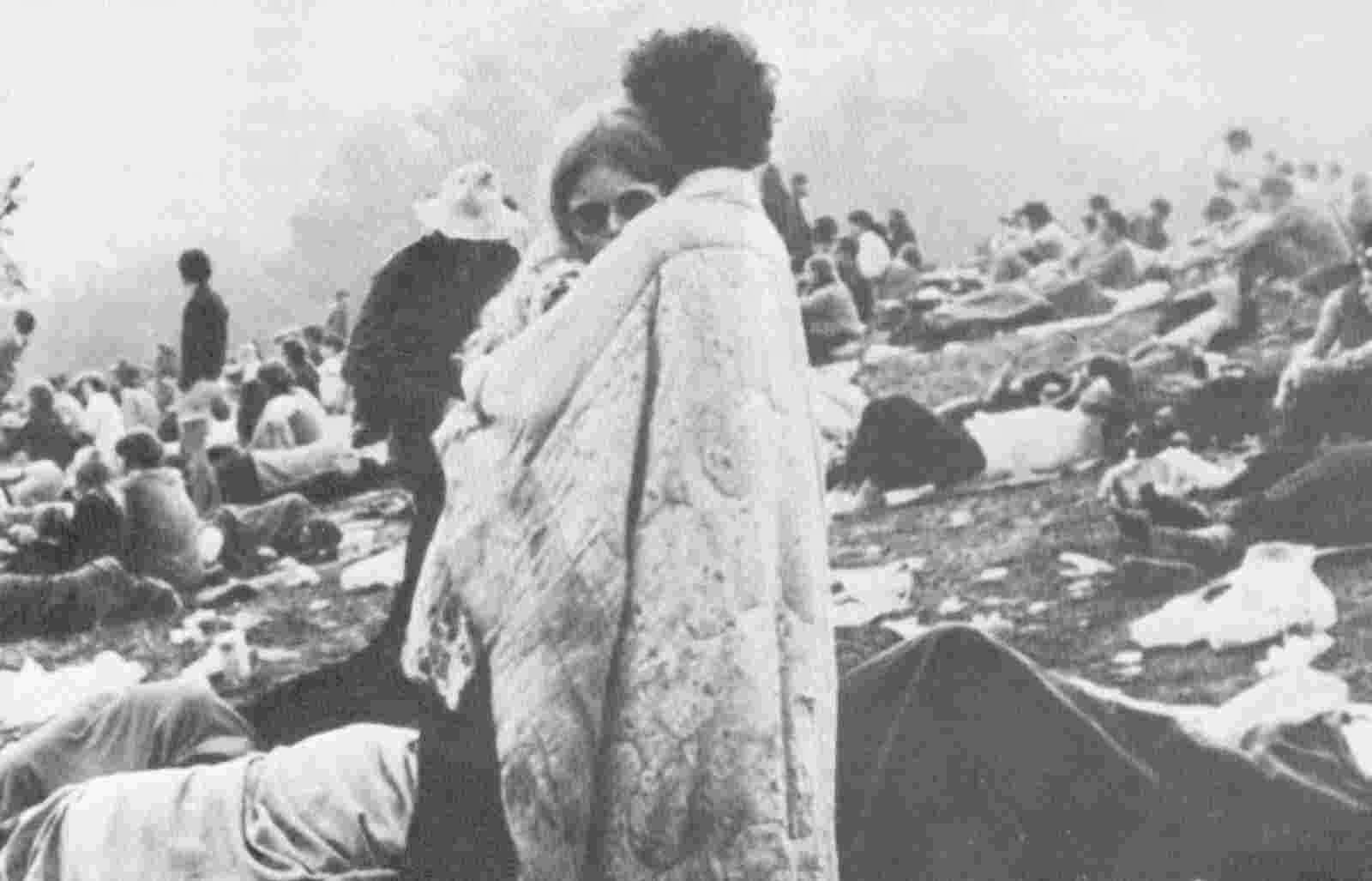
WOODSTOCK
(Michael Wadleigh and Bob Maurice, USA,
1970) (F)
Some day,
Woodstock 1968 will be celebrated as the first of
many
manifestations of a more human society yet to come.
For,
despite the wails of their elders, it represented the
aspirations of a defiantly romantic
counter-movement,
with rock --
its own music -- expressing the new lifestyle.
This
still reflects it: casual disorder, non-conformism, a new
attire, a closeness to nature,
informality -- and love. A ro-
mantic,
utopian, and necessary vision if man is to survive. SC
COUNTERCULTURE
AND AVANT-GARDE
The
decade of the 60s has seen the beginning of a new kind of
subversion which, despite its smiling
gentleness and all-accepting love,
may
possibly constitute a grave and comprehensive threat to organized
society. It is possible that future
generations will view the rise of the
Counterculture
movement -- Woodstock, the Beatles, Zen Buddhism,
the
flower children, communes, and free schools -- as the beginning of
the new radical politics of the latter
20th century. For here the young
have
declared their independence from received wisdom and
"immutable"
patterns
(such as competitiveness, violence, and the desire for bourgeois
living), creating their "alternative
lifestyles" with a gusto and consistency
that
unites -- as does the avant-garde in art -- form and content
and
hence becomes doubly
dangerous. Those who mistakenly believe that
the
setbacks this movement has suffered and the relative
"quietitude"
of
the bodypolitic signal its end have many surprises in store;
for the
causes that
originally triggered the youth and student
revolution --
unbridled
technology, depersonalization, the coldness of the computer
age, the boredom of affluent
consumer society, the insipidness
of
the rat-race -- continue to exist in increasingly threatening
forms and will, in turn, engender new
oppositional waves.
The
brave and innocent attempts of this counterculture to reintegrate man
with nature and his fellows, to return
"flowers" and "love" to the arena of
human discourse, to proclaim acceptance of
all that exists and the oneness
of
individual and cosmos, do not represent a romantic return to
Rousseau,
but an imperative
necessity if man is for the first time to recognize himself
as such so as to survive. In their
driving rock music, their sensitivity
sessions,
their experiments with mind-expanding drugs, their gentleness
and avoidance of power; in their
acceptance of sexuality in all its forms,
their
striving for full equality of the sexes, their rejection of profit
motive
and socially
useless work; in their opposition to war and injustice, their
love-ins and gay liberation fronts,
their extraordinarily beautiful new
attires,
hair styles, beads and new modes of speech, they have turned
their backs on society as now organized
and are groping their way to-
wards
a new type of communal or at least "related" group living
located
at the opposite pole of
bourgeois individualism. In fact, this movement
has
been unique in combining the social zeal of the political
radicals
with a full-scale
attack on their bourgeois valuesystem, including
their moribund puritanism and interest in
privilege and power.
There
are failures and pitfalls as the ideology, no longer contained in
ossified
political documents,
is being evolved while it is being lived. There are defeats
and there will be more, since these new
gentle fighters are as yet powerless
and
may, in fact, never succeed in turning society around. But the
attempt
is being made -- in the
West as well as the East, as 1968 proved.
The
movement constitutes the first attempt to integrate the world of
Einstein, Freud, and Marx into a
consistent whole and to relate the mys-
ticism
of the East and of Norman O. Brown and Laing with a rationalism
that knows its limitations. It is
Marcuse's historic attempt to integrate
psycho-analysis
and Marxism, Eros, and political struggle that has placed
him in a leading position in a movement
that no longer accepts the need
for
leaders, but, like Rosa Luxemburg, considers their historical task to
be
to make themselves
unnecessary. If we seem to have come to the end of
the period of 1968, it is only the end of
a first chapter, with the evolution
of
these ideologies to be reassumed on a higher level at a later time.
It is
particularly their much maligned "cosmic" attitude that
corresponds
so precisely to
man's now more clearly recognizable position within
an
infinite, monstrously indifferent, magically challenging universe.
The idiocies of national sovereignty,
relics of an earlier stage of human-
ity's
development, must make way not only for world citizenship --
and the abolition of national wars -- but
for citizenship in the cosmos.
This
is Einstein's ultimate and most revolutionary message to future
generations. This realization of the
"cosmic" is possibly the central core
of
the movement and comes from the most disparate and unexpected
sources; "Thre is a certain point for
the mind", said Andre Breton in his
Second
Surrealist Manifesto of 1930, "from which life and death, the
real
and the imaginary, the
past and the future, the communicable and the
incommunicable, the high and the low cease
being perceived as contra-
diction.
(1) William Irwin Thompson, in his At the Edge of History,
refers
to the rise of a new
"planetary consciousness" and this is certainly manifes-
ted in the science fiction novels of Olaf
Stapleton, Ray Bradbury, C.S. Lewis,
and
Arthur C. Clarke; Buckminster Fuller's philosophical-poetic
realization
of earth as a
spaceship travelling through the cosmos; Shklovskii and Sagan's
Intelligent Life in the Universe;
(2) and the utterly fantastic yet highly scientific
studies and speculations by the world's
leading cosmologists in A.G.W. Cameron's
Interstellar
Communication. (3) It connects with an acceptance of death
as part
of cosmic existence
going back to Santayana's statement that "He who, while
he lives, lives in the eternal, does not
live longer for that reason. Duration has
merely
dropped from his view; he is not aware of or anxious about it; and
death,
without losing its
reality, has lost its sting. The sublimation of his interest res-
cues him, so far as it goes, from the
mortality which he accepts and surveys." (4)
It
also relates to the memorable passage in Hesse's Demian, in
which oceanic
consciousness is
portrayed in poetic terms: "The surrender to nature's
irrational,
strangely confused
formations produces in us a feeling of inner harmony with the
force responsible for these phenomenon ...
the boundaries separating us from nature
begin
to quiver and dissolve ... we are unable to decide whether the images
on our
retina are the result of
impressions coming from without or from within ... we disco-
ver to what extent we are creative, to
what extent our soul partakes of the constant
creation
of the world. (5) It is too simple to characterize this
attitude -- which,
like that of
the oriental mystics, invokes sex and orgasm as a means toward the
achievement of the "oceanic feeling
of non-existence and loss of personal identity"
(6)
-- as a mere return to religiosity and anti-rationalism;
instead; it attempts to
reunite
man in all his polarities and to undo the separation of mind and
feeling.
The
basic intention of subversive cinema -- the subversion of
consciousness --
is now
attempted in films that experiment with new forms and contents and
aim not to humor the viewer but to involve
him. They may range from simple
documentations
of the new lifestyles or communes to personal declarations
of faith and to the most original
evocations of the new values. As usual, it is
the
international film avant-garde that takes the lead, and those
marginal
works of the
commercial cinema that at times come close to it. The avant-
garde offers no solutions or programmatic
statements, but a series of intricate
challenges,
hints, and coded messages, subverting both form and content.
In this fundamental sense, it is by
definition both an aesthetic and a political
movement.
Its achievement lies in its continuing and inevitable creating
"desecration" of the medium,
leaving nothing undisturbed, taking nothing
for
granted. In its works, film is sacked, atomized, caressed, and
possessed
in a frenzy of
passionate love; neither emulsion, exposure, lighting, film
speed, or developing, nor rules of
editing, camera movement, composition,
or
sound, are safe from the onslaught of the poets who have irrevocably
invaded the cinema. By restoring the
primacy of the visual element, this
movement
brings us face to face with the essence of the medium, this in-
explicable mystery of the image.
Its god is Eisenstein rather than Shake-
speare.
The literary origin and form of commercial cinema -- tied to
narrative structures and naturalistic
soundtracks, to which the images
are
subsidiary -- is discarded. If, in Hans Richter's
words, contemporary
commercial
cinema represents a 19th century realist art, l that of
the
counterculture is a
desperate attempt to break through to our time.
REFERENCES
(1)
Andre Breton, quoted in Age of Surrealism, 1960
(2) I.S. Scklovskii
and Carl Sagan, Intelligent Life in the Universe, 1968
(3) A.G.W. Cameron,
Interstellar Communication, 1963
(4)
Walter Sullivan, We Are Not Alone, 1964 (5) Herman
Hesse,
Demien,
1969 (6) Alex Comfort, Darwin and the Naked Lady,
1961
FILMS
___________________________________________________________________________________________
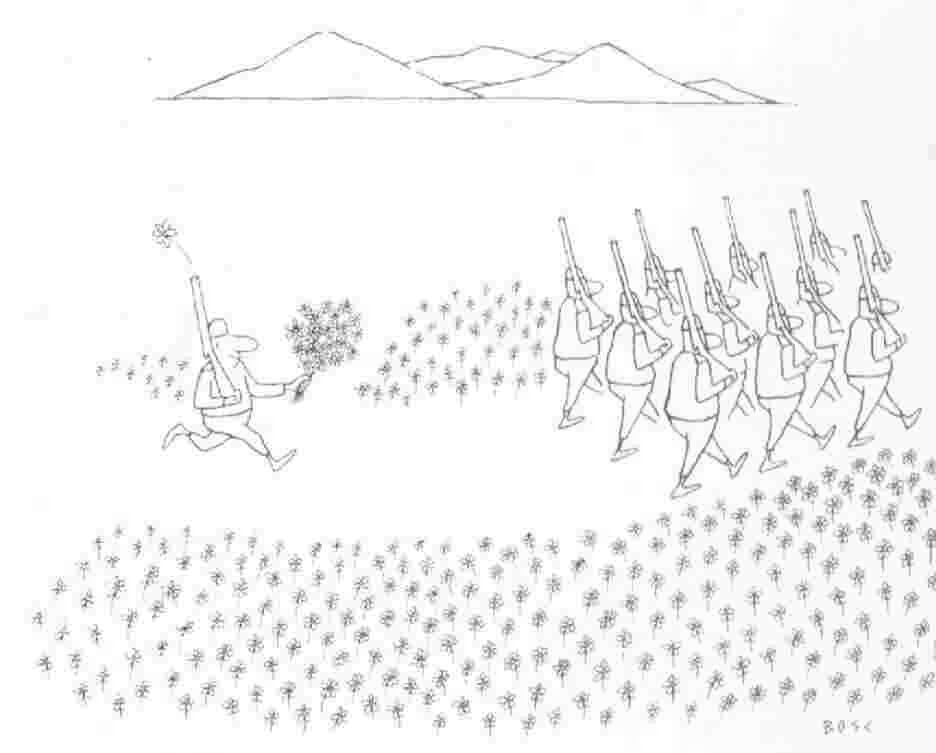
JOURNEY
TO BOSCAVIA
(Bosc,
France, 1960)
As usual, it is
the nonconformist who has the
best
ideas. In this anti-militarist animation,
the
French cartoonist Bosc anticipates
the
flower generation. The outsider is the
only
one who displays a human emotion.
___________________________________________________________________________________________
ALLURES
(Jordan Belson, USA, 1961)
One of the most ravishing abstract
animations by the master
of
"cosmic" cinema, this film pulsates with concentric,
exploding mandala-like forms -- continual
intimations of
a pantheist
universe and of all matter and forms flowing
endlesslyinto each other. The
other-worldly images are
artistic
transformations of actual, yet unrecognizable
objects.
Peace, acceptance, oneness is the implicit message.
___________________________________________________________________________________________
APOTHEOSIS
(John Lennon, Great Britain, 1970)
In a snowy landscape, the camera pulls
back slowly to reveal
Yoko Ono
and John Lennon in the square of a little rustic
town;
it continues retreating and simultaneously rising into
the sky,mounted on a balloon that
remains invisible through-
out.
Dogs bark, there are voices. The surroundings of the town
come into view, then a panorama of the
entire region; suddenly,
blankness
for five minutes -- an unbearably long period in the
cinema. When all hope is gone, the
screen bursts into a pink
explosion
of sky, sun, and cloud tops; the camera had risen
(in
real, not screen time) through an enormous cloud band,
and had passed, by means of minimal art,
from separateness
to oneness
with theworld, "rising into heaven" in a beautifully
romantic, purely visual metaphor of
spiritual ascension.
___________________________________________________________________________________________
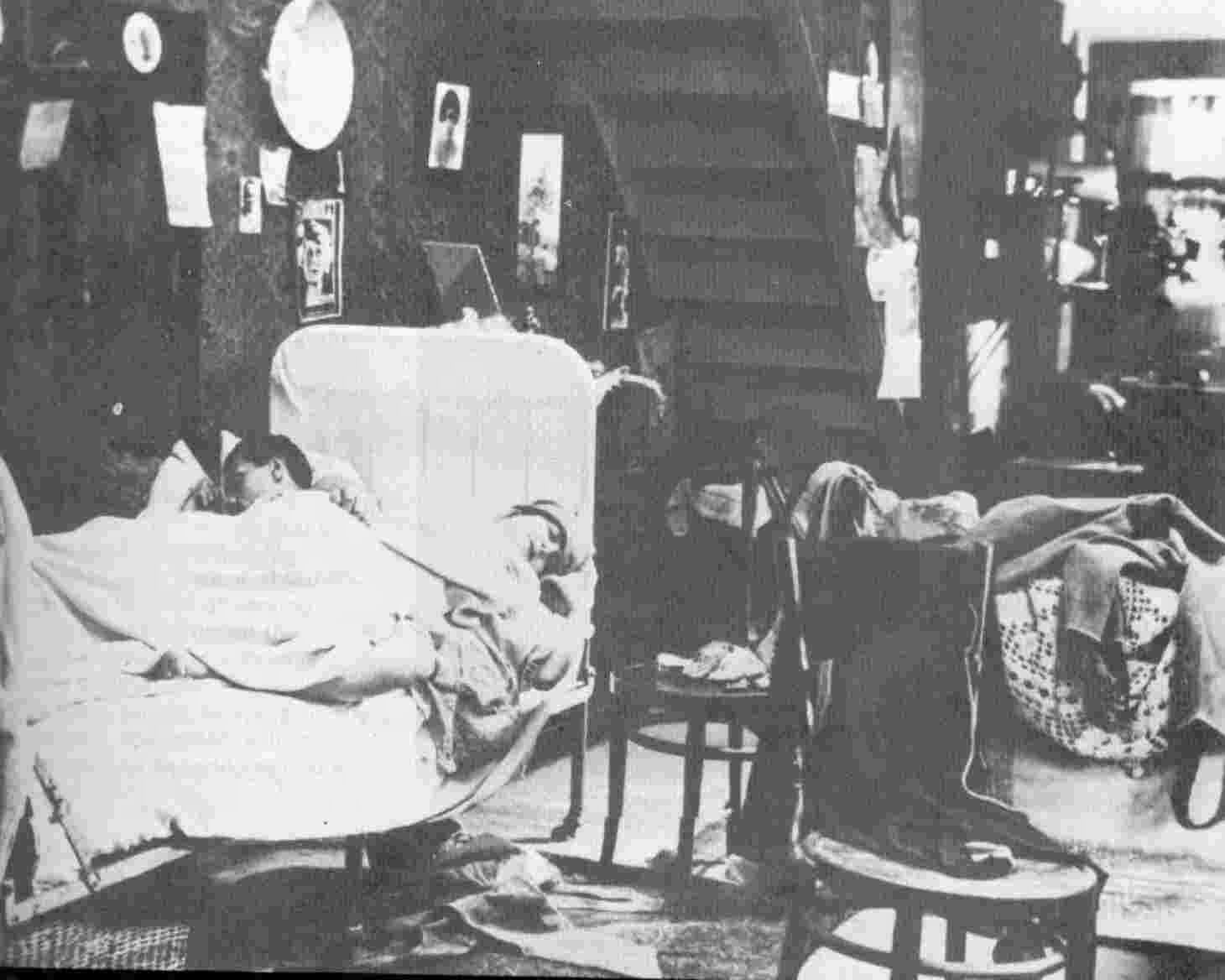
BED
AND SOFA
(TRETYA
MESHCHANSKAYA)
(Abram
Room, USSR, 1927)
A whiff of
counterculture overhangs one of the most
charmingly
humanistic stills of the early Soviet cinema;
a
truly "lived-in" room, filled with pictures, plants, the
disorder of passion, the warmth and
softness of the couple,
heads
in delicious counterpoint to their union, a pretty knee
impudently protruding. Equally
unorthodox was the film's
portrayal
of very informal sex mores in early Soviet Russia.
______________________________________________
This
almost legendary "lost" masterpiece of the Soviet cinema,
hampered by its subject matter, has
suffered from even more
restricted
circulation than other Russian films. A master-
piece of psychological realism, its
sexual triangle (cause by
the
post-revolutionary housing shortage) involved husband
and
lover changing place on bed and sofa, until the pregnant
woman, tired of male chauvanism, decides
to leave them both.
The
film is unique in its emphasis on the individual rather
than class and its portrayal of
unconventional sexual mores
in
early Soviet Russia; it reflects, in its anti-puritanical
humanism, the atmosphere of the
early revolutionary days
far
more accurately than some of the large-scale propagandist
works of the period. Entirely
incongruously, but in accord with
Stalin's
new policy, it contains a crude anti-abortion message.
___________________________________________________________________________________________
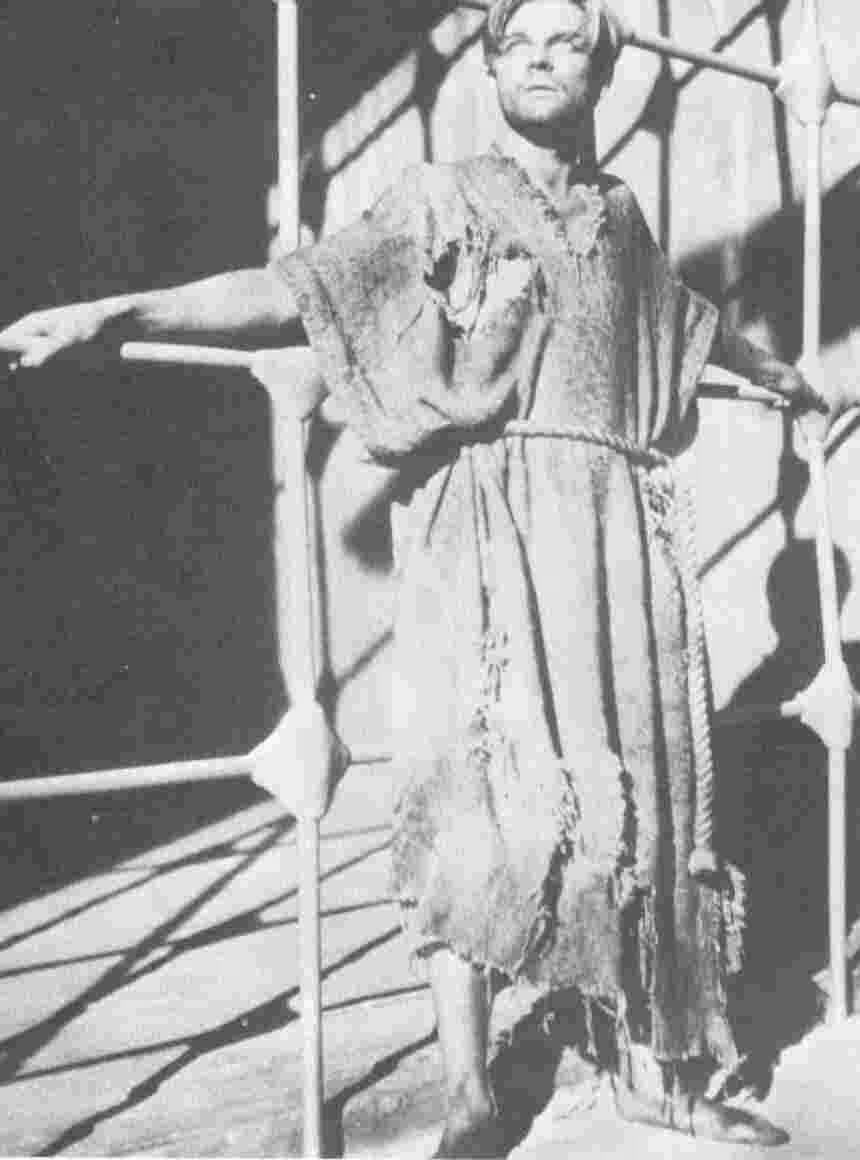
THE
INCREDIBLE SHRINKING MAN
(Jack
Arnold, USA, 1957) (F)
Close-ups
can be deceptive: this man is about an inch tall
and leans against the wire mesh of a
small casement window.
Having
continuously shrunk throughout this haunting film and
survived a thousand crises, he now seems
ready for a happy end;
it
comes, but in a way that has made this work a memorable cult
film of the new pantheists; for,
shrinking further and literally
disappearing
into the vegetation outside, the man at last under-
stands that he gained freedom only by
becoming small enough to
pass
throughthe previously impregnable wire; and that -- by shrin-
king into "nothingness" -- he
is now to be one with all that exists.
___________________________________________________________________________________________
BREATHING
TOGETHER:
REVOLUTION
OF THE ELECTRIC FAMILY
(Morley
Markson, Canada, 1970) (F)
This
important ideological comment on the radical American youth
culture embodies its values even in
structure and style. A most creat-
ively
edited montage of the "struggle between life and death culture
in America", it mingles Allen
Ginsberg, Buckminster Fuller, Abbie
Hoffman,
and John Lennon with newsreels, subliminal effects,
doctored TV images, the A-bomb, the
Chicago Trial, the matrix
of
the new generation's sensibility -- to create a "psychedelic"
equation of fact and metaphysics,
itself an expression
of
Consciousness III and the new political poetry.
___________________________________________________________________________________________
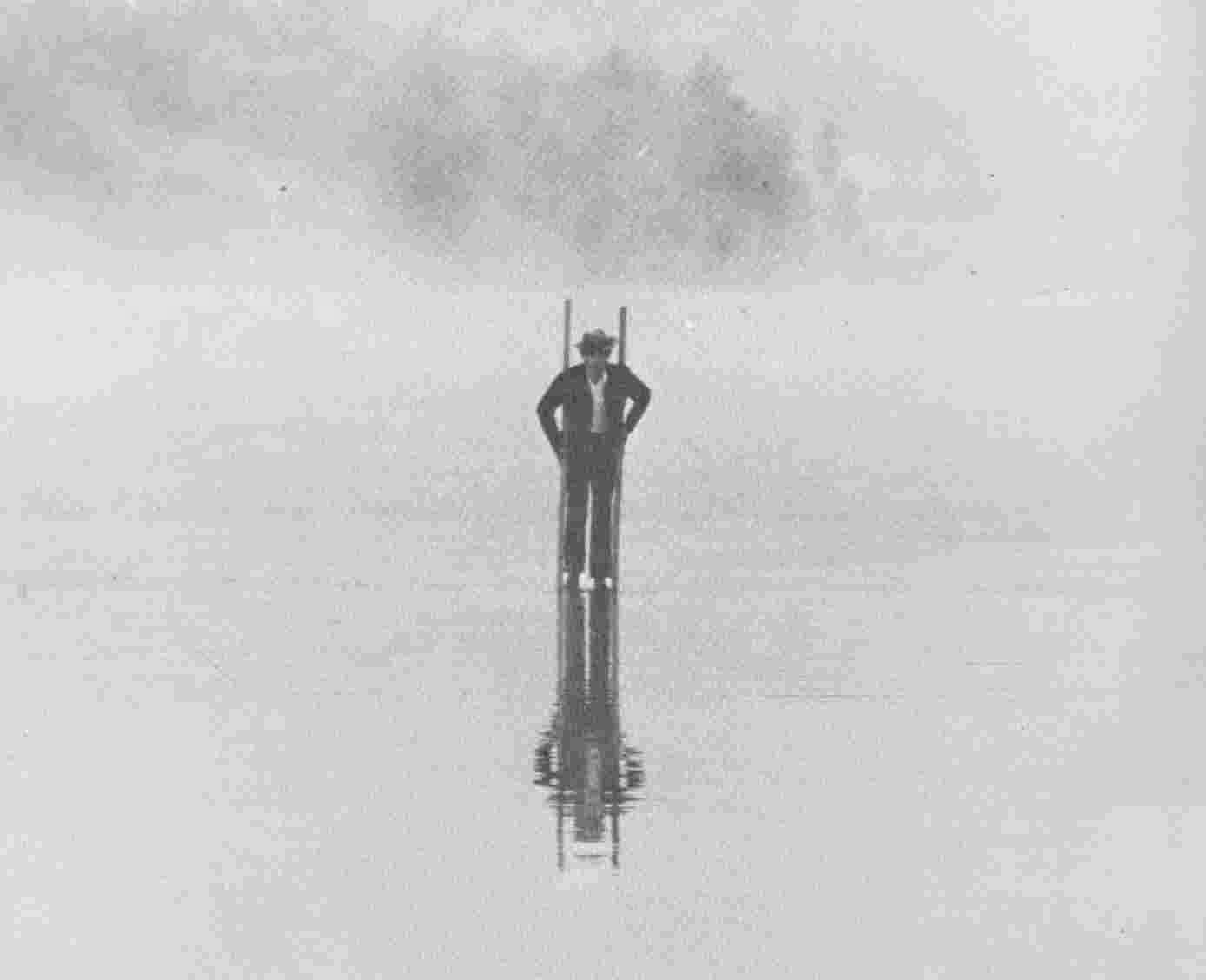
HARRY
MUNTER
(Kjell
Grede, Sweden, 1969)
A
powerful, poetic image: the mystery of black against
white, of an outsider walking on the
water, on stilts, Christ-
like,
stubborn, the tension of his forward-leaning body
reflecting his determination. This,
indeed, is the topic
of this
intenselymysterious, lyrical film, one of the most
original and disregarded works of
contemporary cinema.
___________________________________________________________________________________________
CO-CO
PUFFS
(Ira Wohl,
USA, 1972)
The unlikely -- and
alien -- subject of a detailed drum lesson
becomes
a celebration of counterculture values as (without
being
subjected to "explanations" or "editorializing"),
we
discover the painful
process of learning, the inevitable failures,
the
ultimate triumph and the power relation between teacher
and taught. An original and
consciousness changing message
from
a world so odd we never knew we could learn to care about it.
___________________________________________________________________________________________
FAMILY
(Hubert Smith, USA, 1971)
Made for the National Institute of Mental
Health as a view of the
patterns
and interaction of a middle-class family, this beautiful
cinema verite study, in its concentration
on a particular lifestyle
and
emphasis on non-verbal, unconscious behavior, provides far
more: a view of a relaxed, democratic
family in action, in which
neither
side claims perfection, and all perform as friends in an
eternal circle of warmth and love.
The non-authoritarian attitudes,
the
spontaneous and repeated touching and hugging, the absence
of competitiveness and strife are gentle
indications of the new
sensibility.
Significant moments of unconscious bodily contact
are slowed down and then frozen in
brilliant visual comment.
___________________________________________________________________________________________
'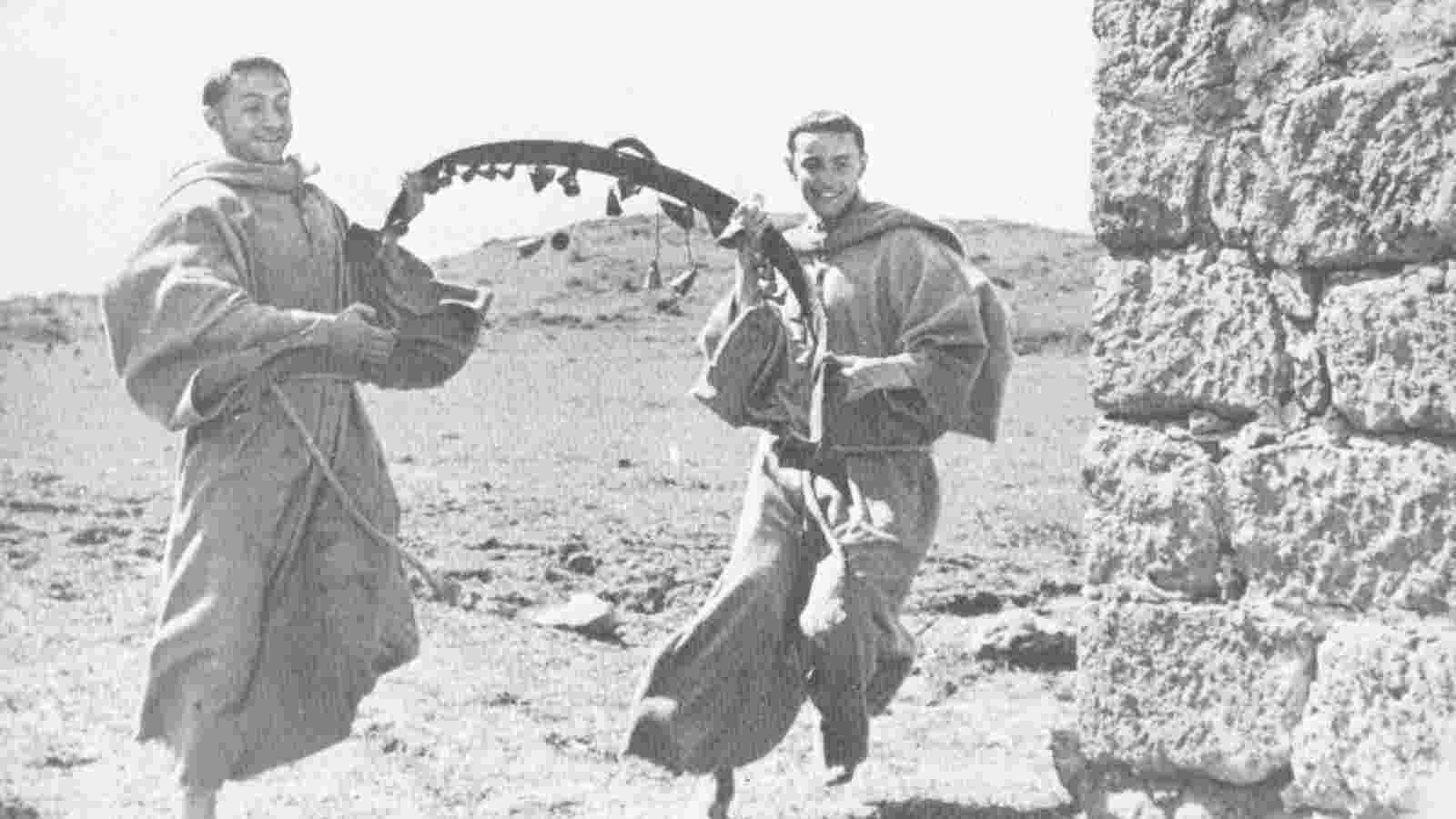
THE
FLOWERS OF ST. FRANCIS
(Roberto
Rossellini, Italy, 1950) (F)
Early
proponents of the counterculture: St. Francis
and
his followers return to nature, simplicity and
povertyin
Rossellini's neglected masterpiece of the
humanist
cinema which portrays subtle, haunting
episodes
in the life of a fervent and innocent
seeker.
Scenario by Rossellini and Fellini.
___________________________________________________________________________________________
FATA
MORGANA
(Werner
Herzog, Germany, 1970) (F)
Films
are now emerging from Germany that reveal, perhaps
for
the first time, the true state of mind of a country that has
undergone fascism, total war,
destruction, and killed its Jews;
these
films may be considered examples of a new, complex hu-
manism tattooed -- for a change --
on the skins of shell-shocked,
psychologically
maimed Aryans. Such a film is Fata Morgana
(cruelly disregarded by critics), which
may some day be viewed
as The
Cabinet of Dr. Caligari of the New German Cinema with
its declaration of independence from the
old, and shedding
of both the
commercial film and imitative avant-garde.
Fata
Morgana is a sardonic, melancholic comment on man in
the universe, its subtle and
hallucinatory images accompanied
by
texts from sacred 16th century creation myths of Guatemalan
Indians and the 1970 German avant-garde.
It moves on a poetic,
visual
level, has no conventional plot, but cunningly employs
the trappings of surface reality
(sandscapes, barbed wire,
industrial
debris, natives that do not fit their environs)
to
probe depths beyond surrealism and metaphysics.
The
land, though Africa, is a landscape of the mind, archetypal
and eternal. The immense, inhuman
grandeur of primeval
dunescapes,
waters, and horizons is caught in sensuous
travelling
shots revealing man's triumphant and empty rape
of
the land: flaming red girders of abandoned factories
in the middle of deserts, their initial
purpose unfathomable,
masses
of abandoned vehicles, steel pipes, barrels, military
supplies, rotting symbioticallty with
animal cadavers in
intimate,
frozen family tableaux that melt into the soil
before
our eyes; emaciated black children and strange
old
men in mysterious, poverty-stricken habitats -- all
of
this permeated by sand, nameless dread, flies, and an
insufferable sun made visible in heatwave
distortions
which lend objects
and "sets" a hallucinatory quality.
"In
Paradise," says the narrator, "man is born dead";
and Herzog refers to Hieronymus Bosch's
"Garden of
Earthly
Delights": his paradise, too, contained God's
fatal errors from the start (visible only
in corners "so
that the
painter would not be branded as heretic").
Among
Herzog's ideological weapons are absurd, bizarre tableaux:
a determined young German woman,
senselessly making black
children
repeat "Blitzkrieg is madness" in German (all of them
knee-deep in water); a ridiculous frogman
with fins and snorkel,
holding
on to a huge turtle while breathlessly informing us that it
has flippers to move, a mouth to take
nourishment, and "a behind
where
it comes out again"; a sweating, maniacal lizard-lover
(obviously affected by years in the
African sun), his square-jawed
German
visage distorted behind black glasses as he sadistically
manipulates the animal, comments on its
habits, and attempts
to
avoid its bites (flies hover over festering wounds on his hands,
inflicted earlier). The strongest
sequence involves a catatonic
drummer
and a female pianist on a tiny stage in a brothel, who
perform like robots, endlessly and
off-key: "In the Golden Age,
man
and wife live in harmony", the commentator says, as they
are photograph- ed head-on, with all the
merciful cruelty
of a humanist
filmmaker who must show everything. At
the end, they remain immobile and there
is no applause.
Stylistically,
the film consists of a series of extended travel
shots
moving along a horizontal axis, reminiscent in their
ideological intensity of Godard's Weekend
highway sequence;
these
are interrupted by stylized, frequently immobile
set
pieces, in which the always anonymous protagonists
addressthe camera directly in
medium shot or close-up.
The
result is an interior travelogue, an obessive, hypnotic, and
iconoclastic "comment" on
technology, sentimentality, and
stupidity,
filled with everyday objects that reveal their frightening
secrets; images, camera movements, and
montage hewn as if from
stone;
a poetic, epic mood, perversely corrupted (and hence, elevated)
by a sardonic, suffering magician,
tremblingly aware of our limited pos-
sibilities,
outrageous perseverance and almost lovable ridiculousness.
With
this film, Herzog fulfils the promise of genius implicit in his
earlier
Signs of Life
and Even Dwarfs Started Small, progressing to a level of
artistry
at once more
subversive and more inaccessible; for here, working solely
with the materials of reality, the
filmmaker in a cosmic pun on cinema
verite
recovers the metaphysical beneath the visible. It is only in
such works
that we achieve
intimations of the radical new humanism of the future. SC
___________________________________________________________________________________________
FREE
RADICALS
(Len
Lye, USA, 1957?)
"A Free
Radical is a fundamental particle of matter
which
contains the energy of all chemical change,
very
much like a compressed spring before release.
The
film gives an artistically symbolic portrayal of
fundamental energy." With
beautiful, exemplary
economy,
this long-neglected masterpiece of an-
imation
creates a perfectly controlled abstraction
that
foreshadowed the contemporary "cosmic" view
in
its fusion of science and mystery. The nervous,
vibrating, non-objective designs, under
constant, agit-
ated tension,
were directly engraved on blank film --
black
leader, without the intervention of a camera.
___________________________________________________________________________________________
GLEN
AND RANDA
(Jim
McBride, USA, 1971) (F)
Unaccountably
disregarded by critics, this is a poisoned
idyll
of two young people in an America destroyed by
atomic
war: turnpikes overgrown by weeds, nomads living
off the debris, travelling con-men
ironically hawking
fragments
of a lost civilization, and the unbearable search
for
a new beginning. Particularly moving is a silent,
real-time sequence in which an old man
and a youth
stare out at an
ocean sunset, looking for a non-existent
answer.
A paraphrase of the counterculture's sensi-
bilities,
the film's subversive potential lies in its straight-
forward acceptance and naturalistic
portrayal of the
destructibility
of eternal American symbols; a destroyed
Howard
Johnson's restaurant is more difficult to take than
newspaper articles warning about the
dangers of atomic war. SC
___________________________________________________________________________________________
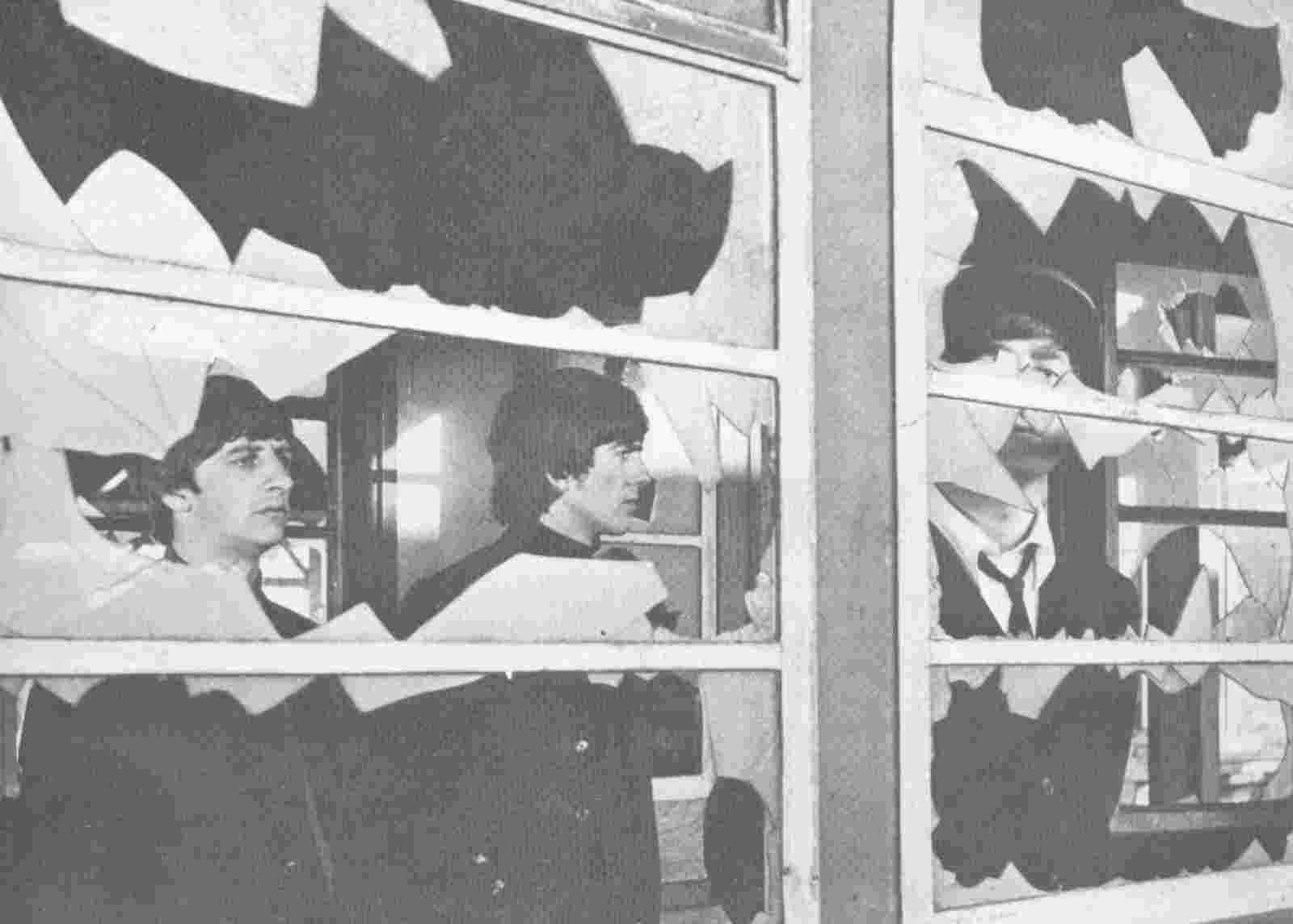
A
HARD DAY'S NIGHT
(Richard
Lester, Great Britain, 1964) (F)
The
jagged patterns of broken glass dominate three
of
the Beatles in their first film. In a prophetic image
of things to come, Paul is absent.
But even if the group
itself
no longer exists, its legacy continues in the values
of
the counterculture and within every member of the
new
generation; for these subversives pointed in the dir-
ection of the future; only very few can
make this claim.
______________________________________________
The
playful anarchism and exuberant vitality
of
this work -- a thumbing of noses at the "straight"
adult world -- caught the essence of the
Beatle mystique
and even
reinforced their electrifying presence with
machine-gun
editing, jump cuts, accelerated speed, quick
movements
in close-up, and a camera that never stood
still.
The best sequence is of their largely improvised,
anarchic outdoor "dance" shot
from a helicopter and
closely
cut to their famous "Can't Buy Me Love". The
constant dissolution and reformation of
their group
patterns, seen in
fluid motion against the geometric
lines
of a playing field is delightfully choreographic and
lyrical. The Beatles' ideological
refusal to take the world
or
themselves seriously, their almost surreal approach
to
their environment proved a perfect foil for Lester,
previously responsible for the surrealist
Running,
Jumping And
Standing Still Film (with Peter Sellers).
___________________________________________________________________________________________
LAPIS
(James Whitney, USA, 1963-67)
Whether working together with his brother
John, or singly,
as here,
James Whitney is one of the foremost pioneers
of
abstract cinema. Since the 60s, his work has turned
increasingly complex, computer-oriented
and religious
in the
cosmic sense. Lapis is hypnotic, centering around
a mandala pattern and Indian music, and
proceeding
through ascending
stages of wordless visual contemplation.
Though
the image is non-objective -- or perhaps be-
cause
-- the viewer, caught in its ever more consistent
rhythms, loses himself in order to find
his truer self.
The
orchestrations of ever-changing dots round a
transforming, fiery core, coupled with
the mono-
tonously
beautiful music, becomehallucinatory.
"The
only subversive aspect of my film is the unrecognized,
but mighty taboo; our tacit conspiracy to
ignore who, or what
we really
are, Tat-Swam-Asi (That Art Thou), the startling
and
psychologically "subversive" way of realizing that
theself is in fact the root and
ground of the universe --
a
realization so strange and inadmissible to the West
that
it isvirtually our most rigid taboo." (James Whitney)
___________________________________________________________________________________________
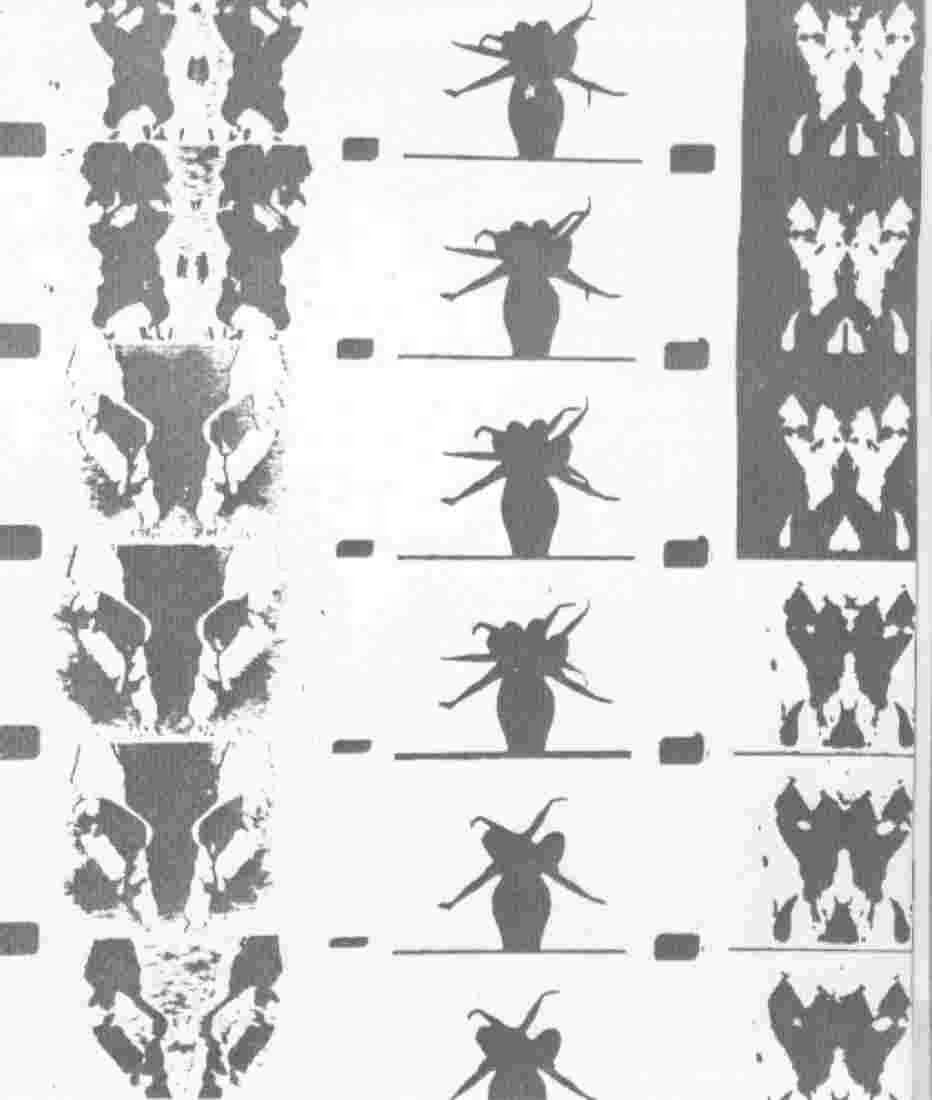
OFF-ON
(Scott Bartlett, USA, 1967)
One of the most important attempts so far
to express the new
sensibility
directly and poetically, in a perfect, magical fusion
of
non-verbal communication and advanced technological
filmmaking (video-manipulation, multiple
exposures and
printing,
solarization, and synthetic color). Indeterminacy,
the
union of opposites, the cosmic, the expansion of conscious-
ness, the going beyond rationalism; all
these are intimated
purely
visually, almost subliminally -- to those willing to "see".
___________________________________________________________________________________________
LIGHTNING
WATERFALL FERN SOUP
(Shelby
Kennedy, USA, 1971)
Amidst
flashes of lightning, fern is gathered, sliced,
mixed
with water, and cooked; after this poetic,
religious,
act, it is eaten with reverence in a simple,
romantic
statement of Third Consciousness sensibility.
___________________________________________________________________________________________
PARADISE
NOW
(Sheldon
Rachlin, Great Britain, 1970)
At
least forty films have been made about the Living Theatre;
it remained to the American underground
filmmaker Sheldon
Rachlin
(previously responsible for the marvelous Vali) to make
the "definitive" film about one
of the most famous of their works,
Paradise
Now, shot in Brussels and at the Berlin Sportpalast. Made
on videotape, with expressionist coloring
"injected" by electronic
means,
this emerges as a hypnotic transmutation of a theatrical
event into poetic cinema, capturing the
ambience and frenzy of
the
original. No documentary record could have done it justice.
SC
___________________________________________________________________________________________
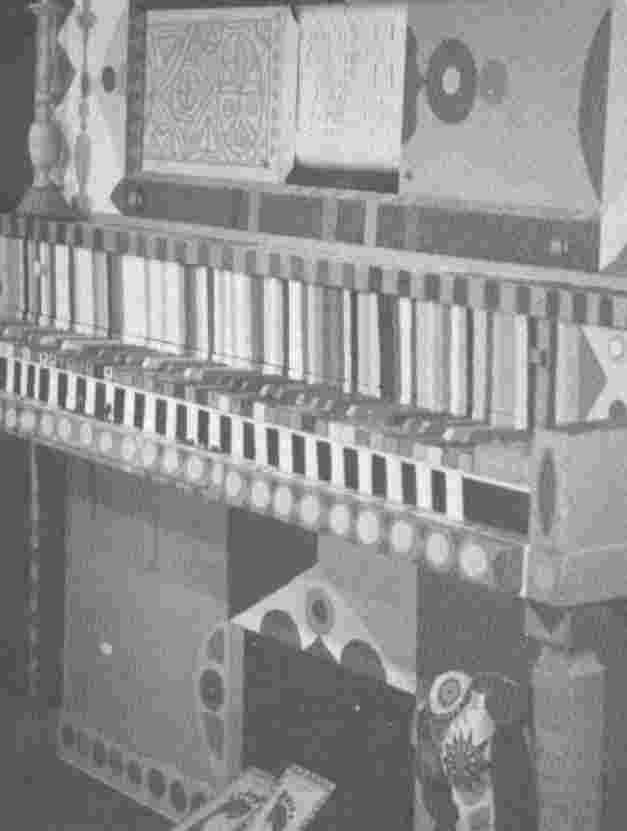
PIANISSIMO
(Carmen D'Avino, USA, 1963)
An outstanding precursor of the new
sensibility uses
single frame
animation to hand-paint (image by image!)
an
entire piano in an exuberant, maniacal explosion of color
(and strong filmic rhythm). As he
does this, the invisible
artist
creates his own version of reality: non-competitive,
life-affirming, peaceful, filled with
warmth and love of beauty.
___________________________________________________________________________________________
NEBULA
II
(Robert
Frerck, USA, 1971)
After
Jordan Belson, one might have thought no further
mandala
films could fruitfully be made; Nebula II
quickly
dispels this notion. As the ever-changing circular
patterns become more complex and change
in increasingly
rapid fashion,
the incessant bombardment of our senses
with
flicker effects, visual transmogrifications, pulsating
color, and enforced forward movement via
zoom, finally
sets up a
sensory overload both hypnotic and over-
powering
in its beauty and mystical revelation.
___________________________________________________________________________________________
SAMADHI
(Jordan Belson, USA, 1968)
Belson is the filmmaker who has most
rigorously
developed the forms
and shapes of cosmic cinema --
non-objective
patterns that yet remond one of microcosm
and
macrocosm, finding their ever-changing centers in
works
of constant flux, devoid of boundaries. The intention
is
to relate man to the universe or rather to reaffirm their
indivisibility. Here he comes
closest to recreating, in
spectacularly
beautiful images, the awe and splendor of
the
cosmos. Samadhi in Sanskrit stands for "that state of
consciousness in which the individual
soul merges with
the universal
soul." This ultimate condition of consciousness
is therefore non-sensorial; the film
concerns approaches to it.
___________________________________________________________________________________________
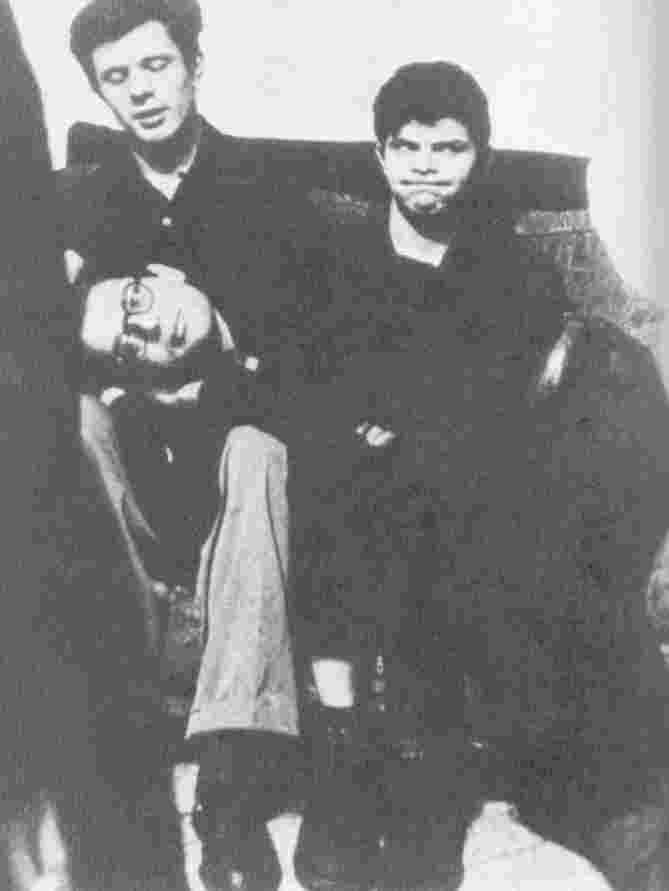
PULL
MY DAISY
(Robert
Frank and Alfred Leslie, USA, 1959)
Even
the pose -- open, casual, mask-less -- reflects the
new
style. The poets Peter Orlovsky, Gregory Corso, and
(sideways) Allen Ginsberg in a
significant pioneering
film of
the (then emerging) counterculture which com-
plied
with James Agee's request for "works of pure fiction,
played against, into, and in
collaboration with unrehearsed
reality".
Jack Kerouac's spontaneous narration helped
evoke
an image of a heroic, bedraggled, and prophetic
circle that changed the consciousness of
America's youth. SC
___________________________________________________________________________________________
THIS
IS IT
(James
Broughton, USA, 1971)
A little
nude boy in the woods -- exploring, playing with a ball --
and a Zen-like poem, its individual
segments repeated several
times,
with long pauses between them. "This is it ... This is really
it ... This is all there is ... And It's
perfect as It is." The simplicity
of
the central idea increases its effectiveness, but because of
the specificity of its realistic imagery
and of the poem, it raises,
more
than the consciousness-lowering, hypnotic abstractions by
Belson or James Whitney, the basic
question about the resurgence
of
Indian philosophies in the Western counterculture: is the
problem of poverty and oppression
resolvable by cosmic accep-
tance?
Is it the task of the privileged West to encourage
others to accept conditions that
ought to be changed?
___________________________________________________________________________________________

SELF-OBLITERATION
(Jud Yalkut, USA, 1967)
In
a strange film, the painter Kusima paints
dots
on bodies, flowers, grass, and even water in a
suddenly
significant attempt at expressing panthe-
ism
and ego transcendence by purely visual means.
______________________________________________
A
strangely compelling study of Yayoi Kusama, painter,
sculptor and environmentalist, who paints
polka dots on
flowers, bodies,
water, and grass in a thought-provoking
attempt
at pantheism and ego transcendence, culmi-
nating
in relazed nude body painting and group sex.

LION'S
LOVE
(Agnes
Varda, USA, 1969)
An oddly
affecting anarchic view of aspects of a new American
sensibility by a noted French film
director (the only dressed
figure
in the still). A collage of aspiring actors awaiting
their opportunity in Hollywood, it stars
Viva and the two
creators of
"Hair" in a casual menage a trois -- in which sex
and nudity are neither "issues"
nor proselytizing slogans. SC