FILM
- AS A -
SUBVERSIVE ART
AKTION
J
(Walter
Heynowski, East Germany, 1961)
One
of the most sensational East German "expose"
films of former Nazi leaders continuing
in leading
positions in
post-war West Germany concentrated
on
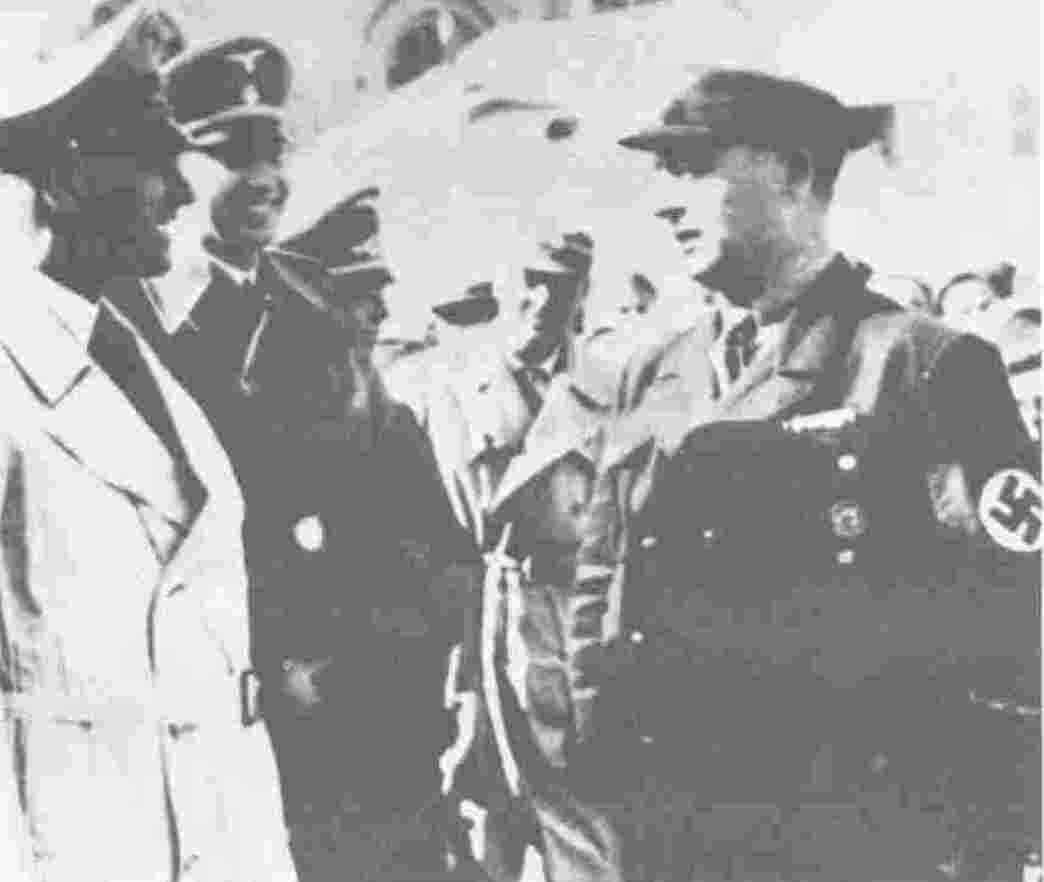
the case of Dr. Hans Globke, Secretary of State
to
the then Chancellor Adenauer. Here, in a Nazi
news-reel
shot used in the film, Globke appears in
his
earliest incarnation as one of the main architects
of
Jewish extermination in Nazi-occupied Europe.
EAST
GERMANY:
AGAINST
THE WEST
FILMS
___________________________________________________________________________________________
HOLIDAY
ON SYLT
(URLAUB
AUF SYLT)
(Annelie
and Andrew Thorndike, East Germany, 1959)
This
hard-hitting indictment is possibly the most successful
of the Thorndike series, The Archives
Testify. Diligent research
among
Nazi film, law, and literary archives, revealed the then
mayor of a popular West German resort
town on the island of
Sylt to
have been a leading SS general, perpetrator of war crimes
(visual- ly documented), and the man who
broke the resistance
movement
in Warsaw. A pounding, factual, and authoritative
soundtrack -- pointing to documents,
files, letters, photographs,
and
newsreels -- is crosscut with pictures of corpses, executions,
and interviews with survivors. According
to Jay Leyda's book,
Films
Begat Films, two West German cameramen were sen-
tenced to jail for having tricked the
Mayor into allowing an
interview
for what they knew to be (but he did not) this film.
___________________________________________________________________________________________
O.K.
(Walter Heynowski, East Germany, 1964)
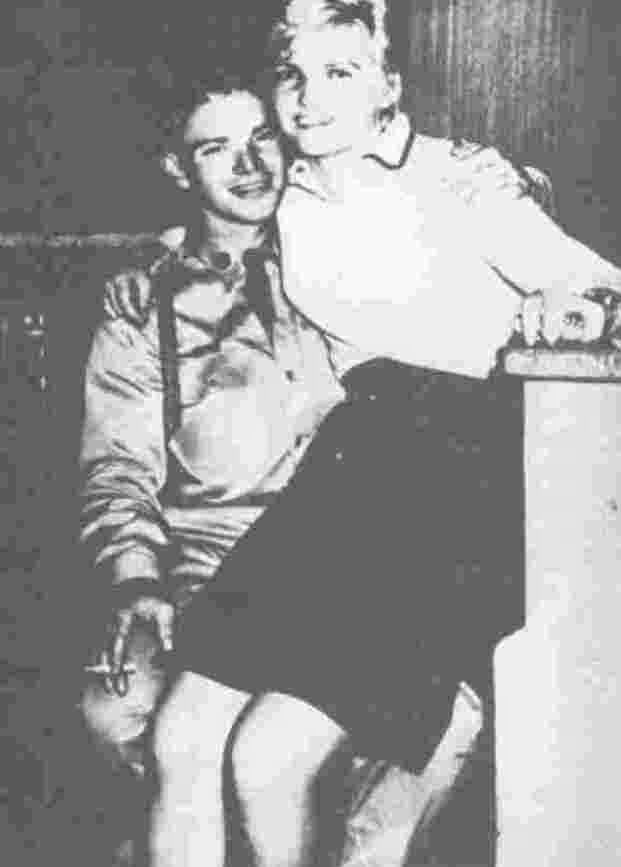
Taken from a family album, this
documentary shot
shows a
former East German girl, now a barmaid in
West
Germany, being further corrupted by an Ameri-
can
soldier. The use of sex for propagandistic attacks
titillates East Germans otherwise
carefully insulated
from
eroticism and reveals the puritanism of the regime.
______________________________________________
This
fascinating and unique film is unfortunately almost
entirely unknown in the West. The
girl, Doris S., leaves
East
Germany in 1961 to join her father in West Germany.
Three years later, she returns and
tells the camera why
she
returned. The reason is simple: West Germany is a
country of moral and sexual corruption,
full of bars, Amer-
ican
soldiers, American cars, alcohol, and prostitution.
Doris S. succumbed to both
commercial sex and drinking,
but
finally decided to return to clean living in East Germany.
Clearly
designed to discourage actual or potential emigration
from East into West Germany, the film
nevertheless operates on
a
second, unintended level as well. For in this lengthy interview,
Doris reveals non-verbal and unmistakable
signs of fear and
coercion,
reinforced by the stenatorian, Prussian style of
the
interviewer (rather, cross-examiner). Hesitation on her
part is met with a sharp "Out with
it!", and one suddenly
realizes
that the girl's freedom is at stake, and that she was
in
fact subtly coerced into making this film. ("We have
had access to your diary ... tell us
about it ....") Worse still,
there
is continued emphasis on sexual matters, with close-
ups
of this pretty, fearful girl; her relations with American
soldiers are emphasized and, in a
sensational abberation
from
"Communist" ideology, the old German-Nazi bogeyman
of "Rassenschande" is trotted
out in reference to her having
slept
with Black soldiers. The result is sexual titillation for
the East German petty-bourgeois audience,
otherwise carefully
protected
from eroticism. The strenuous, lecherous, transparent
attempts of the invisible interviewer
successfully to elicit sexual
titillating
("Of course, you had to show your American clients
your personal charms?") and
politically damning information
from
the coolly controlled, yet obviously tense girl are frightening,
as nervous gestures of the victim quite
clearly reveal her simply
as
having exchanged her presumable sexual bondage to the Amer-
icans with another, possibly more
dangerous dependence. At the
end,
the invisible man truly becomes a pornographic Big Brother
as, satisfied with her performance on
camera, he magnanimously
ladles
out a (small) drink to this obviously alcoholic girl -- to
drink on camera. The implicit
obscenity of this unfair interview
is
staggering. Though the social problem raised is real enough --
the presence of large numbers of
women-less and well-paid
(by
German standards) American soldiers -- there has rarely
been as effective an unintentional
self-indictment as this film.
___________________________________________________________________________________________
PILOTS
IN PAJAMAS
(PILOTEN
IM PYJAMA)
(Walter
Heynowski and Gerhard Scheumann, East Germany, 1968) (F)
This East German documentary about
American
POW's in North
Vietnam, also showed American
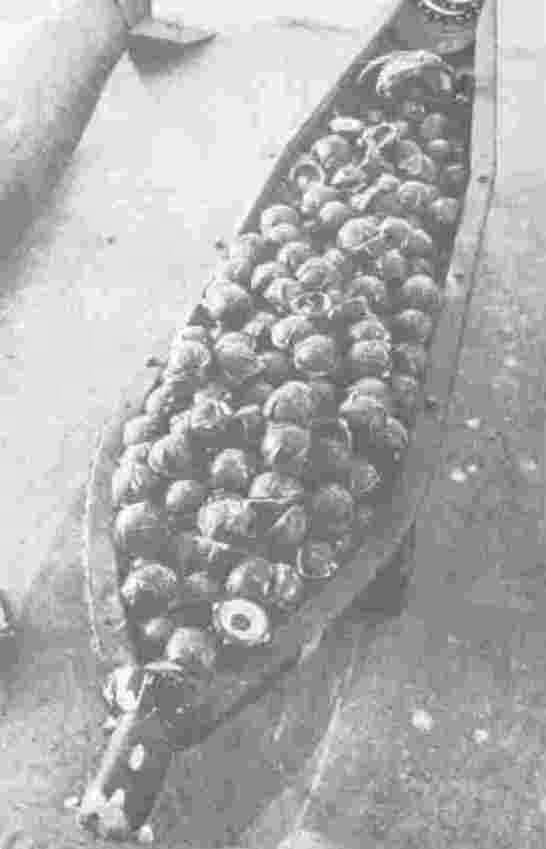
weapons
used there. Rarely discussed in the West,
their
inhumanity is staggering. This bomb opens
to
explode six hundred individual bombs solely
designed
for use against human beings.
______________________________________________
This
film, actually several feature films combined into one,
consists entirely of interviews with
American POWs in
North
Vietnam. The Americans talk at great length about
their lives, values, and Vietnam
experiences, in consistently
fascinating
exchanges with the invisible interviewers. In the
process, more is revealed than intended,
on both sides. The
American
ceremonies should be published in the West for the
light
they throw on the new impersonal, "remote-control"
killers of our day; "honorable men",
all of them. But the East
German
revelation is equally fascinating; for the obscene but
quite serious premise of this film, in
their eyes, is that these were
freely
conducted interviews among equals. The filmmakers do
not seem to realize that some of the
prisoners sweat profusely
while
talking, that all make pro-Vietcong statements, and that
there is fear in the back of their eyes;
Heynowski, at a press
conference,
expressed surprise that the pilots addressed him
with
"Yes, Sir" -- "I don't know why they did that ... "
They
did it because, given the
circumstances of its production,
such
a film, far from being "cinema verite", is a particularly
pernicious (since unacknowledged) kind of
courtroom inter-
rogation
without the usual safeguards and with the prisoner
already under lock and key, imagining
that good behavior
before the
camera may in some way improve his condition.
PILOTS
IN PAJAMAS
(PILOTEN
IM PYJAMA)
(Walter
Heynowski and Gerhard Scheumann, East Germany, 1968) (F)
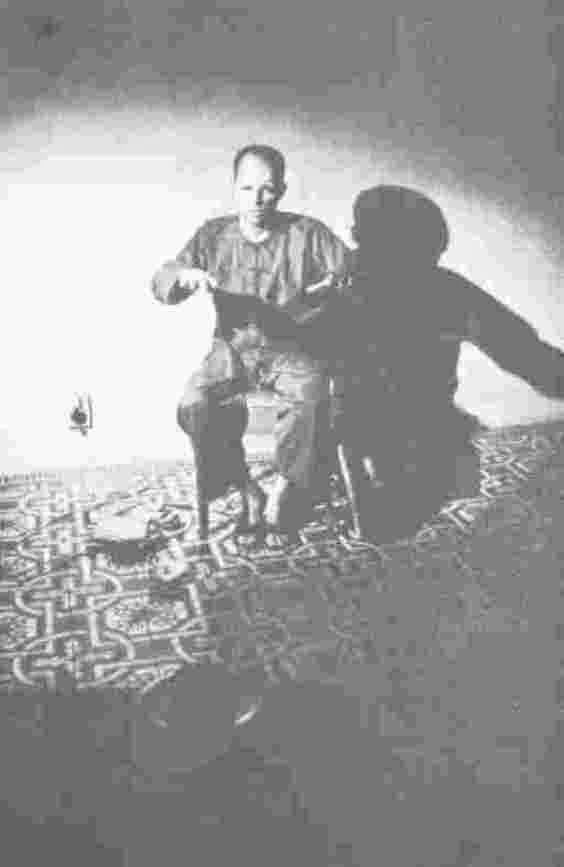
A captured American pilot being
interviewed in a North
Vietnamese
prison for an East German documentary.
The
interview, the place, the man, and what he says,
are all "real"; but he is under
duress and reality is further
manipulated
by lighting, positioning, and ominous shadows.
______________________________________________
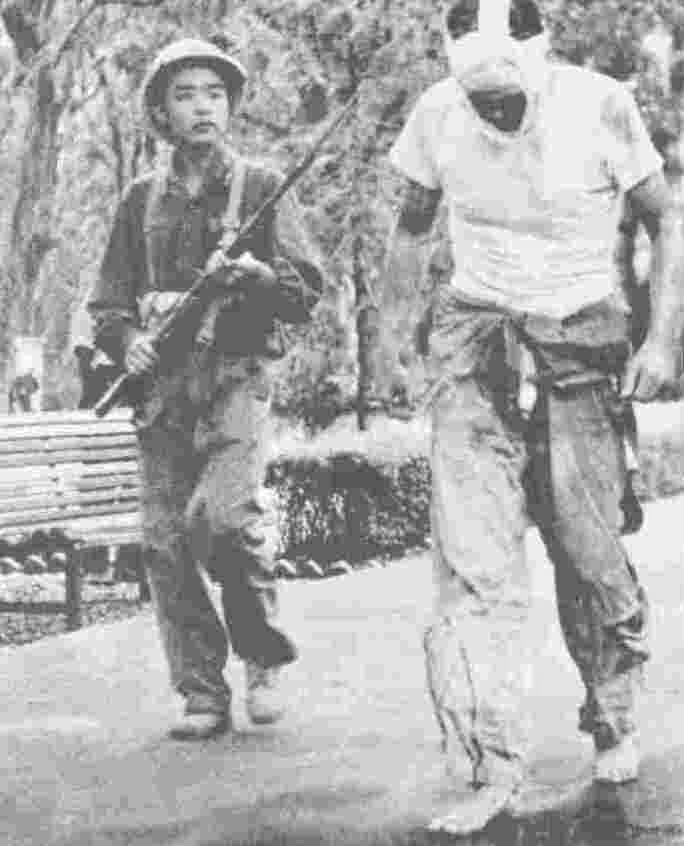
PILOTS
IN PAJAMAS
(PILOTEN
IM PYJAMA)
(Walter
Heynowski and Gerhard Scheumann, East Germany, 1968) (F)
Technological man in trouble; he even
lacks shoes,
as against
"primitive" captor. An unstaged newsreel
images
yields more truth than careful fictional recreation,
felt
in the distance between them, the differences in head
positioning, body size, and attire.
Behind them: bench and
shrubbery
(well-kept despite war) and the rich vegetation
so cruelly
devastated by the prisoner's compatriots.
___________________________________________________________________________________________
SUPERIOR
TOYS - MADE IN THE USA
(FEINE
SPIELWAREN - MADE IN USA)
(Guenter
Raetz, East Germany, 1969) (F)
This
film is a slashing, frontal attack, skillfully
edited,
on American war toys ("sold in West
Germany")
showing Nazi soldiers and tanks,
and
Fokker, von Richtofen, and Stuka planes.
("Have
the Americans forgotten that these
planes
bombed England?") For good measure,
the
film ends with monster toys, torture chambers,
the
Bloody Mummy, and an operating guillotine
("we
apologize for showing this in an East German
film").
The conclusion is that even toys have been
put
at the service of aggressive American imperial-
ism,
which aims at achieving Hitler's unattainable
goal:
the destruction of the socialist bloc.
___________________________________________________________________________________________
THE
LAUGHING MAN
(Walter
Heynowski and Gerhard Scheumann, East Germany, 1967)
Posing as a West German TV production
crew, the two East
German
directors of this film persuaded a former leading
German
mercenary of the Congo civil war (one of many!)
to
discuss his activities and heroic achievements in what
is
surely one of the most sensational exposes of its kind.
Continually
smiling or laughing, this man, a self-acknowledged
Nazi,
proudly reveals that he went to the Congo to save Western
civilization from Bolshevism -- to
complete the work of the Nazis.
Dressed
in his military jungle uniform (with his Second World
War
decorations) he waxes eloquent about the "colors" of South
Africa, "explains" apartheid,
and freely discusses his "adventures".
Shots
of corpses, tortures, and executions of Blacks are intercut.
It is not often that one can see and hear
a real, "live" Nazi in
action,
talking (more or less) freely because he presumed him-
self to be among friends instead of with
two of the most clever
political
propagandists of our time, working for the other side.
______________________________________________
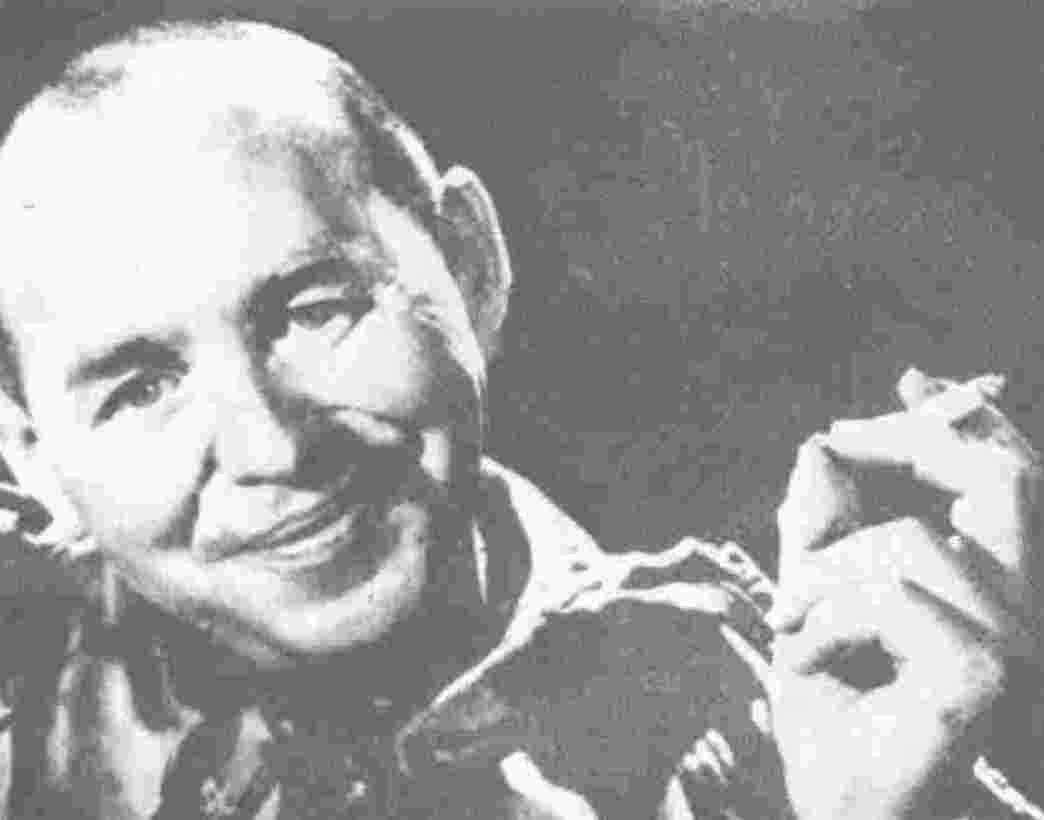
THE
LAUGHING MAN
(Walter
Heynowski and Gerhard Scheumann, East Germany, 1967)
This
jovial man who never stops smiling is a real,
"live"
former Nazi in action, talking freely about
his
"adventures" as German mercenary during
the
Congo civil war (tortures, executions, killings)
because
he -- mistakenly -- believes himself to be
talking
to friends. But the interviewers para-
ding
as a West German TV crew are really
the
East's most clever political filmmakers.