FILM
- AS A -
SUBVERSIVE ART
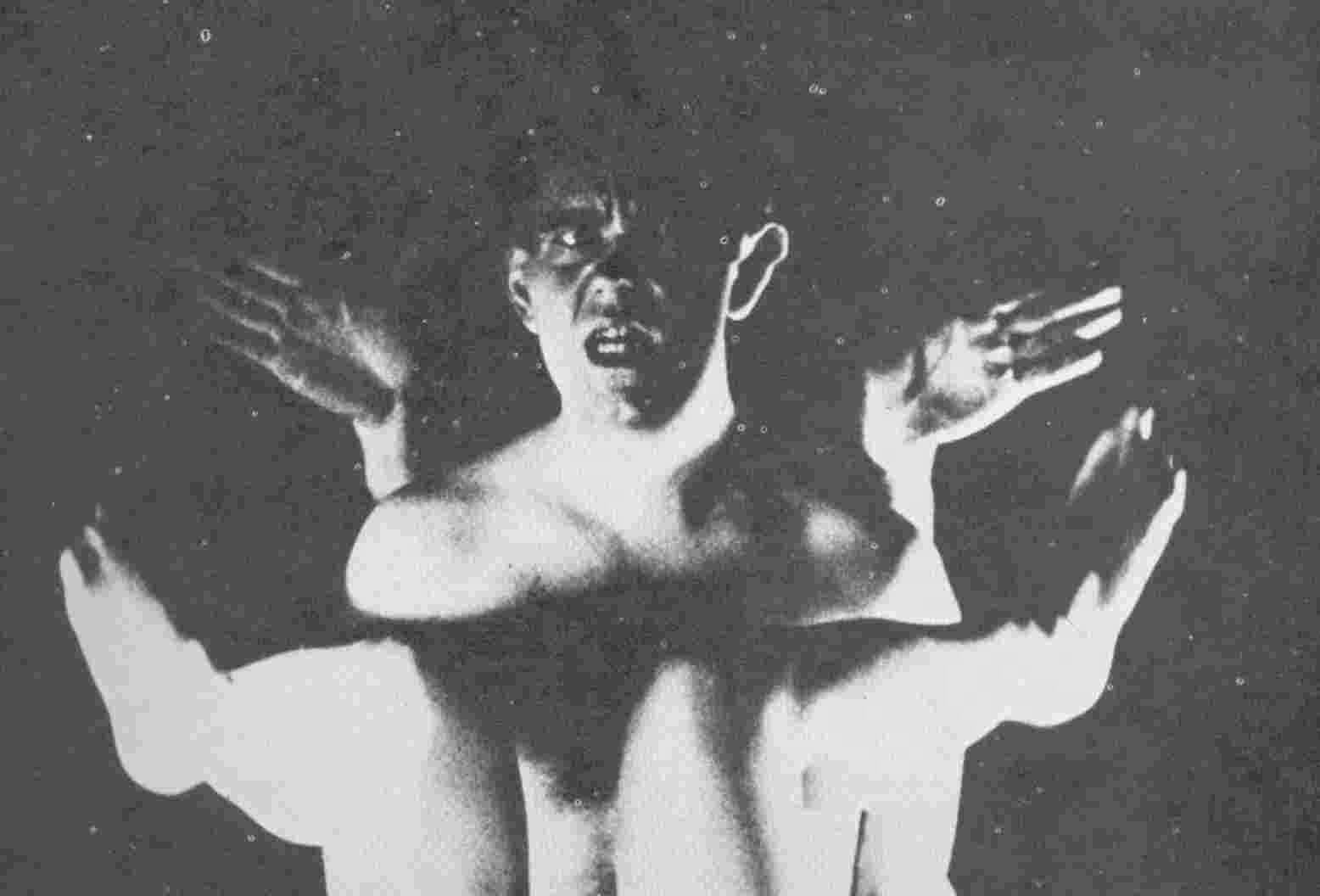
HALLUCINATIONS
(Peter Weiss, Sweden, 1952)
The famed author of Marat-Sade, in
one of his
early avant-garde
films, shows twelve erotic
and
subconscious tableaux envisioned in the
twilight
between waking and sleeping. The
macabre
action denotes sex, yet not quite; the
angle
of viewing seems "wrong", the scowling
intensity denoting orgasm -- or anger.
THE
ATTACK ON
PURITANISM:
NUDITY
Within
the last twenty years, international cinema has indecisively,
yet
irrevocably
moved from prohibition to permissiveness as regards
nudity,
with censors everywhere
thrown into disarrayby changing mores and
unorthodox
court rulings. What used tobe confined to exploitation and
underground films has now
entered the mainstream of commercial pro-
duction, though full frontal
nudity is still rare. Most puritanical are the
supposedly
revolutionary societies (Russia, China, and
their satellites),
closely
followed by nationalist leftist or totalitarian rightistmove-
ments, each afraid of the body for its own
reasons, while more liberal
attitudes prevail in Yugoslavia,
England, America, and Scandinavia.
The
classic court attitude towards the subject is perhaps best
represented
by the New York
State censorship decision, which
instructed its staff as
follows:
"In the scene, in whichthe girl is tortured while hanging by her
hands, eliminate all
views of her with breasts exposed."
(1) This "instruc-
tion"
clearly considers nudity to be more dangerous
than violence; or,
as Lenny Bruce the great and tragic social
satirist observed, Americans
cannot stand the sight of naked bodies
unless they are mutilated.
Since no
one ever dared assume that it would be possible to
show
sex organs, breasts have
always been the censor'smain concern.
Their
display used to be confined todocumentaries of Africa.
While the censors, by allowing
this, expressed their patronizing
racialism (black breasts may
be stared at, but not white ones),
schoolboys
flocked to such films en masse,
just as each year they
persuaded
their (erroneously delighted)
parents to re-subscribe to
the
National Geographic
magazine, with its full-color native breasts.
But
even such photographs and films failed to show primary sex
organs and in the 1950s, the American
Museum of Natural History
documentary Latuko was banned,
since its natives unforgivably
omitted loincloths altogether,
with predictably dire results.
The
artificiality of the visual taboo is best exemplified in
the astonish-
ing case of the
missing pubic hair. Until less than
ten years ago, it was
impossible
to reveal the existence of pubic
hair in cinema. Frontal
views
were avoided or, where greedily attempted,
simultaneously
"shielded"
from view. (In the girlie magazines, pubic areas
were care-
fully
retouched, creating strangely antiseptic spaces.)
In America,
laboratories
refused to develop even 8-mm nudehome movie footage.
In the last decade, however, court decisions
in Denmark and America
have
suddenly introduced pubic hair to
the cinema, leading so far
neither
to anarchy nor a collapse of the
nation's moral fiber. Though
pubic
hair remains rare (and therefore still
titillating) in commercial
cinema,
the 1972 Playboy decision finally to admit it to its
pages
(years
after the nudist magazines) augurs ill for this taboo.
The
previous total ban on nudity and its sudden availability
proves once and for all the transitory,
arbitrary nature of what
conformists
consider unalterable facts of life. What induces
censors to withhold such materials is also
their realization
that the
abolition of a taboo leads to its devaluation and
ultimate acceptance as "normal",
no longer either threatening
or
stimulating; censors, after all, have a vested interest in sin.
The
further erosion of the taboo on nudity, however, was
in
its various stages as predictable as it was inevitable.
In
the
50s and 60s, the cinema inched towards equalnudity of
both sexes (Antonioni, Bergman, Godard,The
Graduate,
Romeo and
Juliet). Sex organs, still too
threatening,
were not shown,
the taboo being so deeply embedded
as to
make them appear
distasteful even to sexual
progressives
(Freud noted that
secondary sexual characteristics
were
universally accepted as
more arousing). It was only in the
late 60s -- again in
America and Scandinavia -- that "beaver"
films
were beginning to be publicly
shown; crudely vulgar film
records
of writhing nude females spreading their legs
for a
close-up investigation.
In a few isolated instances, the male
organ
made its appearance, inevitably flaccid, even
in the most
tantalyzing
circumstances, for legal rather than medical reasons.
Along
the way, there were amusing detours: extraneous nude
footage added to films by businessmen
eager to boost box-office
returns (such as the unexpected
appearanceof a second nude
girl,
undressing in the bushes with Hedy
Lamarr in Ecstasy);
the
antiseptic, carefully retouched
nudist films; the sudden
popularity
of films about certain
painters -- the nudity vali-
dated
as art and the artist serving as
licensed voyeur. All
of
these transformed nudity, Randall
ironically noted, into
"the
most extensively expounded idea in
motion pictures". (2)
Later, even these "genuine"
nudist films were replace by
commercial
fakes, in which gorgeous nude starlets in gleaming
Hollywood swimming pools had replaced the
matrons with
pendulous
breasts playing tennis on broken-down nudist farms.
The
commercial cinema often continues fraudulently to
use
nudity for titillation; strategic areas are
blocked by
props and
camera angles or by framelines and such careful
posingthat nudity is both pretended and
absent. The
director
is thus able at the same time to arouse the
viewer and also obtain
censorship clearance. The Ameri-
can
Owl and the Pussycat (1971)is a recent example.
Where
full frontal nudity infrequently appears in commercial
films (such as Five Easy Pieces,
The Last Picture Show, Last
Tango in Paris) it is generally
confined to women, probably
on the theory that as regards primary sex
organs,there is
less to see.
This subtle "male chauvanism" continues to
prevent the appearance of the penis, the
most threaten-
ing
object known to the censors. If ever a
fleeting glance
of it
is permitted, it is either limited to a child
(it's
smaller and
not yet sexually operative) or to some
activity not even indirectly
related to its usual functions.
The full
acceptance of the nude human body and its organs
is
unquestionably an achievement of the avant-garde,
reflecting its attempt to desentimentalize
man, to
re-integrate this
over-civilized being into nature,
returning
him to more primitive, less alienated realities.
In these
counterculture films, nudity has become casual
and
free, sensual or not, depending on circumstance,
reflecting the
non-pornographic outlook of the young.
While
nudity has already been seen on West European TV,
it
made its first cautious appearance in America on national
educational television during Alwin
Nikolais'1972 ballet, Relay.
Topless dancing even receivedconstitutional sanction, when
the American Superior Court
Judge Robert Winsor ruled in 1972
that
"there can be no doubt that a
go-go dancer is communicating"
and
hence is covered by the First Amendment
protecting freedom
of
expression. But while commercial television(to "protect"
the
inevitable child audience)
was stillanxiously preventing even
fleeting
shots of bared breasts,American cable television, on
a
1972 medical program for doctorsbut available to all sub-
scribers, brought a huge vagina
into American living rooms
for
a 30-minute close-up of a
cauterization procedure.
Ultimately
the popularity of nudity (perhaps not only in a
sexually
repressed society)
reflects a basic responseto our own beauty
and
sensuality and reveals the connection
(if not, as Freud
maintained,
the inhibited identity) between
sexual sensibility
and the
concept of beauty. Our frequent
censorial agitation, our
titillating
scandals, and cautious see-sawing regarding "it"
will
undoubtedly be a source of
much merrimentto future generations.
REFERENCES
(1) Richard S. Randall, Censorship of the Movies, 1970 (2) Randall
FILMS
___________________________________________________________________________________________
THE
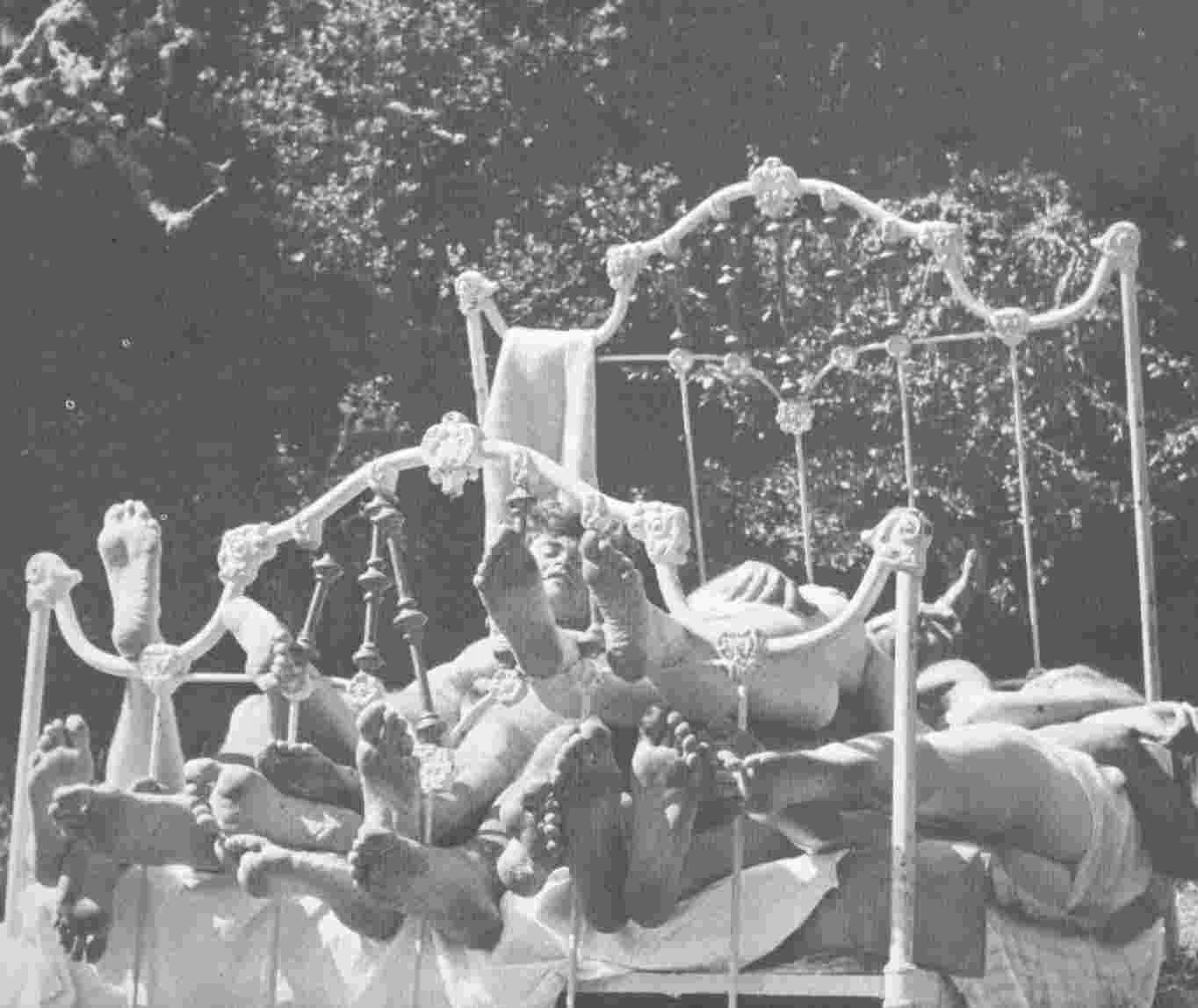
BED
(James
Broughton, USA, 1967)
A
perfect visual representation of the
polymorphously
perverse eroticism of the
American
counterculture and its Zen-like
acceptance
of all sexes and possibilities
as
one. Even the camera angle emphasizes
the
casualness and joyful abandon with
which
sex is viewed by the moment.
______________________________________________
The
entire cast of this delightful, wise manifesto of
counter-
culture sensibility
performs in the nude. An
ornate bed, magic-
ally
located in a meadow, provides as
always, the stage for man's
most
significantmoments; birth, sex, death. The actors, who
exu-
berantly
perform scenes of the human comedy, include Imogene
Cunningham, AlanWatts, and other San
Francisco artists and
writers.
While even avant-garde nudity seems often to
betray
an absence of joyful or
uncomplicated sex, The Bed displays a
smiling,
polymorphously-perverse eroticism. For once, penises
appear inlove scenes, but they are limp,
denotic not impotence
but the
precise moment in time at
which this film was made.
______________________________________________
THE
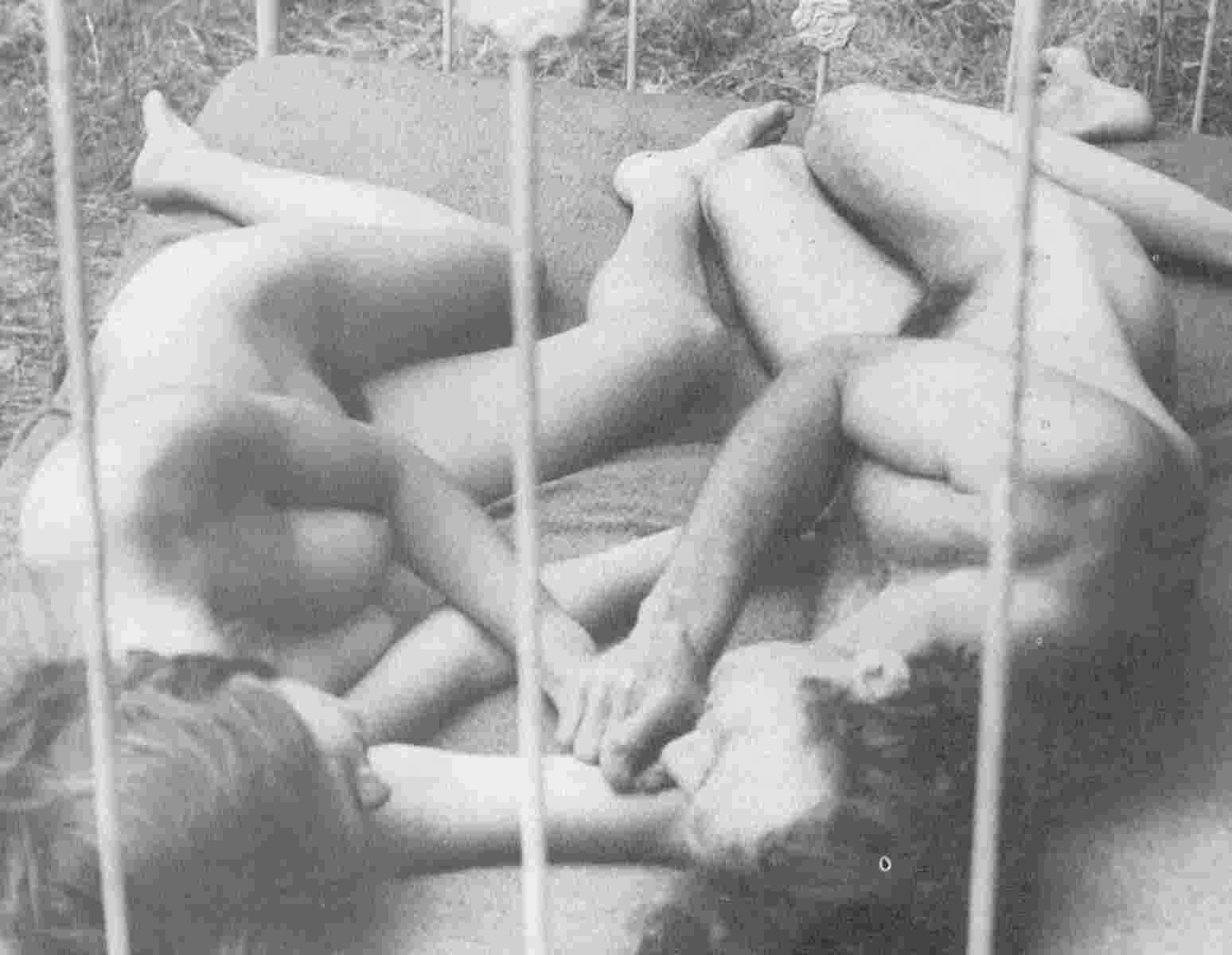
BED
(James
Broughton, USA, 1967)
Ideological
off-shoot of the American counterculture
movement
of the 60s, this first example of an all-nude
film
(starring many of San Francisco's best-known
artists
and writers) is a lyrical, poetic portrayal of "the
bed" as the eternal arena of human
life, love, and death.
___________________________________________________________________________________________
THE
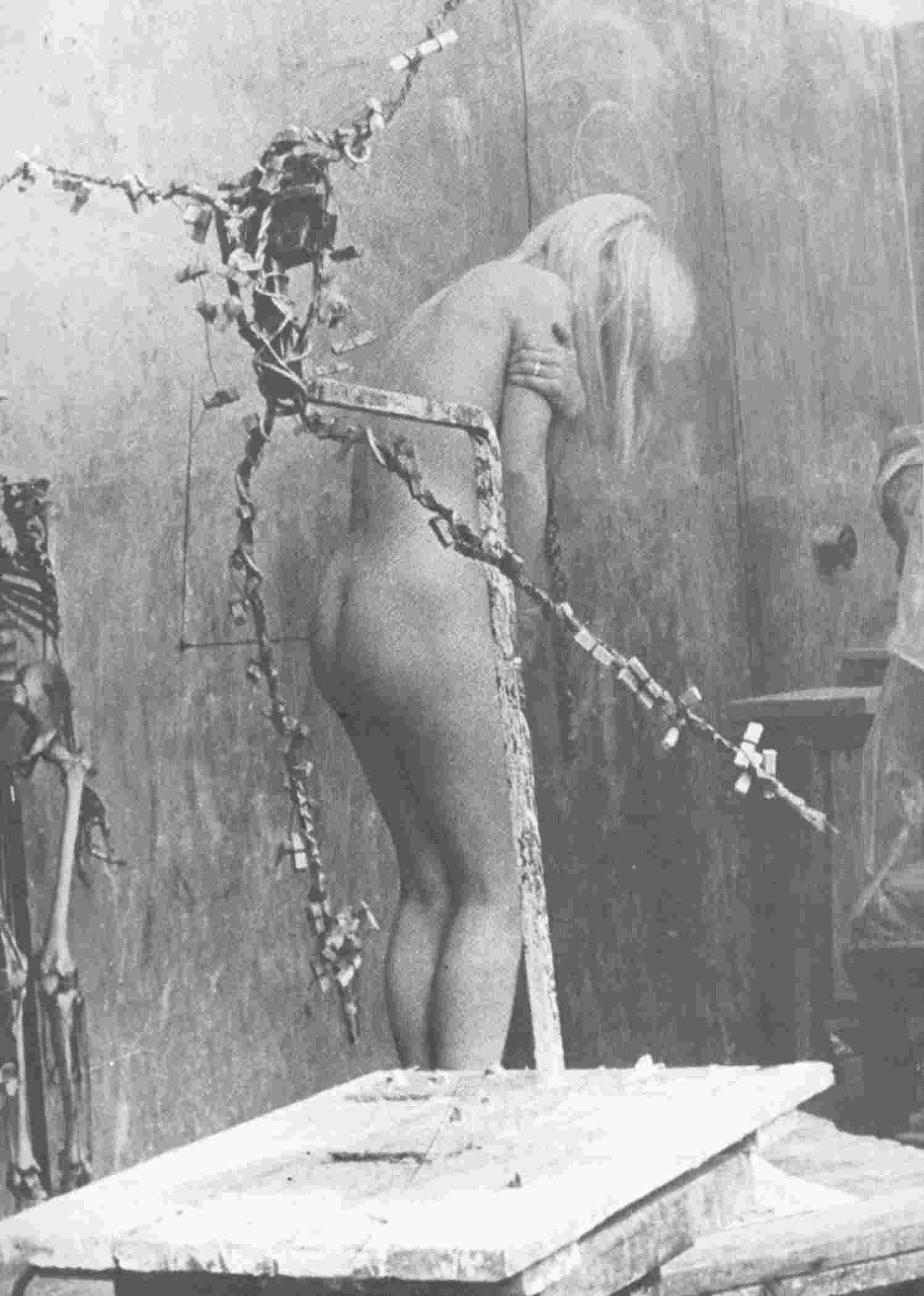
MOST BEAUTIFUL AGE
(Jaroslav
Papousek, Czechoslavakia, 1968) (F)
The
film's director tendentious preoccupation
with
man's foibles proves that, under totalitarian-
ism,the
portrayal of purely human values becomes
itselfideological. A young
housewife, attempting
to pose
for art students, somehow changes through
compositionand
decor into a semi-surreal object;
her
warm sensuality is in counterpoint
to an
appropriateskeleton,
while her hair provides the
alienatinganonymity
necessary for the final effect.
___________________________________________________________________________________________
DOCUMENTARY
FOOTAGE
(Morgan
Fisher, USA, 1968)
A nude girl
on a stool reads a series of inane
questions
addressed to herself into a tape recor-
der without answering them, leaving
15 second
pauses
after each. Afterwards, she reruns
the tape,
rises, and answers
each question with charming
improvisations. An early example
of structural
cinema,
the formalist meaninglessness of
the
action is continuously
subverted by the girl's fem-
ininity and "hot" (however
unaffected) nudity.
As
we "helplessly" waver between the two poles,
a
philosophical joke is being played on us.
___________________________________________________________________________________________
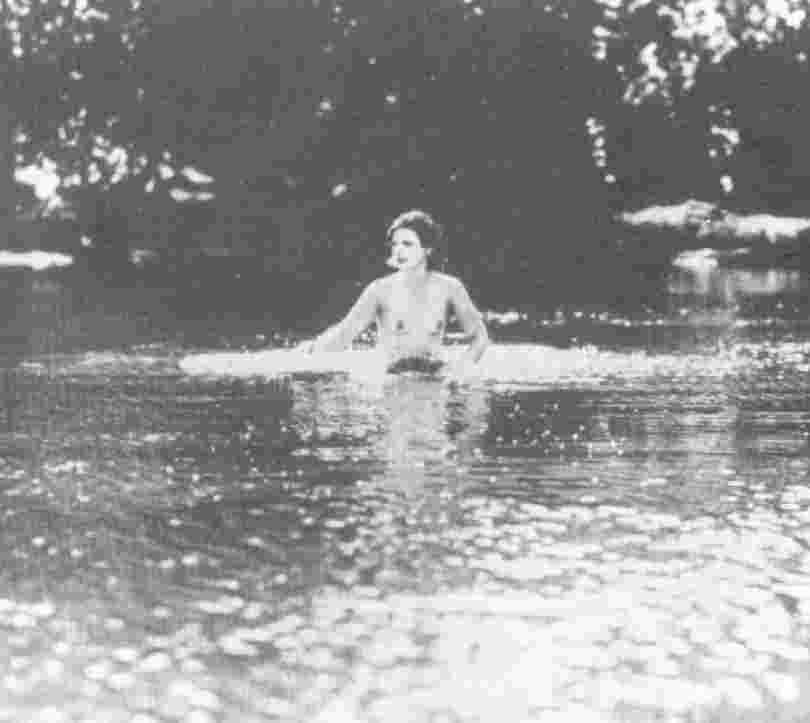
ECSTASY
(Gustav Machaty, Czechoslavakia, 1933)
This much maligned film remains one of
the great
works of the poetic
cinema, a sensuous story
ofpassion
and desire, seen entirely through a
woman's
eyes. Though known primarily for its
then
daring and unprecedented nude scenes, the
film
effectively attacked still another taboo in
its
lingering portrayal of Hedy Lamarr's orgasm
(seen
in her face only) during cunnilingus.
Probably
no other film in film history has been
involved
in more legal and censorial wrangling.
___________________________________________________________________________________________
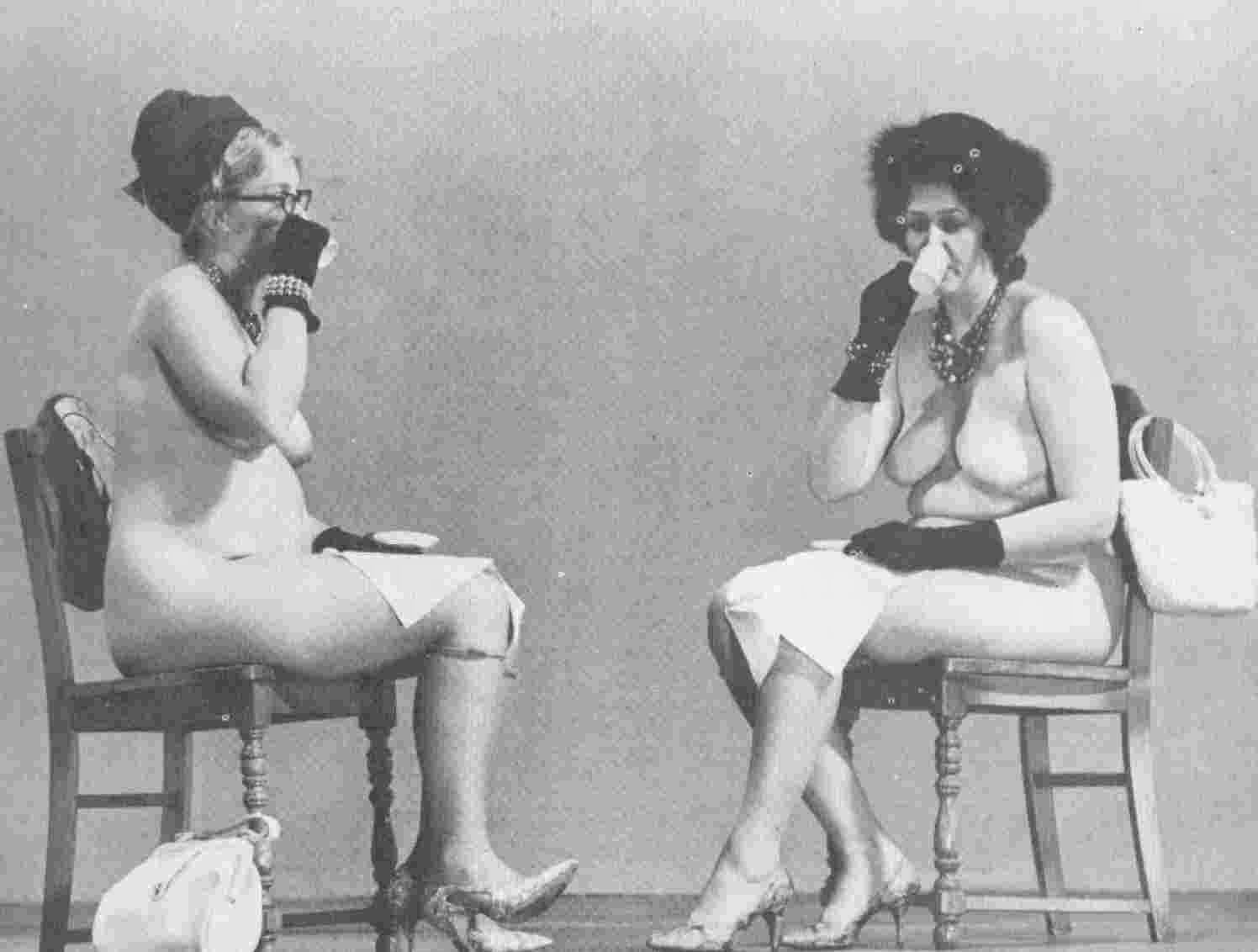
THE
GOLDEN POSITIONS
(James
Broughton, USA, 1970)
Nudity,
combined with an age group
not
usually shown nude and with the
accoutrements
of bourgeois etiquette and
attire,
serves to debunk the pomposities of
the
well-bred. Particularly effective is the
subjects'
solemnity within the ridiculous
position
the filmmaker has placed them in.
___________________________________________________________________________________________
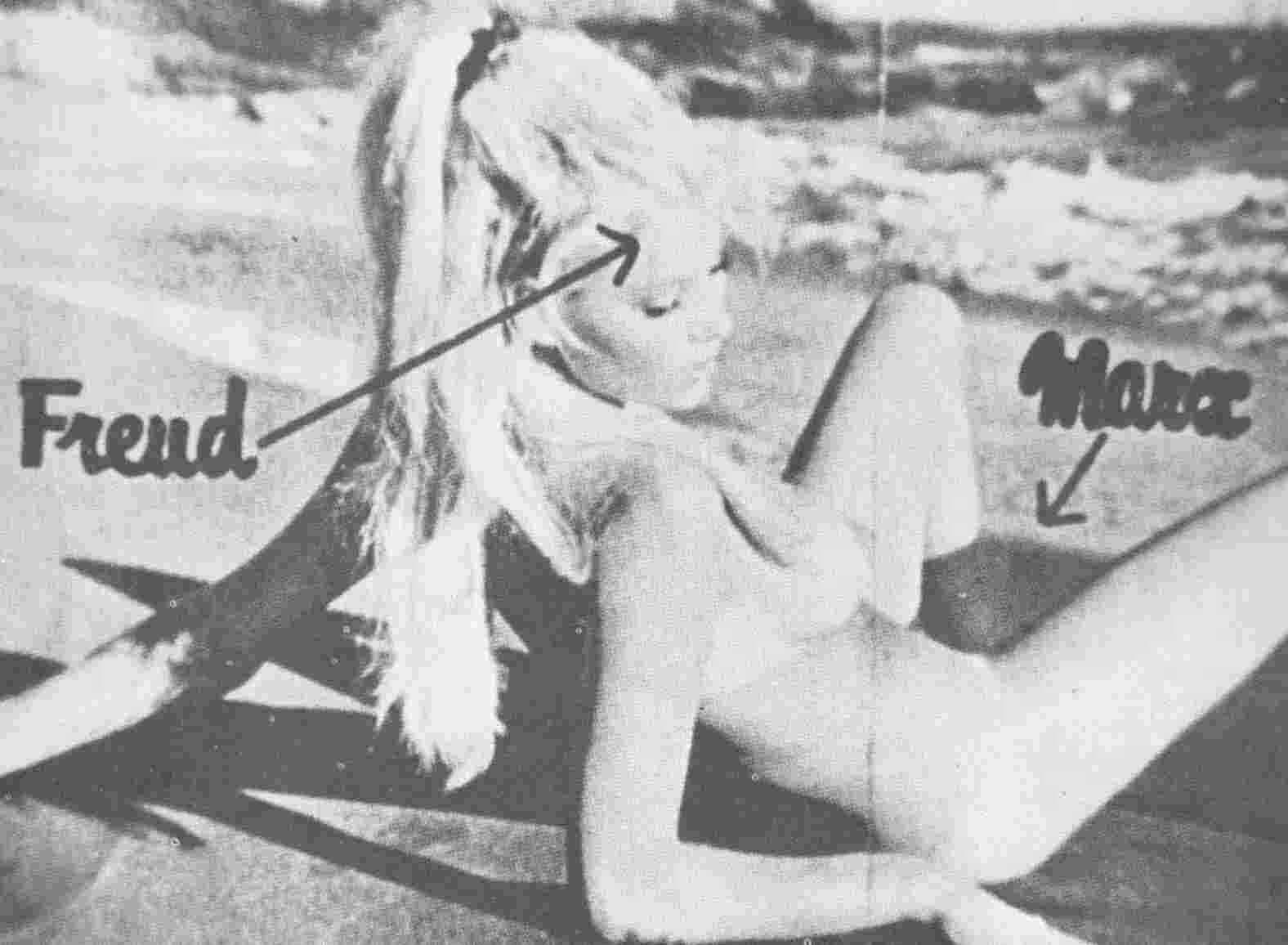
LE
GAI SAVOIR
(Jean-Luc
Godard, France, 1969)
With
typically playful perversity, Godard
uses
nudity to serve as ideological statement,
surrealist
and "obscene" in its unexpected
transposition
of Freud with brain and Marx
with
sex. These two names also denote the
true
parameters of Godard's universe and
his
determination to destroy illusionism
by
introducing lettering into the visuals.
___________________________________________________________________________________________
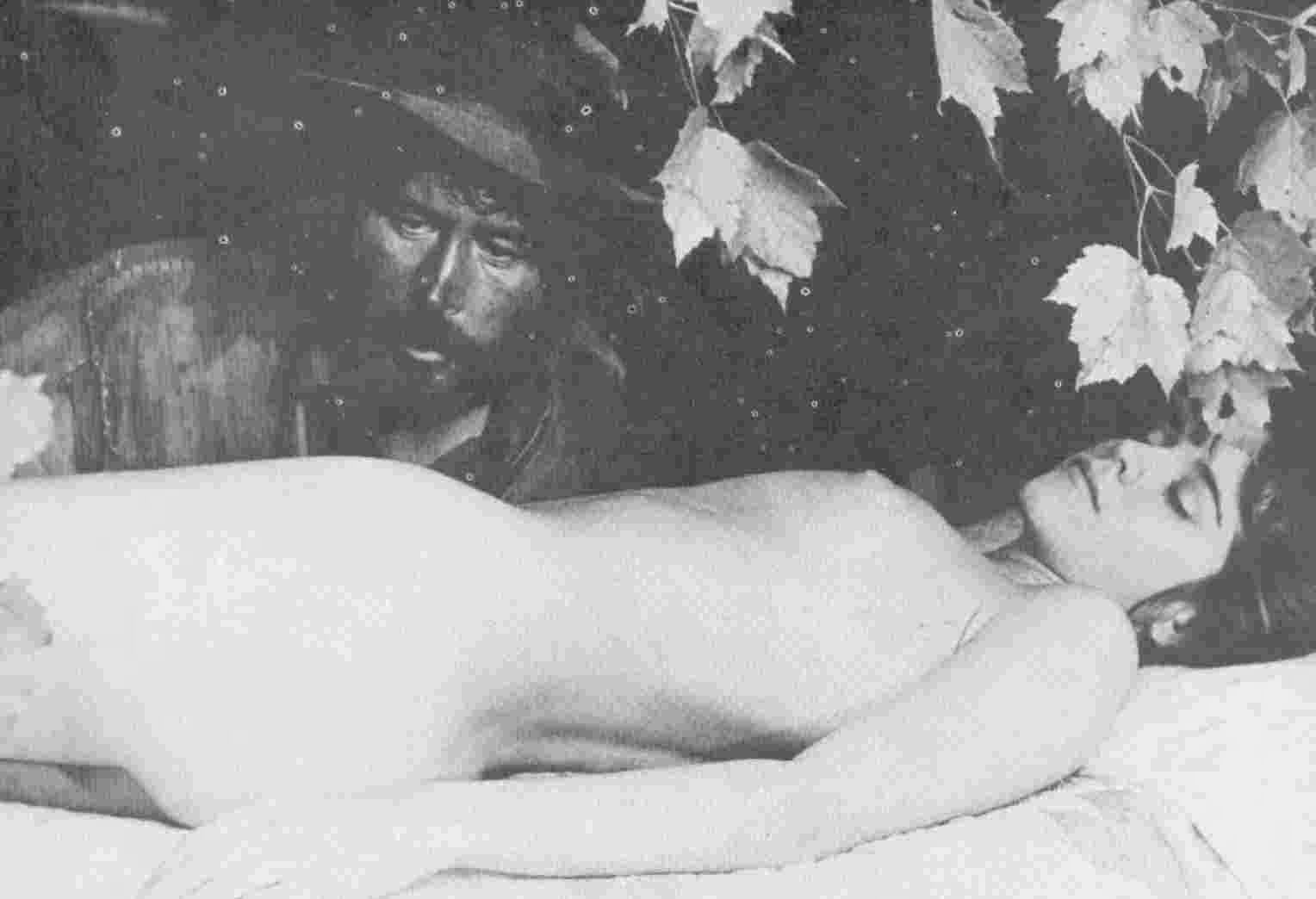
LES
MALES
(Gilles
Carle, Canada, 1971)
A
frequently erotic comedy of two drop-outs
fromsociety
whose Thoreau-like idyll in
Canadianwoods
is improved upon by a very
real
girl. The still conveys the
mixture of sweet
romanticism
-- the girl, disarmingly asleep,
framedby
leaves -- and lust, free of Hollywood's
sniggering
sex. Film nudity has become
casuing
(though no less arousing than before).
___________________________________________________________________________________________
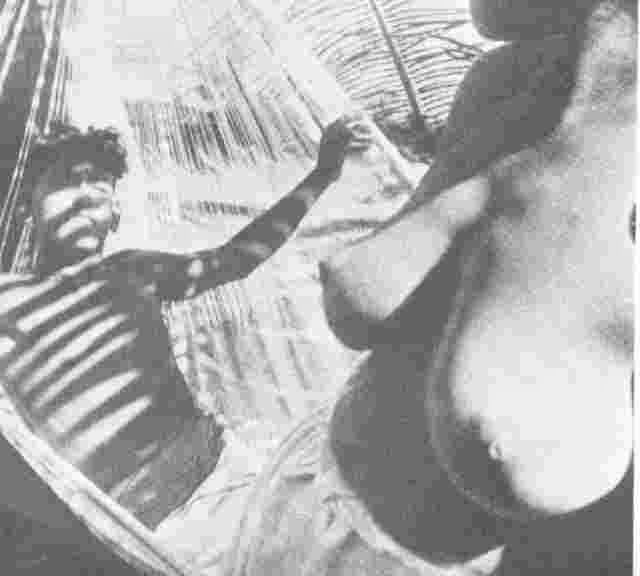
TIME
IN THE SUN
(USA,
1930)
Mexico does strange
things even to cosmopolitan
(and
inhibited) communists as seen in this unusual
still
from Eisenstein's unfinished Mexican film.
The
provocative pose of the girl, the play of light
and
shadow, the young man's languid yet watchful
reaction,
denote a hot, lazy erotic afternoon.
(edited
by Marie Seton with Paul Burnford,
from
some of Sergei Eisenstein's footage for
his
unfinished film, Que Viva Mexico)
___________________________________________________________________________________________
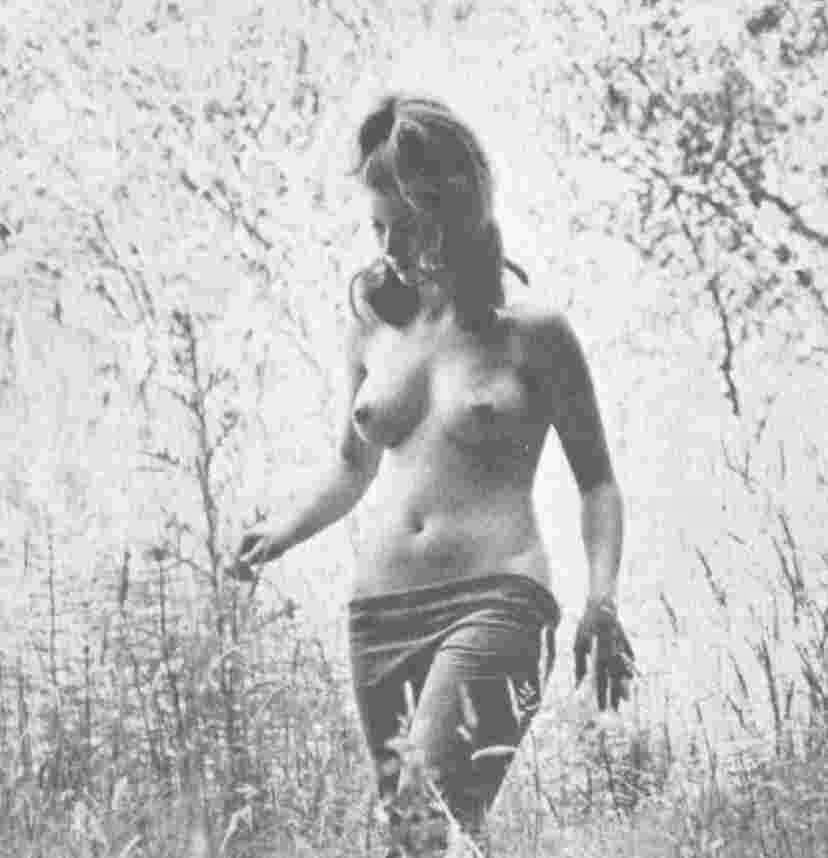
VIXEN
(Russ Meyer, USA, 1968)
The
All-American girl, pensive and nature-loving,
engulfed
by vegetation. Until liberated by such
sex
pioneers of commercial cinema as Russ Meyer,
she
was forbidden practically into the sixties. SC
___________________________________________________________________________________________
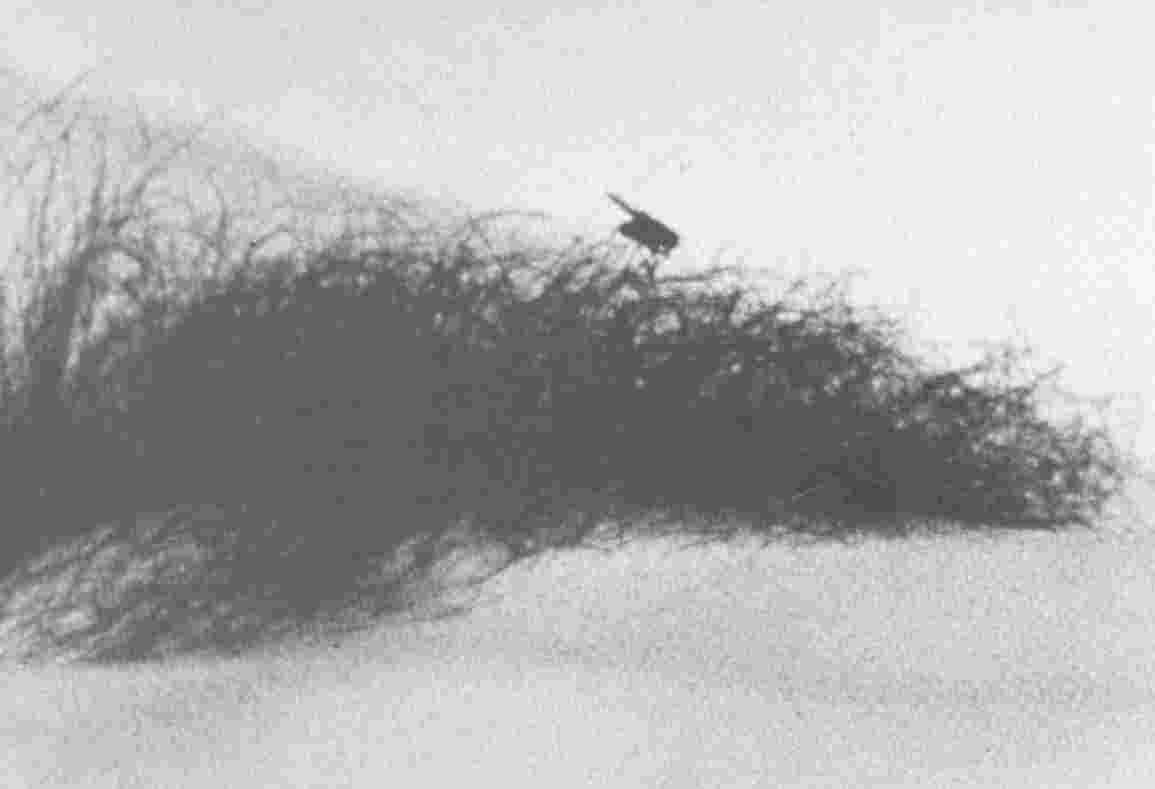
FLY
(Yoko Ono, USA, 1971)
Extreme
magnification removes the eroticism
of
nudity, abstractifies the body, and reveals it
as
a mysterious, unknown universe. Ironically,
the
fly -- acting as intrepid explorer --
serves
to "humanize" the proceedings. SC
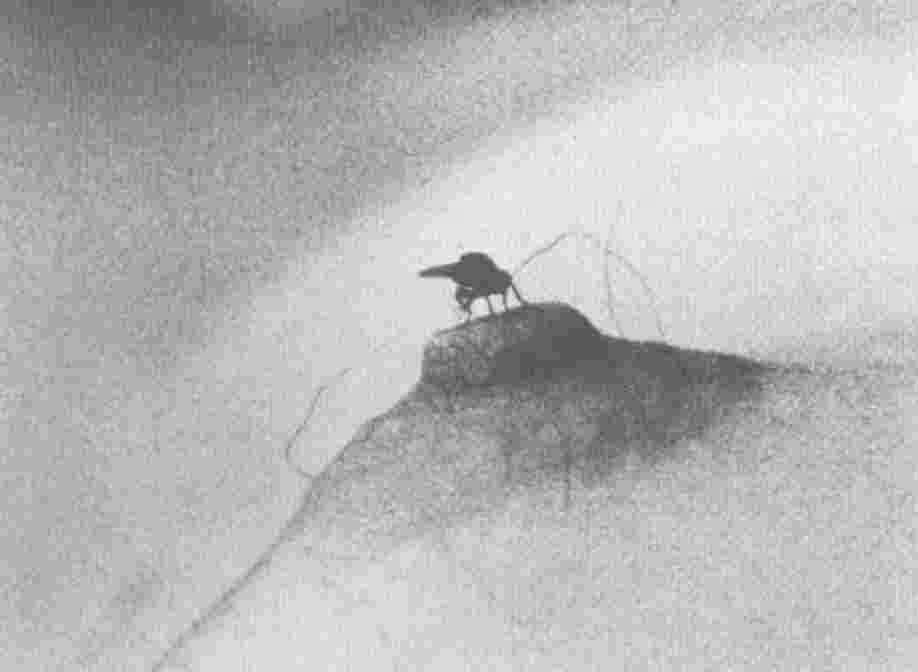
______________________________________________
A
hypnotic juxtaposition of predatory insect and beautiful
body, with neither party performing
according to rules,
thereby
disrupting the reality game. For
25 minutes we see
a very
pretty girl, deeply asleep, over
whose nude body
creeps a
diligent fly that never takes off
but explores her
fully,
including pubic hair and sex. The
film is almost
entirely in
close-up, with nipples appearing
as mountain
tops, the fly as
climber, the girl's body as the
fly's universe.
Finally, the girl breathes; now
there are many flies and
long-shots
of the girl's body inhabited by
them; at last she
shoosthem
away.Much of the film seems to progress in
real
time,supposed guarantor of veracity. Yet, and
with
intentionalperversity, the odds are stacked in
favor
of artifice;both fly and girl are drugged; one to
effect
passivityunresponsive to constant irritation,
the
other to ensureperambulation and inability to fly.
___________________________________________________________________________________________
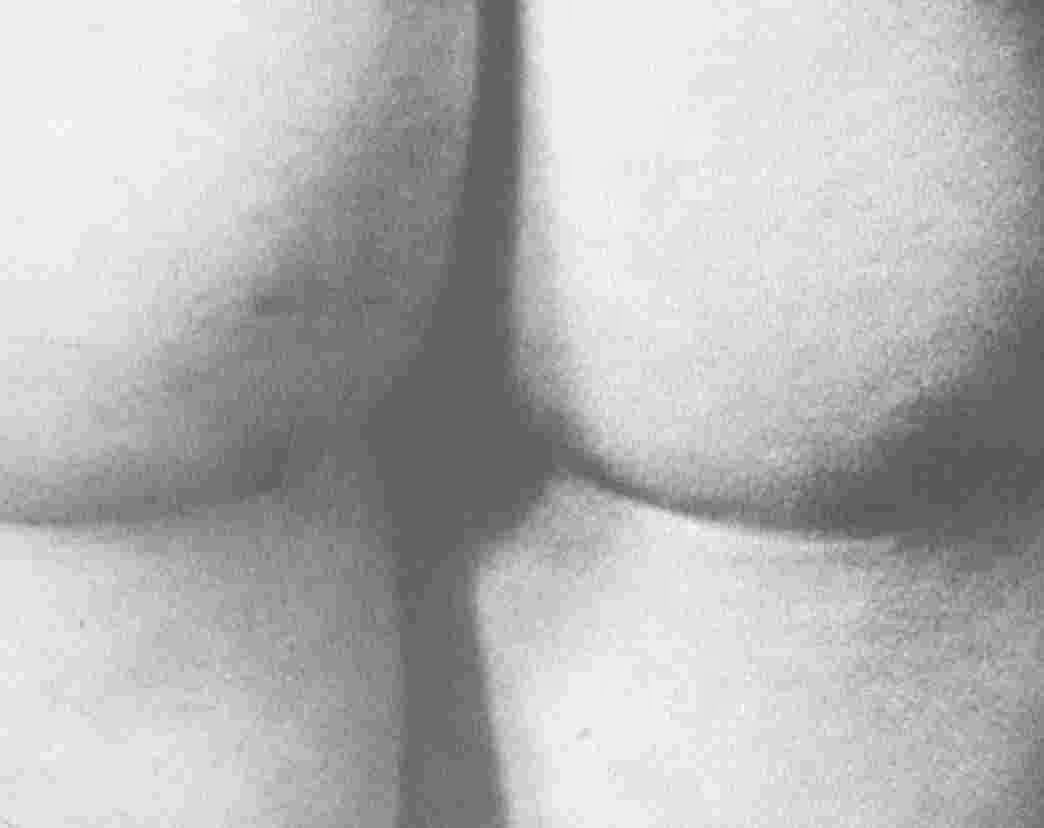
NUMBER
4
(Yoko
Ono, Great Britain, 1968)
Unlike
the portrayal of sex organs, the sight
of
buttocks is always somewhat humorous,
denoting
unconscious defense against a process
considered
objectionable, though harmless.
Here
365 nude behinds (London's leading
artists
and intellectuals) pass the camera in
never-ending
procession at 20 second intervals
for
90 minutes, while we are forcibly impressed
by
how different and alike we are. SC
______________________________________________
For 90
minutes, 365 bare behinds of many of London's
leading
artists and
intellectuals pass the camera at
20 second intervals
in
anever-ending procession of hair or smoothness, carefully
closed or casually open legs,
dangling testicles, dimpled buttocks,
sensuously rubbing thighs; soon they turn
into hypnotic, semi-
abstract
designs.The soundtrack -- as unidentifiable as the
visuals -- carries unstaged comments by
the participants.
Focusing
on the mystery of the
commonplace, this (very)
"instructional"film
proves buttocks to be an overlooked
meansof
self expression and consciousness-expansion.
___________________________________________________________________________________________

HOW
TASTY WAS MY LITTLE FRENCHMAN
(Nelson
Pereira Dos Santos, Brazil, 1971)
A
strange and comical exploration of the moral
dimensions
of cannibalism in 16th century Brazil,
played
by an all-nude cast, in which a French
adventurer
is finally "integrated" into a primitive
tribe
by being eaten. Nature and positioning
of
body paint as well as phallus-like objects in
the
back, reinforce the eroticism of the shot.