FILM
- AS A -
SUBVERSIVE ART
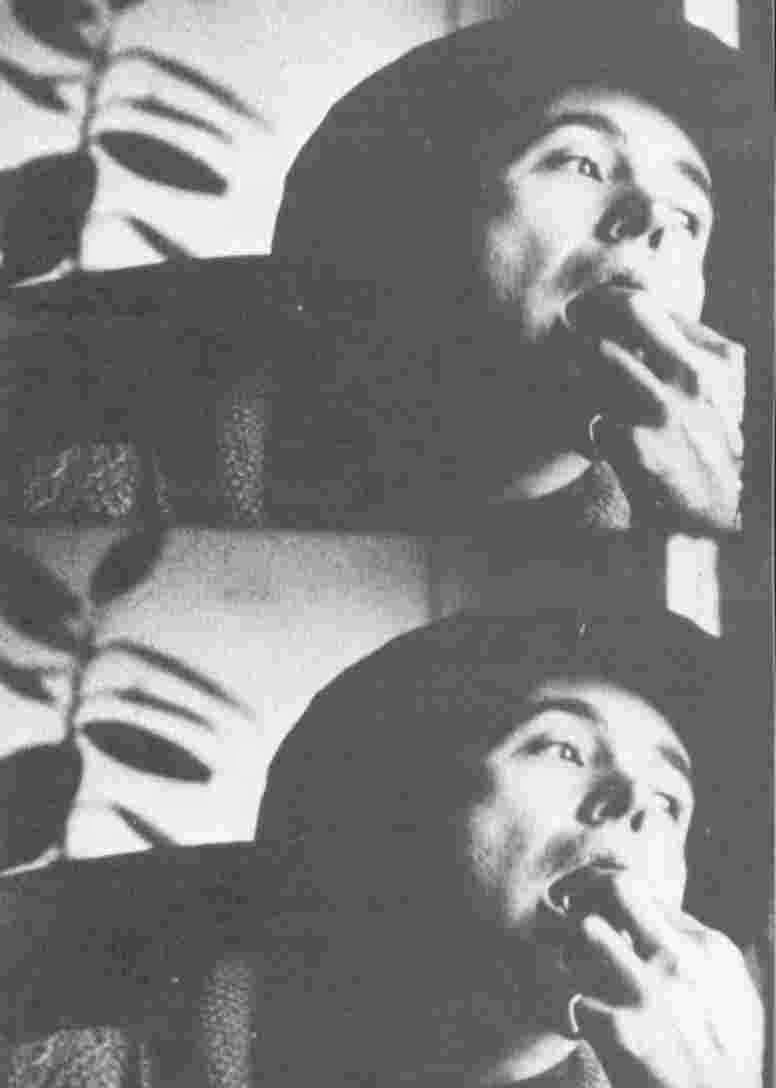
EAT
(Andy Warhol, USA, 1963)
In
this famous early Warhol film, the painter
Robert
Indiana eats a mushroom for 45 minutes.
This
ordinary act, due to the absence of other plot,
becomes
an event; and proves that "real time"
in
cinema (where we are used to condensation)
prolongs
actions and is almost unbearable. SC
THE
DESTRUCTION OF
PLOT
AND NARRATIVE
The
dilution or rejection of conventional narrative and straight-
forward realism is the predominant
tendency of contemporary art.
The
multi-faceted, fluid nature of reality as now understood can no
longer be subsumed in the certainties of
linear narrative structures.
Since
neither simplistic causality nor terms such as
"beginning" or "end"
are any longer philosophically
tenable,
it becomes increasingly difficult to tell a tale.
The
narrative, as our academic critics conceive it, represents
an order, linked to an entire
rationalistic and organizing
system,
whose flowering corresponds to the assumption of
power
by the middle class ... All the technical elements of
the
narrative -- systematic use of the past tense and the
third person, unconditional
adoption of chronological
development,
linear plots, regular trajectory of the
passions,
impulse of each episode toward a conclusion,
etc.
-- everything tended to impose the image of a stable,
coherent, continuous, unequivocal,
entirely decipherable
universe.
Since the intelligibility of the world was not
even
questioned, to tell a story did not raise a problem.
The
style of the novel could be innocent.
(1)
From
Kafka to Beckett, from Joyce to Burroughs, from Proust
to
Robbe-Grillet, there is an unbroken evolution towards vertical
rather than horizontal explorations --
investigations of atmosphere
and
states of being rather than the unfolding of fabricated plots.
In an interview with L'Express,
(2) Ionesco referred to a play as
a
structure of states of conciousness and added that there was no
longer a story, but rather "a
progression by a kind of progressive
condensation
of states of mind, of a feeling, a situation, an anxiety."
This may be another way of saying
that -- through modern science and
philosophy
--art once again returns to poetry and the significance of
poetic truth. This truth does not
deny the "story" -- it only robs it, as
Robbe-Grillet put it, of its character of
"certainty, tranquility, innocence". (3)
This
mature "uncertainty" -- so much more open to life than the
dogmatic
authoritarianism of
our forefathers -- now also extends to characterizations
and motivations of the story's
protagonists. The elegant characters created
by
the older masters of world literature, the "full"
explanations of human
behavior,
the delineations of the character's past, are replaced by dimly-
perceived personages whose actions and
motives remain ultimately as
unclear
as they are in real life: we are all enmeshed in knowledge of
others or self that is forever
"incomplete", forever tinged with ambiguity.
A
character who can present no convincing
arguments
or information as to his past
experience,
his present behavior or his
aspirations,
nor give a comprehensive
analysis
of his motivations, is as legitimate
and
as worthy of attention as one who,
alarmingly,
can do all these things. (4)
The loss
of virginal certainty, however, leads to a more profound --
if more painful -- understanding of man.
This mystery was glimpsed
by
Dostoevski, whose torn, neurotic characters display the fullness
(ambiguity) of human nature; their actions
are seldom predictable, their
motives
opaque, but they frequently offer intimations of a larger truth.
Acknowledged
by Dostoevski and legitimized by Freud, the admission of
the unconscious into our sensibility has
forever removed expectations of
an
"unravelling" of human mysteries. Instead, we
have the protagonists
of
Pinter; even more hermetic and alienated than Dostoevski's. Yet we
are moved by their mystery and our
certainty that we are like them.
And
though the end of bourgeois individualism may indeed be at hand,
perhaps man (as Shapley and Robbe-Grillet
point out from different,
yet
convergent vantage points) can exchange his shaky monomania for
a larger, less anthropocentric
conciousness. Film, the most modern of
the
arts, has not remained exempt from these new developments.
Nonetheless, Hollywood still hankers after
19th century style, stories
and
type-cast stars; after all, Gone With The Wind, The
Sound
of Music, and
Love Story still sell the largest number of tickets.
But both
the independent avant-garde and the serious 35-mm
directors have been profoundly affected.
In the underground
(from Man
Ray, Richter, and Epstein to Brakhage, Peterson,and
Bartlett), plot and character had always
been subsidiary to the
medium's
poetic potential. Even in the commercial cinema,
the same trend is evident in Bresson,
Godard, Skolimowski,
Bertolucci,
Fassbinder, and others. Significantly, the attack on
plot and bourgeois individualism,
initiated half a century ago by
the
Aesthetic Left (Breton, Eisenstein, Tzara, Bunuel) is thus joined
by contemporary Western artists with
a different emphasis. But
the
assault on narrative structures takes yet another, insidious path.
REFERENCES
(1)
Robbe-Grillet, For A New Novel, 1965
(2)
Interview with Eugene Ionesco, L'Express, Jan 28 1960
(3) Robbe-Grillet
(4) Harold Pinter, The Theatre of the Absurd, 1961
FILMS
___________________________________________________________________________________________
AKRAN
(Richard Myers, USA, 1970)
(F)
Myers is unquestionably a
major talent of the
American
avant-garde and Akran one of his most
important
films. A feature-length deluge of incessant,
brilliant
bursts of images (short takes and jump cuts,
single
frames in series, freeze-frames slightly altered
between
takes) it creates a Joyce-like, dense and sombre
mosaic
of memory and sensory impressions, a texture
instead
of a plot, a dream-like flow of visually-induced
associations often flashing by faster
than they can be
absorbed.
Described by the director as an "anxious
allegory
and chilling album of nostalgia", its pene-
tratingmonomania is unexpectedly --
subversively --
realized to be
a statement about America today:
the
alienation and atomization of technological con-
sumer
society is reflected in the very style of the film.
___________________________________________________________________________________________
ANTICIPATION
OF THE NIGHT
(Stan
Brakhage, USA, 1957) (F)
Light
and shadow, sun and moon, dream and color: a
daring
attempt, by one of the great experimentors of our
day,
to portray events, objects, the world as they might
look
to an infant as yet unable to organize his impres-
sions. "Reality" is here
broken into a flow of colors and
shapes,
rushing by in complex, mysterious orchestration. SC
___________________________________________________________________________________________
L'AVVENTURA
(Michelangelo Antonioni, Italy, 1960)
(F)
With this film -- booed at
its initial Cannes presentation --
Antonioni
developed the language of the new cinema and
entered
film history. The old-fashioned plot has gone; as
if to spite it, the heroine disappears
early in the film, never
to be
found. To show the empty lives of empty people, there
is monotony; and long, repeated,
silences, as in life. In fact,
with
its extreme long-takes in almost real time, the work
today appears as a forerunner of minimal
cinema. But
unlike the latter
it is suffused with meaning: the absence
of
communication, the spurious utilization of eroticism to
alleviate loneliness or anxiety, the
crumbling values of the
elite,
the ennui and lethargy of the rich. Space, decor, com-
position, and environment become integral
components of
the moral action
and a very modern sense of disintegration
permeates
this major work of the new cinema. SC
___________________________________________________________________________________________
EMPIRE
(Andy Warhol, USA, 1964) (F)
An eight hour long film, during which the
camera,
from one fixed
position, uninterruptedly photographs
the
Empire State Building in real time; an object
existing
outside us, in its own universe of non-meaning.
___________________________________________________________________________________________
DESTROY,
SHE SAID
(DETRUIRE,
DIT-ELLE)
(Marguerite
Duras, France, 1969) (F)
The
famed French ideologue of the New Novel and author
of
Hiroshima Mon Amour creates a hypnotic film about five
alienated people isolated in an unworldly
hotel. Enmeshed in
ritualistic
power games, they continuously exchange personalities
as
each acts out his own ambigious charades. A highly stylized,
non-logical dialogue creates enigmatic
fear; long, uniterrupted
takes
and absence of close-ups evoke ennui and distance. At the
end, there is a mysterious climax of
revolutionary destruction.
___________________________________________________________________________________________

THE
MARRIED WOMAN
(LA
LATER UN FEMME MARIEE)
(Jean-Luc
Godard, France, 1964) (F)
The
powerful close-ups of arched, yielding body
and
the man's possessive, loving hand, posed
against
white background, reflect Godard's
fusing
of humanist and minimal cinema. SC
______________________________________________
To
analyze all the stylistic innovations of this most original
director would require separated
discussions of practically all
his
films. The underlying tendency is nevertheless clear; an
increasing atomization of conventional
cinematic structures in
favor
of freer, collage-type improvisations. Plot and narrative are
subsumed by Godard's preoccupation with
the nature of cinema and
of
reality, his investigations of contemporary problems, ideologies,
paradoxes -- the capturing of modern
ambiguities and confusions of
hich
he is very much a part. The "plot" of The Married
Woman -- 24
hours with a
woman between husband and lover -- is therefore merely a
pretext for vertical,in-depth
explorations of values, atmospheres, tex-
tures;
of relation- ships, lies, ignorance of self,
sex-as-communication.
For
audiences brought up on Hollywood, the style, tempo, and content
of the film is maddening.
Consisting almost entirely of three stylized,
intensely
beautiful love scenes and seven cinema-verite interviews
involving the protagonists, the work
swings wildly between extremely
long
takes (the interviews) proceeding at a painfully slow tempo, and
the tightly edited love scenes, composed
of individual, 10- to 20-second
long
tableaux -- beautifully stylized fragments of nude bodies, hand,
faces -- separated by sensuous fade or
quick cuts. The alternation
of
tempo between these lyrical, yet fast sequences and the almost
Warhol-like interviews (perversely, the
usual reaction shots are
missing),
creates a disturbing dichotomy. Alienation is caused in
the love scenes by fragmentation and in
the interview scenes by the
use
of real time. This prevents conventional "identification"
with
the protagonists, rather
compelling the viewer, in Brechtian manner,
to
ponder the social ramifications of the action; the domination of
people by false images, advertisements,
slick consumer goods; the
alienation
of women (if not of man); the need for self-awareness and
for true values, so entirely lacking in
the film's sensual, empty star.
Also
apparent are Godard's preoccupation with the nature of cinematic
reality and his insistence on subverting
the screen's illusion, constantly
recalling
us to the artificiality ("created-ness") of what we are
viewing.
There are even
anti-illusionist games: after we have viewed a series of
ads in a woman's magazine, the last of
these, filling the entire screen as
did
the others, is suddenly revealed as a huge outdoor billboard by the
shocking device of having the heroine
unexpectedly enter the frame
"in
front" of it. Only then is the true size, scale, and nature of
the image
revealed to us and
its "reality" as a newspaper advertisement destroyed.
SC
___________________________________________________________________________________________
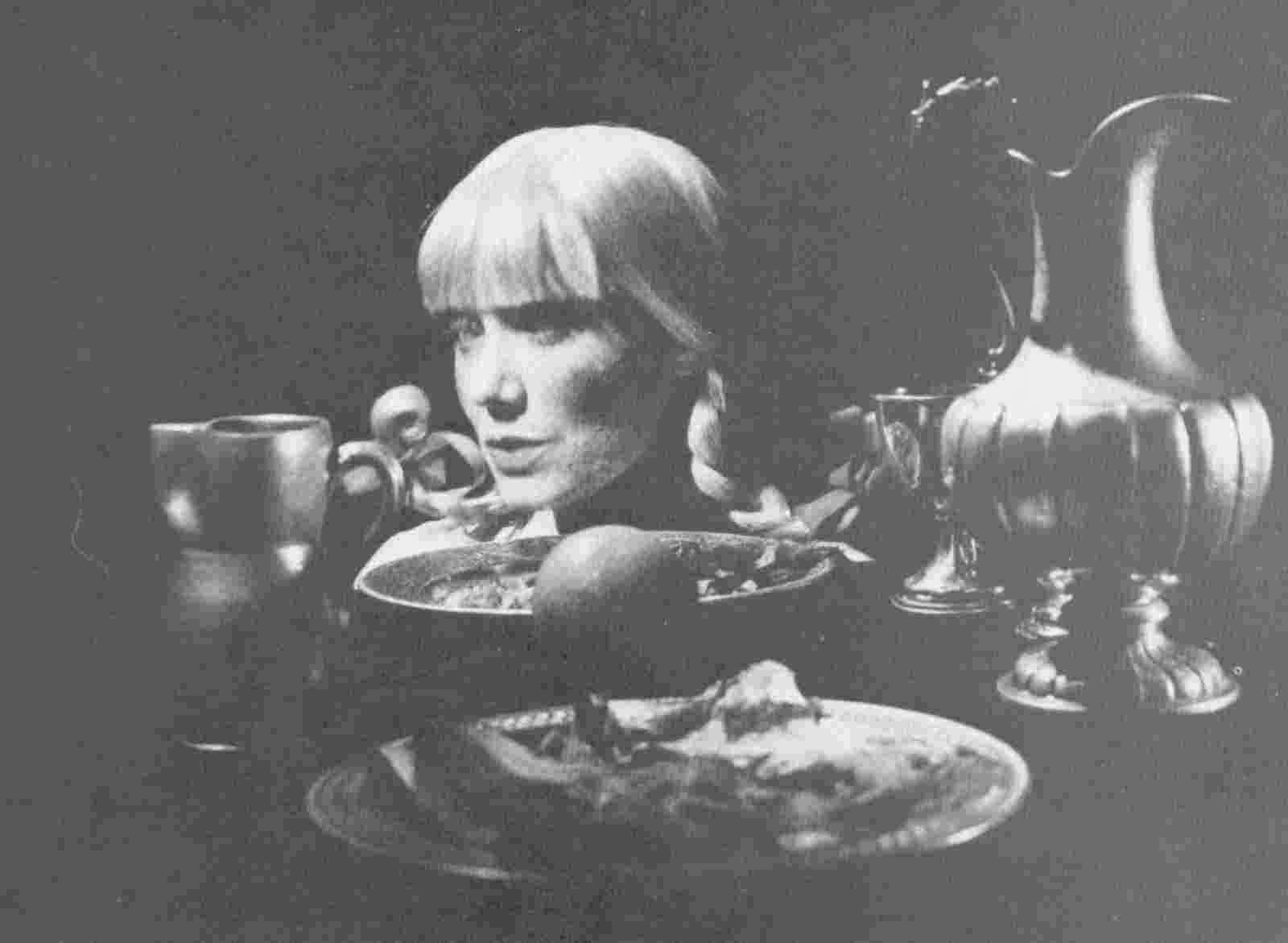
DON
GIOVANNI
(Carmelo
Bene, Italy, 1970) (F)
The
woman's averted glance, harsh light,
enveloping
blackness, create disembodiment
and
dissociation -- a perfect visual metaphor
for
the compulsive, cubist fragmentation
of
the opera's conventional plot.
______________________________________________
More
sombre, controlled and abstract than Bene's earlier work,
this is a baroque, ironic and
claustrophobic avant-garde
"restatement"
of the opera's incest episode. Accompanied
by
Mozart's score, this compulsive, cubist fragmentation of
conventional plot in favor of a more
profound exploration
also
utilizes complex, subtle montage, varying from minimal
cinema to a sustained staccato
rhythm. Bene is reconfirmed
as
one of the true iconoclastic talents of contemporary cinema.
___________________________________________________________________________________________
TOM,
TOM, THE PIPER'S SON
(Ken
Jacobs, USA, 1969) (F)
This
structuralist dissection, enumeration, decomposition
and
reconstruction of a 1905 Biograph film of the same title
provides a painstaking metaphysical
exploration of the nature
of
cinema. Practically every shot and scene of the original
10-minute film is ominously "analyzed"
and re-interpreted into
a
feature-length work by manipulation of image, introduction
of slow motion, repetition,
freeze-frames, abstracting, and
other
"subversions" of the original. Shades of
Vertov!
___________________________________________________________________________________________
VAMPYR
(Pedro Portabella, Spain, 1970)
(F)
A most original work,
A hallucinatory montage of unfinished,
non-consecutive
fragments of scenes photographed on the set
of
a new Spanish version of Dracula, this sophisticated homage
to the vampire film genre transmutes its
visual data into a new
poetic
reality. The plot of the commercial Dracula (though not
its eerie atmosphere) effectively
disintergrates in this lyrical,
nostalgic
evocation of its essential elements, refracted by a 20th
century sensibility. As irrelevant
extras or technicians with smoke
machines
walk spectrally through scenes of intended horror and
become part of Portabella's daring new
universe instead of disrup-
ting
it, we are suddenly confronted with a brooding reflection
on the genre itself -- a memory piece
that is also a farewell. SC
___________________________________________________________________________________________
LA
VERIFICA INCERTA
(Gian
Franco Berucello, Alberto Griffi, Italy, 1965)
"A
calculated assault upon the supposed logic of the structure of the
narrative film. Clips from a dozen
or more cinemascope movies, shown
still
squeezed, follow each other in a perfectly logical but complete anar-
chic progression. The filmmakers
replace the conventional sequence of
shots
describing a simple action (opening a window, for example) with
an equal number of shots, all technically
"correct" and all dealing with
the
same dramatic/functional situation, but which throw the event
into
total confusion.
The hero changes person mid-shot; camera movement
reverses halfway through an action;
the lighting jumps from phony
blue-filter
darkness to over-exposed multi- shadowed "daylight";
and
the color range
(which throughout the movie manages to reflect every
imperfection of mass produced color
prints) cuts from all-over brown
to
washed-out blue-green." David Curtis, Experimental Cinema,
1971
___________________________________________________________________________________________
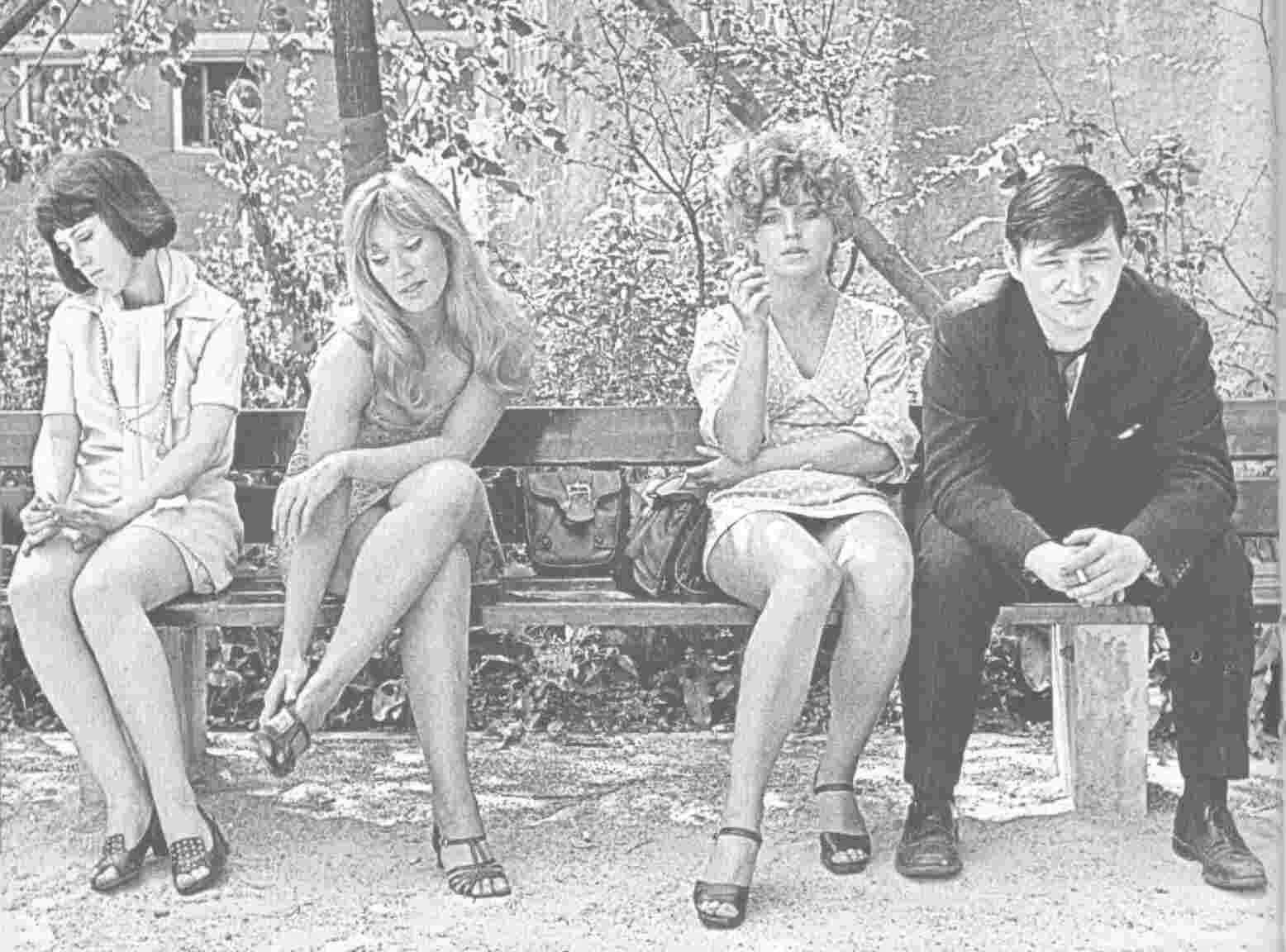
KATZELMACHER
(Rainer Werner Fassbinder, West Germany,
1969) (F)
Stylized,
proscenium-type acting by non-emoting stereotypes
against
chalk-white backgrounds creates a Brechtian attack
on
the German petty-bourgeoisie. The artist's tampering
with film stock itself contributing to
the alienating effect.
______________________________________________
An
early work by one of Germany's best new filmmakers,
who
-- like Godard whom he quite deliberately emulates --
produces at least two features a year
while directing the
famed
avant-garde Munich Anti-Theatre. Played in
proscenium-style by non-emoting
stereotypes against
chalk-white
backgrounds, the film depends less on its
minimal
plot that on the careful creation of a Brechtian
universe
to make an intricate attack on the German petty-
bourgeoisie, viewed once again as
potential prototypes
of
neo-fascist tendencies. The "actors" appear not as
individuals, but as social types, drowned
in empty lives
and cliched
"values". The stifling narrowness of the petty-
bourgeois mind has seldom been more
penetratingly revealed.