FILM
- AS A -
SUBVERSIVE ART
BY
THE LAW
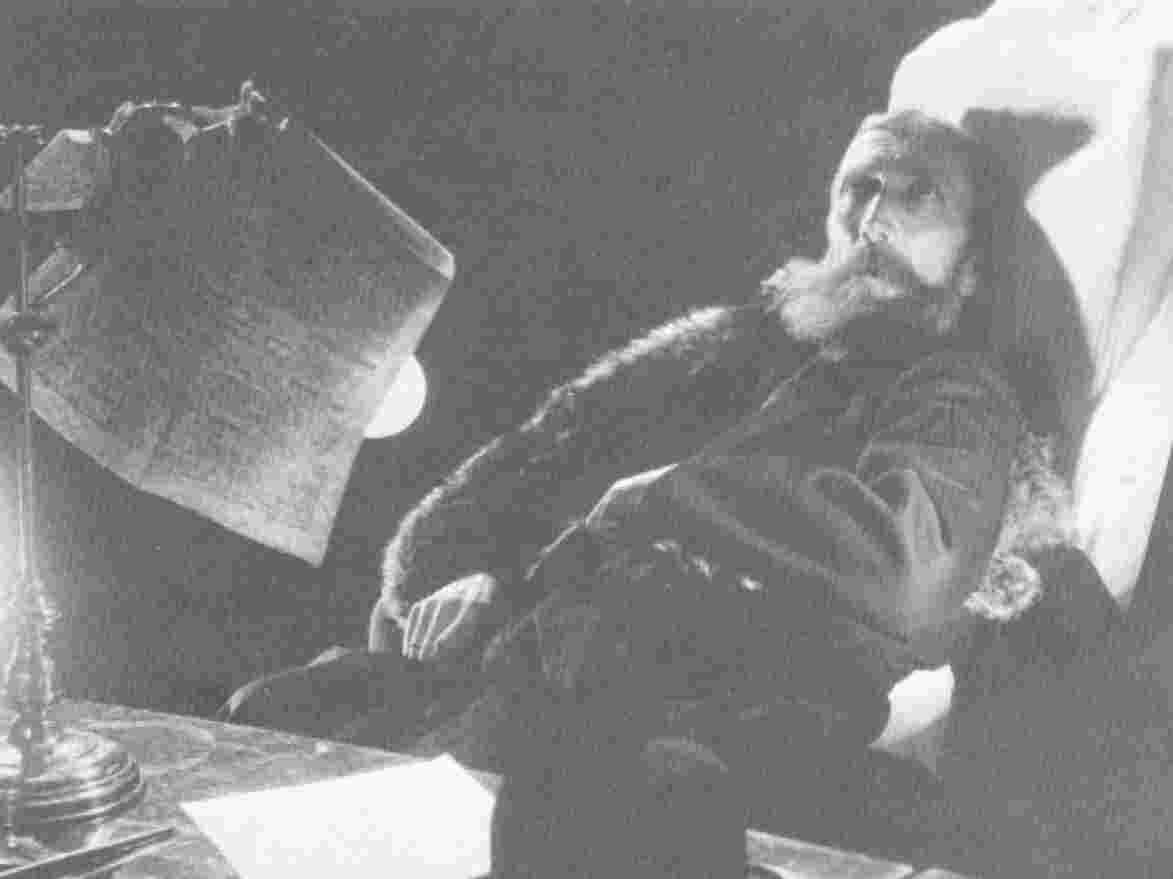
(Lev
Kuleshov, USSR, 1926)
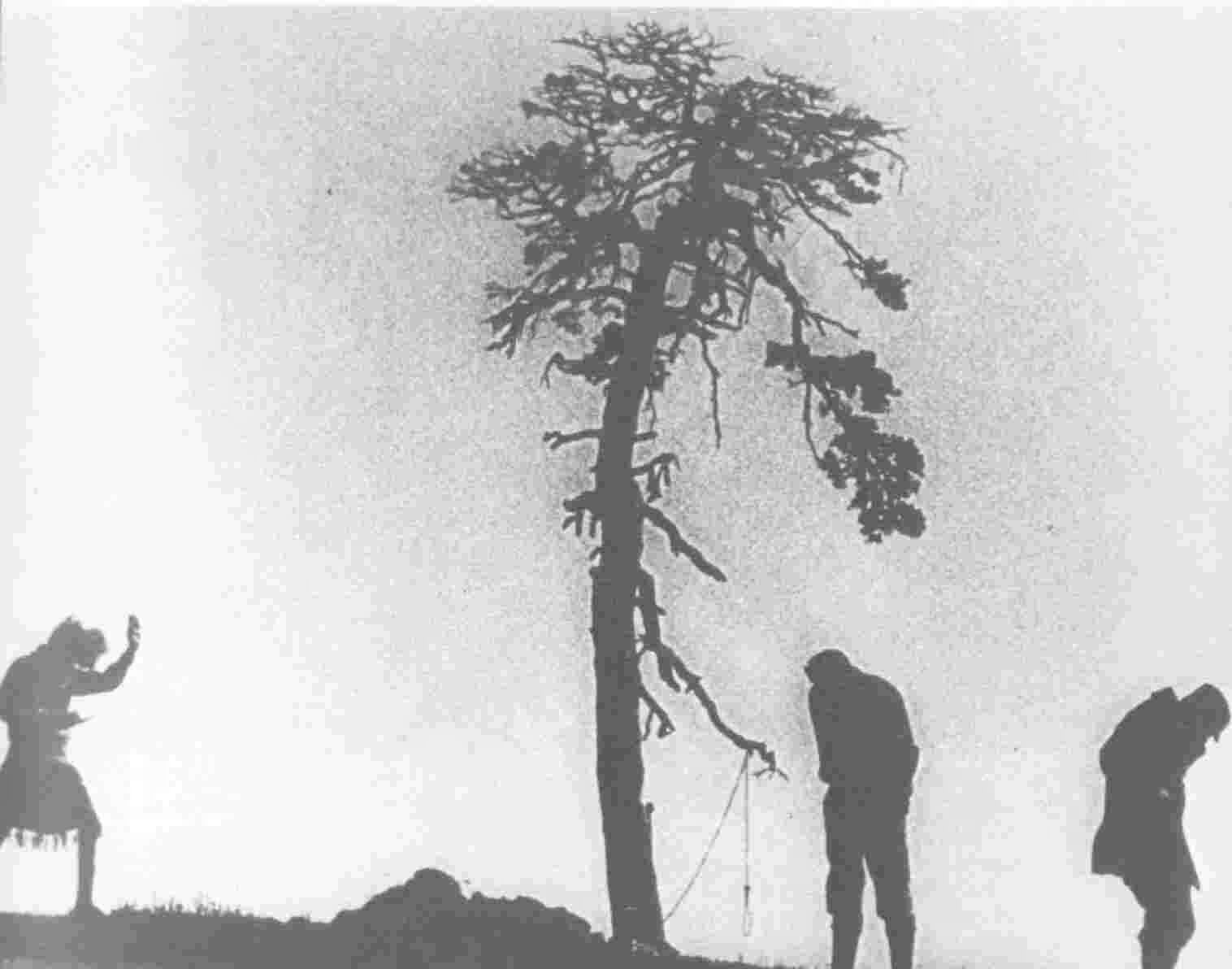
Three
people, related by murder, trapped in an Arctic wilderness
amidst mounting psychological tension.
Plot, decor, and style
are
stripped to their essence, thus making gestures and small
events loom larger. The agitated
yet formal composition
of the
still relfects the film's ordered melodrama.
THE
REVOLUTIONARY FILM
AVANT-GARDE
IN SOVIET RUSSIA
To
anyone acquainted with the Soviet cinema of the Stalin era --
a numbing succession of academic,
conventional, "bourgeois"
works
reflecting the ossified ideological superstructure --
a
return to the great Soviet masterpieces of the 1920s is
the equivalent of a trip to another
planet. As in politics, the
two
periods are aesthetically and thematically poles apart.
Never
before had there existed a state-financed, nationalized cinema
entirely devoted to subversion as was
built in Russia after the October
revolution.
The creation of a new conciousness, the destruction of
reactionary values, the demolition of
myths of state, church, and capital --
these
objectives were to permeate the ideological superstructure of the
proletarian state, its arts, its
education. And the cinema --- in Lenin's view,
the
most important of the arts -- was to assume a central role in the
struggle;
for it was the art
form most accessible to the dispersed, illiterate masses.
Several
factors contributed to the unprecedented explosion of creative energy
forever linked with the towering
achievements of the early Soviet cinema.
Among
these were the profoundly liberating, innovative tendencies freed by
the liquidation of the former regime, the
exuberant hopes for the creation of a
first
society of equality and freedom, and the Lenin-Trotsky-Lunacharsky
decision,
despite their
insistence on proletarian dictatorship, to permit freedom of expres-
sion to the various artistic tendencies
beginning to develop. This was particu-
larly
significant, since Lenin's views on the arts were conservative and
tinged
by that same ascetic
puritanism so often found in the revolutionary movement.
The
result was an unprecedented flowering of diverse avant-garde and
intellectual tendencies in theatre,
painting, literature, music, and cinema --
unique
also in being self-financed. This cultural proliferation saw
the growth
of constructivism
and futurism and the absorption into the Soviet experience
of expressionism and surrealism.
From 1917 into the early twenties, the
congruence
of avant-garde art and radical ideology, the fusion of form and
content (so hotly debated in the West ever
since, and not so secretly the
subject
of this book) existed in action. For a brief, glowing second of
historical time, the commitments of the
vanguard artist and the society
around
him almost coincided. This achievement of the October
revolution
will never be
eradicated; yet, just as the promise of a new society faded
into the gruesome obscenities of Stalin's
state-capitalist totalitarianism,
so
did the wedding of avant-garde and state prove temporal. The eternal
tension between organized society and
creative artist reasserted itself in
the
particularly brutal form of suicides, secret deaths, exile,
emigration,
or abject
surrender. The price paid by Stalin in the arts for the
internal
consolidation of a
regime of terror was -- as in Hitler's Germany -- the
total eradication of modernity and the
creation of a perverse picture-
postcard
Kitsch "art", criminally referred to as "socialist
realism".
Since social
liberation is impossible without personal freedom (which
includes the freedom of all art forms to
develop), the only person
truly
"subversive" of the values of the October revolution was
Stalin.
In
retrospect the basic political and aesthetic tenets of the early So-
viet cinema can be summarized as a
fundamental subversion of filmic
content
and form. In content, it constituted rejection of the
individual-
ism,
sentimentality, and aestheticism of ruling-class art, a passion for
the grasping and taming of reality, and
the creation of archetypes and
revolutionary
conciousness. In form, early Soviet cinema manifested an
aggressive rejection of conventional
methods and systems and a pro-
found
concern with the theory and language of film, influenced by the
formalist critics Shklovsky and Jacobson,
forerunners of structuralism.
These
elements recur in the philosophical and aesthetic writings as
well as in the films of the
director-theoreticians who created an
entire
art in their image and made the Soviet Cinema world-famous.
FILMS
___________________________________________________________________________________________
STRIKE
(STACHKA)
(Sergei
M. Eisenstein, USSR, 1925) (F)
The
genius of Soviet cinema was Sergei Mikhailovich Eisenstein.
Filmmaker, teacher and theoretician, his
writings on film constitute
brilliant
syntheses of philosophy and aesthetics amidst a morass of
mediocrity. Member of a minority
nationality (a Jew born in Riga),
cosmopolitan
by nature and a man of wide culture, this complex
internationalist proved too sophisticated
and perverse for the
earthy
conservatism of Stalin. His life therefore reads like a tragic
caricature of the successful, frustrated,
eternally haunted artist.
Though
he left us Strike (1925), Battleship Potemkin (1925),
October (1927), The Old Man and
The New (1929),
Alexander
Nevsky (1938) and Ivan the Terrible (1944-46).
Eisenstein's
life was an unbroken series of abandoned projects.
His
films were shelved by official fiat; they were banned, mutilated,
or worse, self-censored. His was a
life of powerful and uncertain
official
position, of compromise and emasculation, of abject self-
criticism and isolation within triumph.
Eisenstein is the archetypal
tragic
artist who cannot "fit" into any establishment; his
ill-fated
ventures in the USA
(Dreiser's unfilmed An American Tragedy) and
in
Mexico (with Upton Sinclair) testify to his inability to co-exist
with capitalism as well. (1)
In the end, emasculated by the bureau-
crats
in the East and the financiers in the West, one of the few
authentic geniuses of cinema died in
embitterment and impotence.
Strike,
his ill-fated first film -- a veritable compendium of experimental
cinema -- is not even supposed to exist.
Attacked in Russia and renounced
in
later years by Eisenstein himself, banned in several countries, not
shown
in others, it was
officially declared "lost" under Stalin and
"rediscovered"
in
the Soviet archives only after his death. A major work, it
prefigured
in embryonic form
the major tenets of Eisenstein's aesthetic. As such
it is indispensable for understanding
film as a subversive art.
______________________________________________
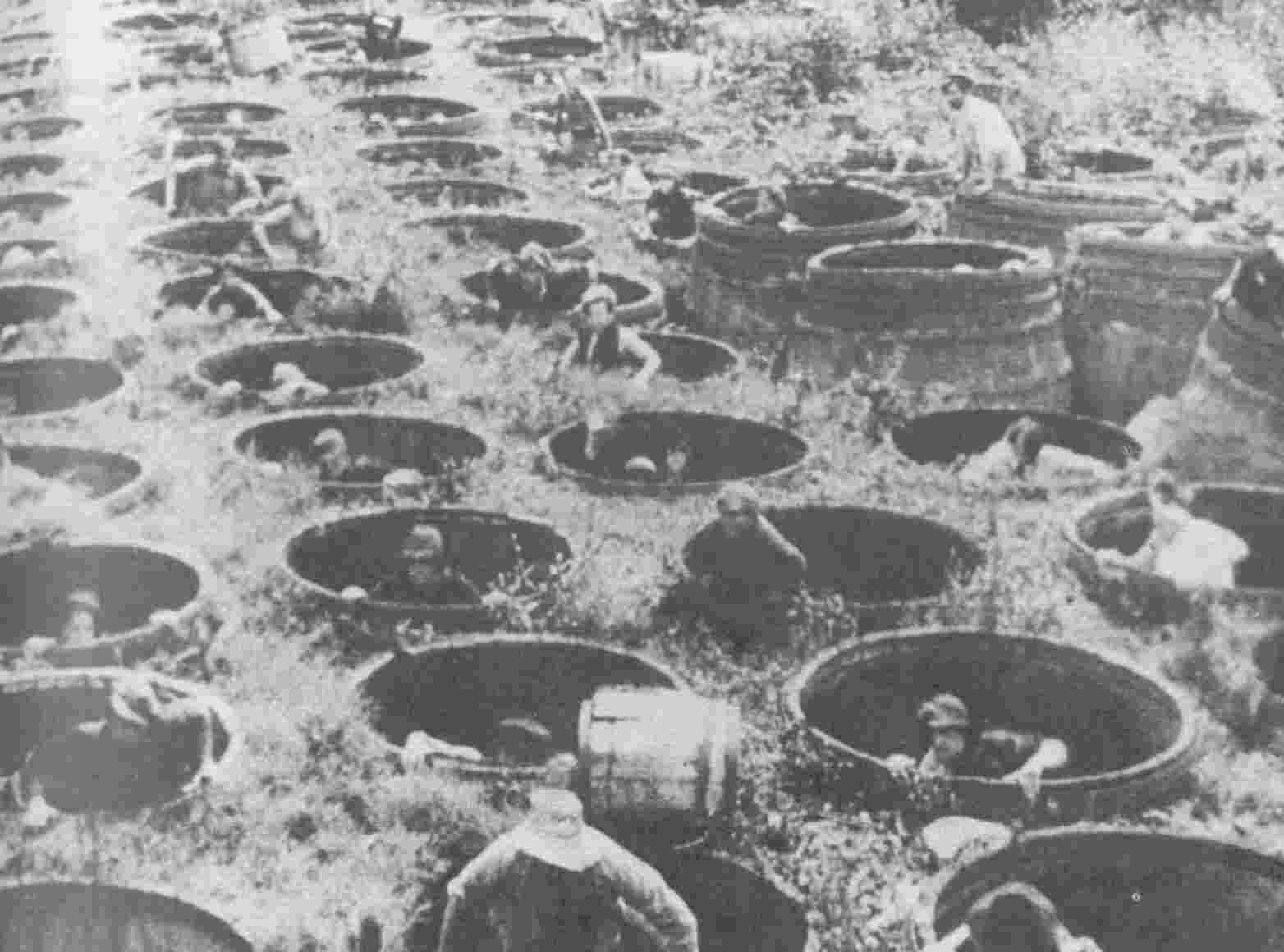
STRIKE
(STACHKA)
(Sergei
M. Eisenstein, USSR, 1925) (F)
Expressionism,
Commedia dell'Arte, a love of the
bizarre,
and a strong feeling for visuals and compo-
sitions
converge in this extraordinary shot of Lumpen-
protelarians emerging from their "homes"
to become
police provocateurs
against the striking workers.
______________________________________________
EDITING
AS THE ESSENCE OF FILM ART
The
essence of film art for Eisenstein lies in the creation of a
new psychological reality by means of
creative editing (montage).
Increasingly
dissatisfied with the too limited (because static)
realism of theatre. Eisenstein had
made a final abortive attempt
to
force immediacy by staging the play Gasmasks inside a factory.
He then turned to cinema under the
slogan: "Away from Realism --
to
Reality!" A profound, possessed adherent of visual culture, he
firmly placed the image at the center of
his filmic ideology, but
only
as it existed in relation to subsequent or preceding shots;
cinema was seen as an art of conflicts
between images. A technical
process
(the ordering of strips of film into logical, narrative sequence)
was thus transformed into an aesthetic
act. The cinema became an
art
of the laboratory, not of the act of shooting: events, seen in
real life
as a continuous,
integrated flux of objects in motion, were "cut" by the
director-editor into discrete segments
(mere snatches of reality), then
dynamically
joined in combinations designed to create a new reality.
In a
not entirely tenable analogy with Japanese character writing,
Eisenstein explains creative editing as a
multiplication rather than
addition
of separate effects. Just as the Japanese character for "dog"
and another for "mouth" form,
when juxtaposed the character for
"bark",
so the juxtaposition of two shots creates an entity greater
than the sum of its components (as in
Gestalt psychology). Each
shot
is an object: but in their combination, shots create concepts --
metaphors, symbols, a new grasp of
underlying intellectual concepts.
Montage
works by the collision of two pieces of film, not by their mere
"joining". Eisenstein
insists on the presence of montage, conflict and
contradiction in all the arts --
surprises, disproportion, distortion,
unexpected
combinations, and, most importantly, irregularity. (2)
As
the brain is confronted by the unexpected, it moves back and forth
in confusion and excited agitation in an
immediate, inevitable search
for
relationships and does not come to rest until a new "understanding"
is reached. Here Eisenstein
parallels the Surrealists' insistence on
unexpected
juxtapositions. Thus editing is not peaceful, but rather like
"a series of explosions of the
internation combustion engine to drive a car
(film)
forward ... " The conflicts between shots or even within a
single shot
might be those of
scales, volumes, masses, graphic direction, close-up as
against long-shot, darkness against
light, image against sound. Each of
these
tensions is, as Gyorgy Kepes puts it, "resolved into a meaning
config-
uration. These
configurations in turn serve as a basis for further tensions:
consequently for further
configurations. Contradiction is the basis of
dynamic organization of the associative
qualities of the image." (3)
Editing,
then, is not merely combining what is visible in individual
shots, but making conscious invisible
concepts arising from their
combination
-- the chains and clashes of psychological associations
diabolically contrived by the artist for
maximum shock.
To
Eisenstein, the concept of collision was the expression in art
of Marxist dialectics -- the movement of
all nature from thesis to
antithesis
to synthesis. It also represents the subverting of objective
reality and of the unwilling spectator,
who is thereby raised to
new
levels of comprehension by the manipulations of the director.
In
Strike, this emphasis on "collision" is carried out
in almost every
one of its
thousands of shots by such technical devices as changing
the size of the image within the frame,
unorthodox dissolves and iris
effects
even to the combining of the two), split screen, slow and
reverse motion, unexpected camera
movements and angles, double
exposures,
the use of masks to hide or reveal portions of the image, the
sudden intrusion of objects and limbs
into the frame, the introduction
of
new locales and/or characters without prior explanation. Even
the
titles interspersed
throughout form part of the montage, since their
wording, typography, length, and
positioning (precisely specified by
Eisenstein)
are integrated into the rhythm of the film. Throughout,
there is deliberate visual manipulation
and mystification to put
the
spectator into a state of permanent psychological tension.
The
best example of Eisenstein's montage methods occurs in the famous
sequence in which the four capitalists
dealing with the strike are seated
in
the plush comfort and isolation of their mansion, smoking and
drinking.
Through
cross-cutting, we now see, in this order: workers at a
clandestine
strike meeting;
the capitalist putting a lemon into a juice extractor; the
workers discuss their demands; the handle
of the juice extractor descends
to
crush the fruit; the workers are charged by mounted police; the boss
says in an inter-title: "Crush
hard and then squeeze!"; the workers are
attacked;
a piece of lemon drops on to the well-polished shoe of the
capitalist; disgusted, he uses the paper
containing the workers' demands
to
wipe it off. The juice extractor both embodies the force used
to crush
the strikers and
simultaneously implicates the bosses in the action.
______________________________________________
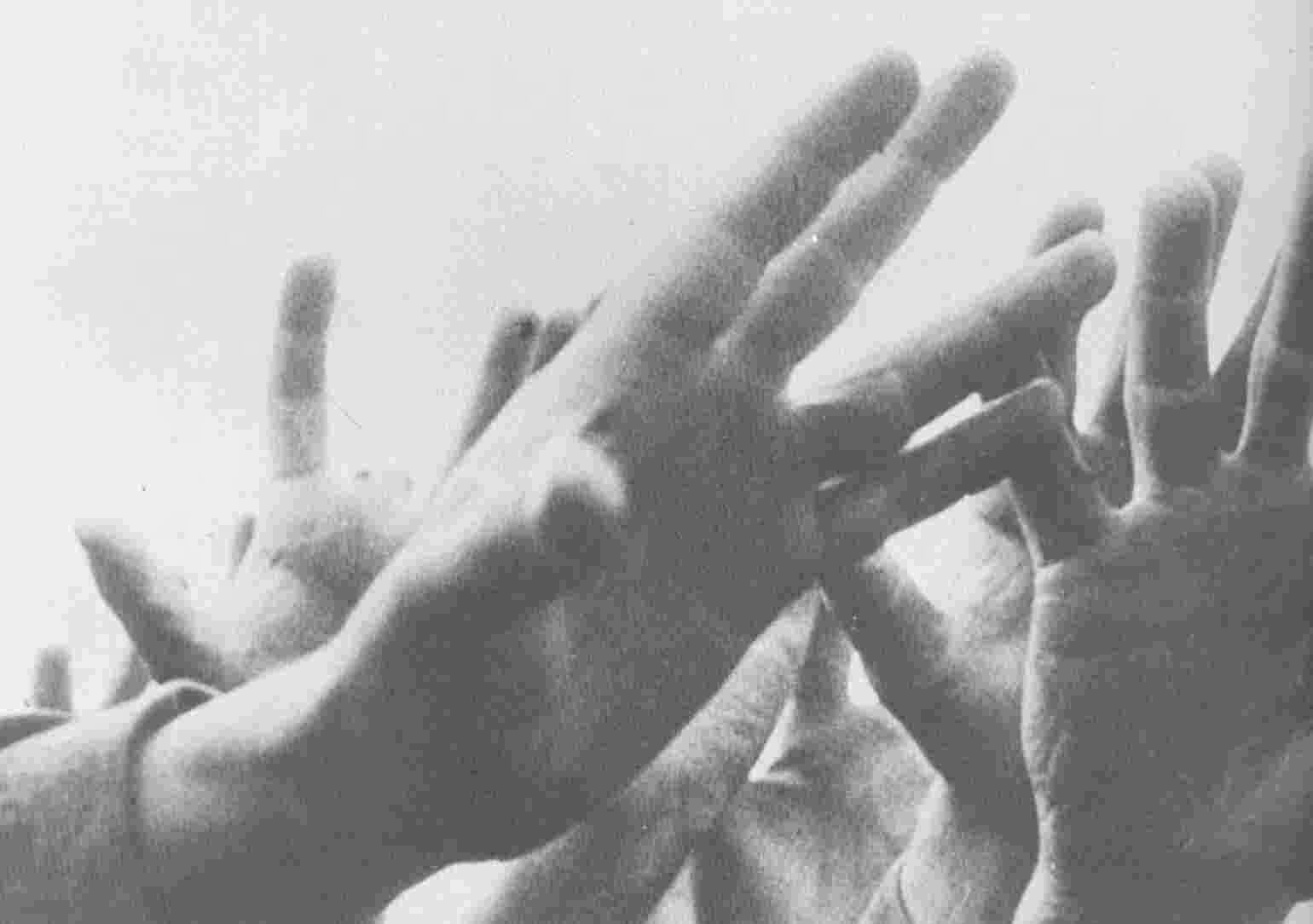
STRIKE
(STACHKA)
(Sergei
M. Eisenstein, USSR, 1925) (F)
Aesthetic
and formalist preoccupations of Soviet
film
avant-garde join with ideological content:
the
hands of striking workers, raised in sup-
plication
or self-defense against the attacking
police.
Dynamic utilization of frame area.
______________________________________________
STYLIZATION
AND TYPAGE
From
his life-long preoccupation with circus, music hall, Commedia
dell'Arte, and Kabuki Theatre, Eisenstein
derived the concept of
"typecasting".
This entailed the creation of composite "stock" types --
worker, capitalist, spy -- a distillation
of the most significant traits
of
a particular social "type". Eschewing subtlety or the
"building" of
character
as bourgeois individualism, Eisenstein portrayed the "essence"
of social types for purposes of
propagandistic art. In Strike, capitalists
are fat, smoke cigars, wear top hats,
grimace frequently, are vicious,
oppressive,
spoiled, and sensual (a peculiar equation of sex and the
ruling class); to increase their
grossness and power, they are frequently
photographed
from below. In a similar manner the stock characters in
Commedia dell'Arte, Punch and Judy shows,
and the films of Chaplin
(whom
Eisenstein greatly admired) move through pantomime
and
slapstick to portray easily identifiable "types".
Since
Eisenstein, "typage" has become a favorite
tool
of propaganda films, used by political systems
of
every persuasions to attack their enemies in
the
most direct, most simplistic manner possible.
______________________________________________
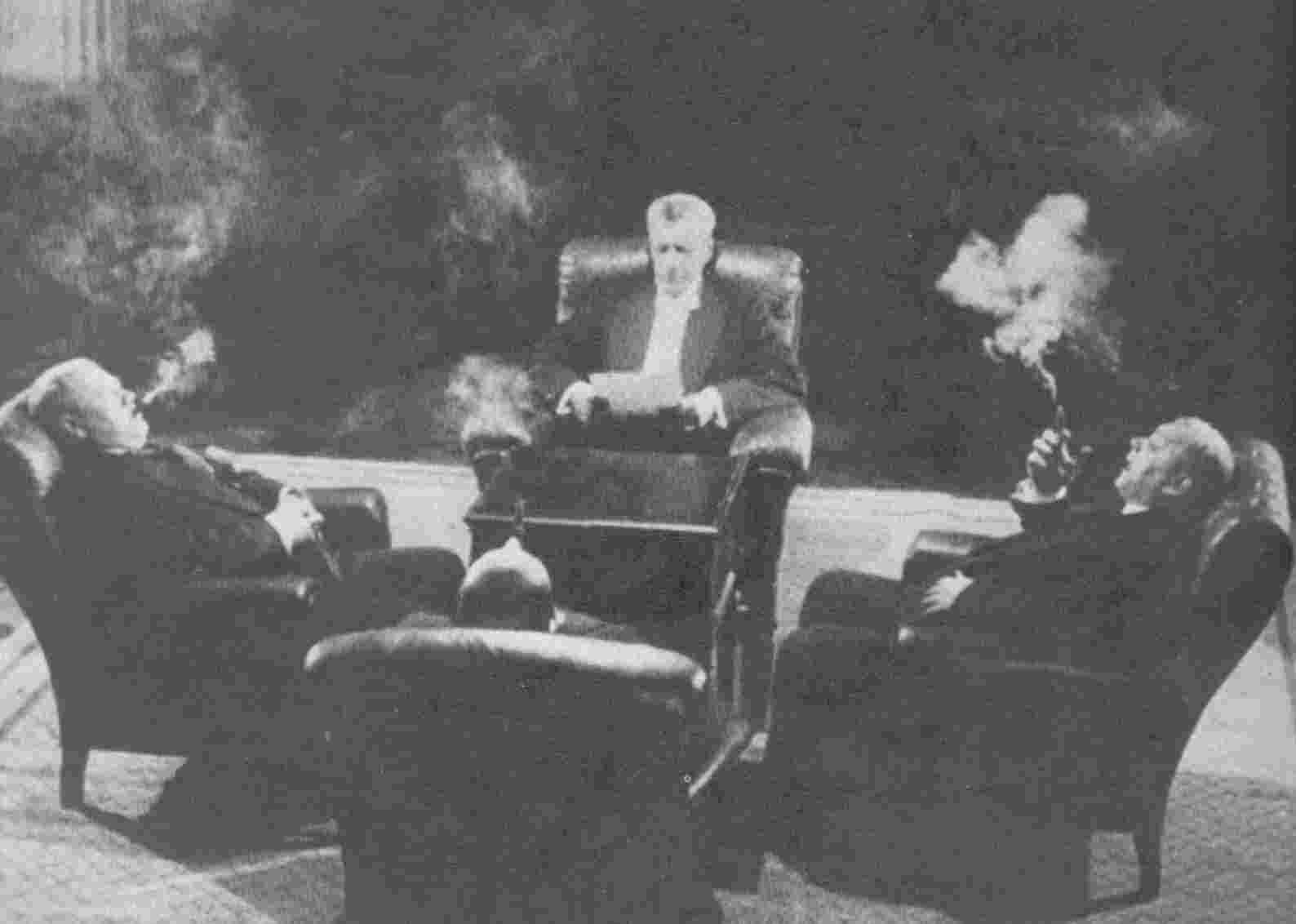
STRIKE
(STACHKA)
(Sergei
M. Eisenstein, USSR, 1925) (F)
The
Ruling Class: plush comfort, cigars (excessively
used), reclining figures sure of being
"on top". As
in
Commedia dell'Arte -- a life-long influence on
Eisenstein
-- the director works with easily identi-
fiable
stock types. Strong formal composition avoids
superfluous decor and concentrates
action in the center.
______________________________________________
SUBSTITUTION
OF COLLECTIVE MAN FOR INDIVIDUAL HERO
Customary bourgeois tales of individual
sorrow or sex, eternal triangles,
and
unrequited or orgiastic love affairs were eliminated by Eisenstein in
favor of dramas involving the movement of
classes or masses. In Strike,
the
protagonist is "collective action" -- an episode of mass
struggle in
pre-revolutionary
Russia. Despite its propagandistic intent, the film
is
suffused with an aestheticism that proved anathema to the regime
and later to Eisenstein himself. A work
of youth -- free, exuberant, pas-
sionate,
full of "errors" -- it reveals a genius exploring a new
language in
a gushing excess
of imagination. Clearly the story itself -- the suicide of
a worker leading to an ill-fated strike
-- seems in retrospect secondary
to
his basic preoccupations. But Eisenstein was never to systemize his
structuralist concern with the new
vocabulary and syntax of cinema,
though
he continued to explore them in his films, his teaching and writing.
______________________________________________
(1)
See Marie Seton, Sergei M. Eisenstein, New York, A.A. Wyn
(2) Sergei M.
Eisenstein, Film Form, 1949
(3)
Gyorgy Kepes, Language of Vision, 1967
____________________________________________________________________________________________
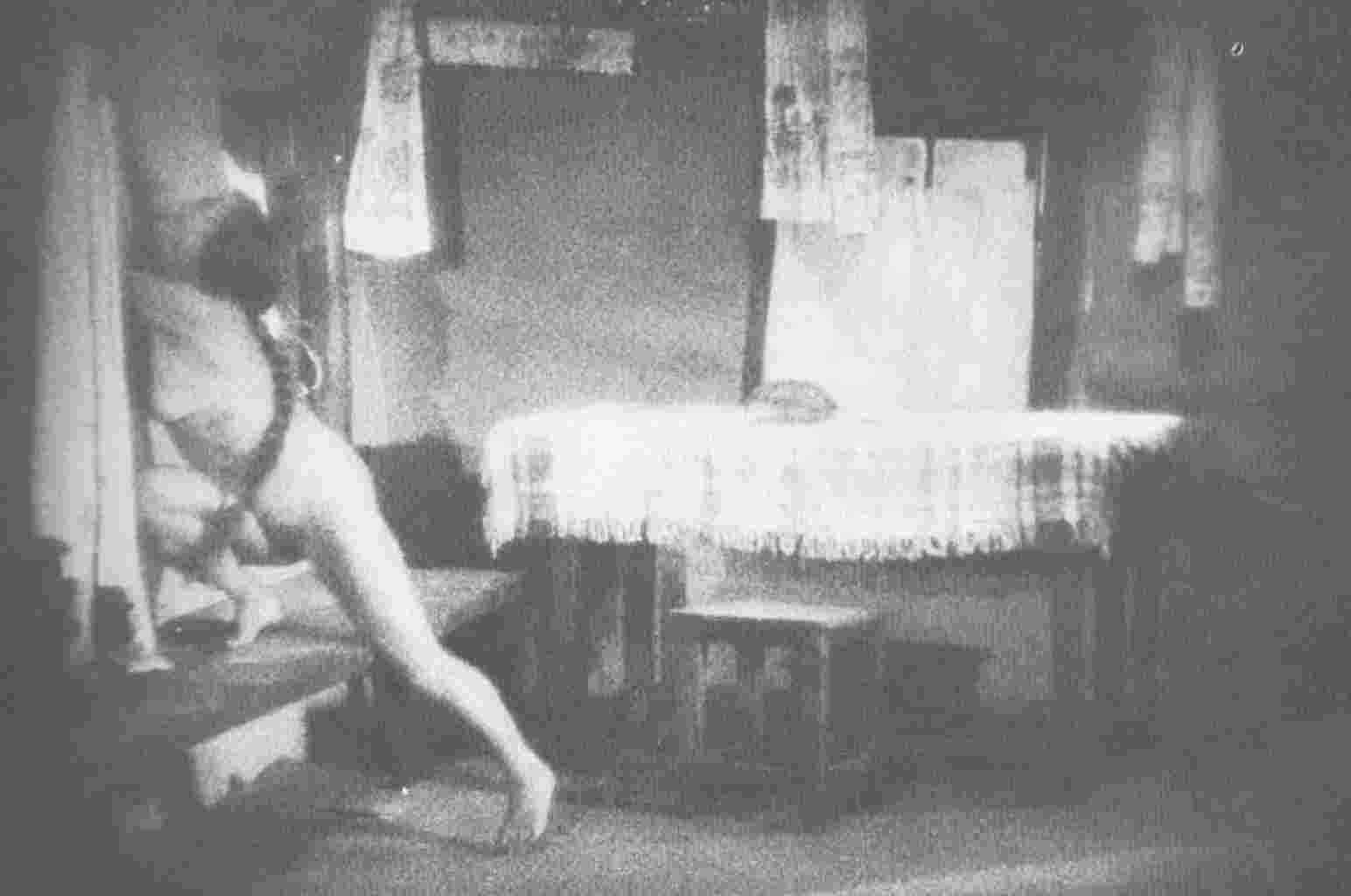
EARTH
(ZEMLYA)
(Alexnader
Dovzhenko, USSR, 1930) (F)
Excised
by Stalinist censors, this sequence --
unique
in Soviet cinema because of its nudity --
violently
conveys the irrational despair of a young
woman
whose lover has just been murdered.
Strong
horizontal and vertical lines (table,
chair,
curtains) are disturbingly broken by the
opposing
diagonals of woman's body and bench.
______________________________________________
In
retrospect, Alexander Dovzhenko emerges as one of the
most profound talents of the Russian
cinema, the man
who raised it
from the encrustations of propaganda and
intellectualism
to the level of visual poetry. The destruction
of
realistic time and space occurs here -- as it does
in
advanced contemporary
cinema -- as a necessity of poetic art.
Aesthetically
revolutionary, Earth was "rightfully"
attacked by conservative Stalinist
commissars who
distrusted its
poetic freedom, pantheist lyricism,
and
the "cosmic" manner in which it absorbed
(instead of liquidating) the class enemy.
The
"plot" is minimal, ideologically safe: the kulaks in
a
Ukranian village are opposed
to the purchase of a tractor by
the
young peasants and arrange to have their leader murdered.
But the film's significance lies
elsewhere, in its one to the oneness
of
man and nature, to the joys and terrors of existence, in its
overpowering procession of lyrical
images, each larger than life.
Earth
exists entirely in episodes: the peaceful, smiling death of an
old peasant among his apple trees; the
almost hallucinatory dance
of
the doomed young leader down a deserted, moonlit country road --
a hymn to the human spirit -- which
continues wordlessly for minutes
and
ends in sudden murder; the distress of his fiancee who tears
off her clothes in spectral despair
-- a sequence unique in Soviet
cinema
for its nudity (promptly removed by Stalinist censors
but
preserved in an uncensored copy discovered in 1958.)
Stylistically,
the film is spectacular in the originality with which
conventional structure is replaced by
poetic continuity. It is framed
by
lyrical imagesf of sky and soil, of the richness of nature's fruit.
It portrays man's place within a
pantheist universe of fertility,
life
and death. A series of passionate episodes -- more powerful
than the plot -- anticipates the concerns
of contemporary and
avant-garde
cinema in its exploration of states of being.
Much of
the film consists of a succession of beautifully sculptured
peasant portraits of great plasticity.
These are photographed in
medium
shot or close-up, in attitudes and motions of joy, repose,
expectation or fear, separated by slow
fades. Though representing
social
"types", these are the real faces of the Ukraine far
removed
from propagandistic
simplifications. Constant tension is maintained
by the massing of related images into
repeated climaxes; several scenes
resemble
frozen shots but are posed by immobile actors in attitudes
of pregnant stillness. Following
the son's murder, an identical scene
of
his father mourning, immobile at a table is repeated three times --
separated by slow fades.
Throughout, time is concentrated to the
utmost.
Decor, events, motivations are reduced to an epic, very
modern simplicity. The real
significance of the film resides not so
much
in its content as in its subversion of established form; it is
a masterpiece of modern cinema
thirty years ahead of its time.
____________________________________________________________________________________________
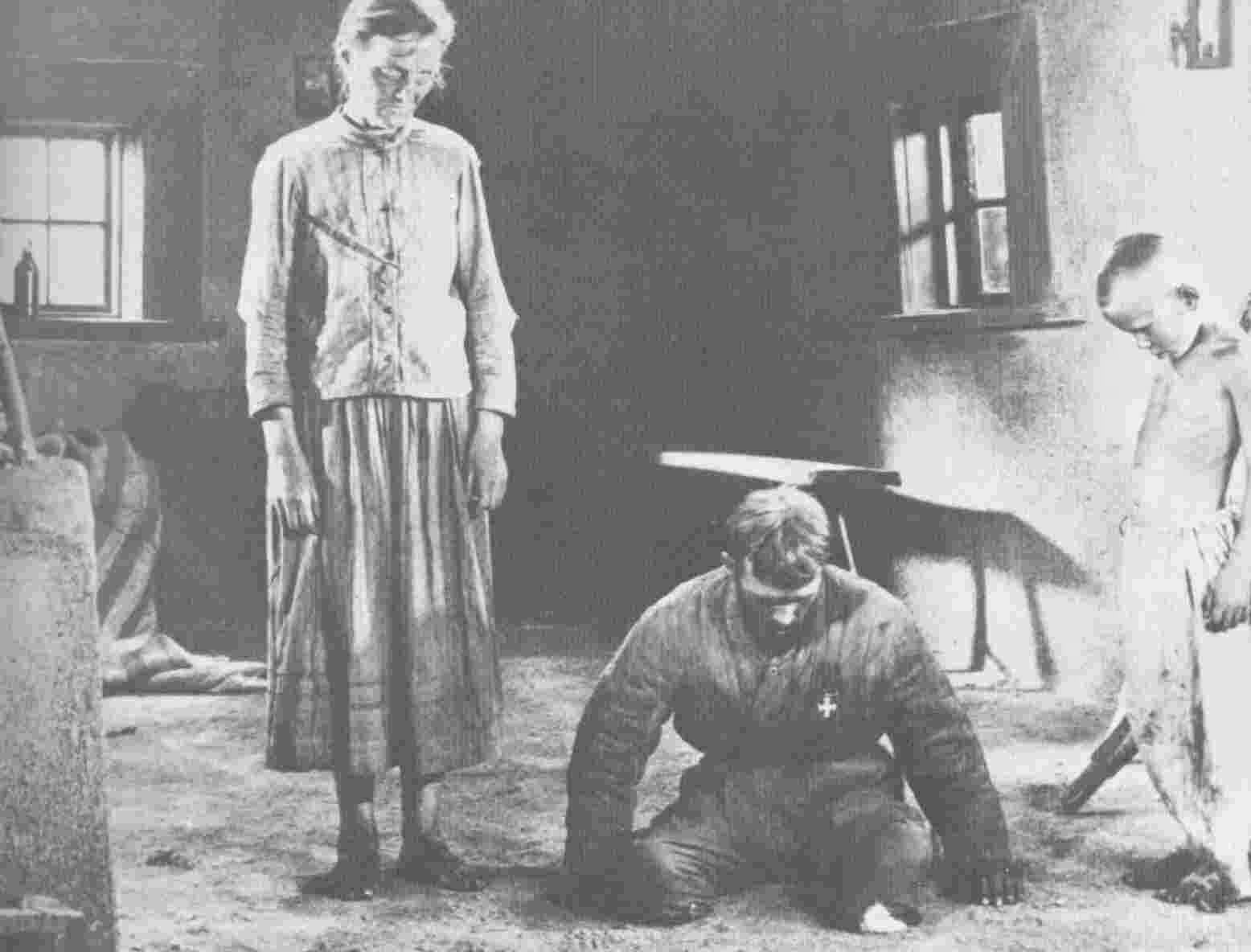
ARSENAL
(Alexnader Dovzhenko, USSR, 1929)
(F)
Poverty and despair as a
political and aesthetic
experience;
the stark realism of minimal decor and
attire
is reinforced by painstaking composition and
lighting.
The shocking juxtaposition of military
decoration
and debility caused by war provides
an
ideological and compositional center.
____________________________________________________________________________________________
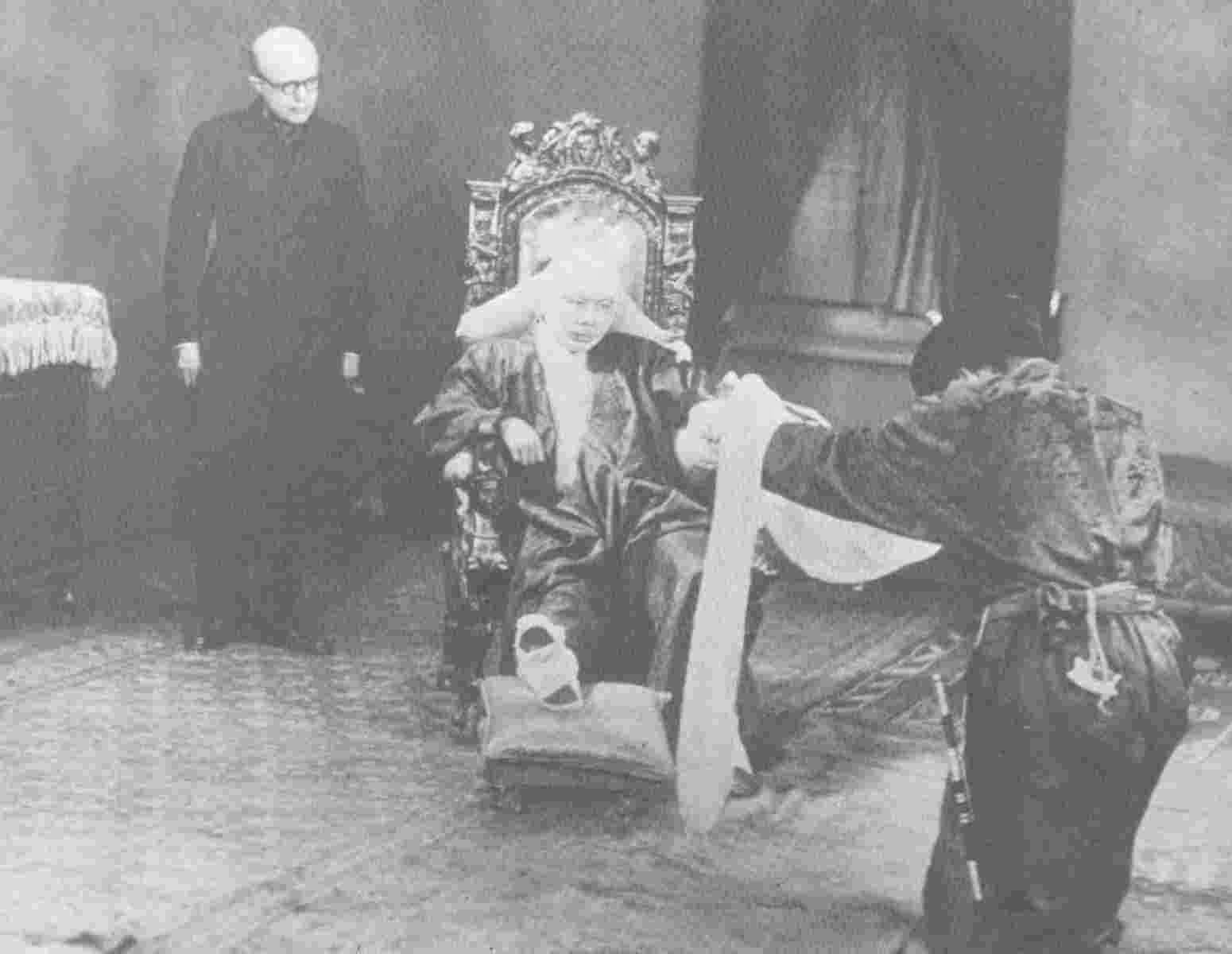
STORM
OVER ASIA (POTOMOK CHINGIS-KHAN)
(V.I. Pudovkin, USSR, 1928)
(F)
Having just wounded him in
a botched execution
attempt,
the British White Army and its clerical
collaborators
-- East and West -- now attempt to woo
this
Mongolian guerilla into becoming their puppet
ruler,
falsely assuming him to be a descendant of
Genghis
Khan. His rebellious innocence, however, has
been replaced by revolutionary distrust,
revealed in a
strongly
diagonal composition converging on the center.
______________________________________________
One of
the four giants of the early Soviet cinema, Vsevolod
Ilarionovich Pudovkin, is at once more
sensuous and less cerebral
than
Eisenstein or Vertov. His films tend more towards clear-cut,
simple stories in which a particular
carefully drawn human fate
serves
as a statement of universal relevance. This frequently is the
attaining of revolutionary consciousness
by the oppressed, learning
from
the experience of life. The intentional simplifications of
character
and situation are
inherently in accord with the requirements of silent
cinema. The style is almost
lyrical, of great psychological resonance,
vigoriously
naturalistic but with strong expressional overtones, depending
heavily on complex, almost mathematcal
montage and rhythm. ("I claim
that
every object shown on the screen to the spectator is a dead object,
even if it moved before the camera, until
it has been edited.")
During
the 1920 Russian civil war, a young Mongolian is falsely assumed
by the British White Army to be a
descendant of Genghis Khan and is
therefore
used as puppet to legitimatize its invasion. He discovers
the imperialists' true intentions, and,
at the head of a suddenly huge
horde
of mounted revolutionaries, drives them from the country.
The
sheer visual dynamism of this final sequence -- a cascade of ever
more rapid, ever more forceful images
interspersed with revolutionary
titles
in increasing crescendo -- had a powerful, radicalizing impact
on audiences. Other strong images
and episodes had the same effect;
the
Mongol about to be executed, heedlessly walking through a mud
puddle which his "civilized"
British executioner studiously avoids;
Buddhist
priests, Western businessmen, and British militarists
related visually to establish their
congruence as ruling class; a
dignified
Lama priest and a ridiculous British general's wife cross
cut while dressing for a formal occasion.
At a moment of revelation,
the
Mongol suddenly grabs hold of the British soldier's lapels.
This is repeated several times in a very
"modern" editing style.
Altogether,
the film is an object lesson in visual political cinema,
glowing with revolutionary fervor and
hatred for oppression.
____________________________________________________________________________________________
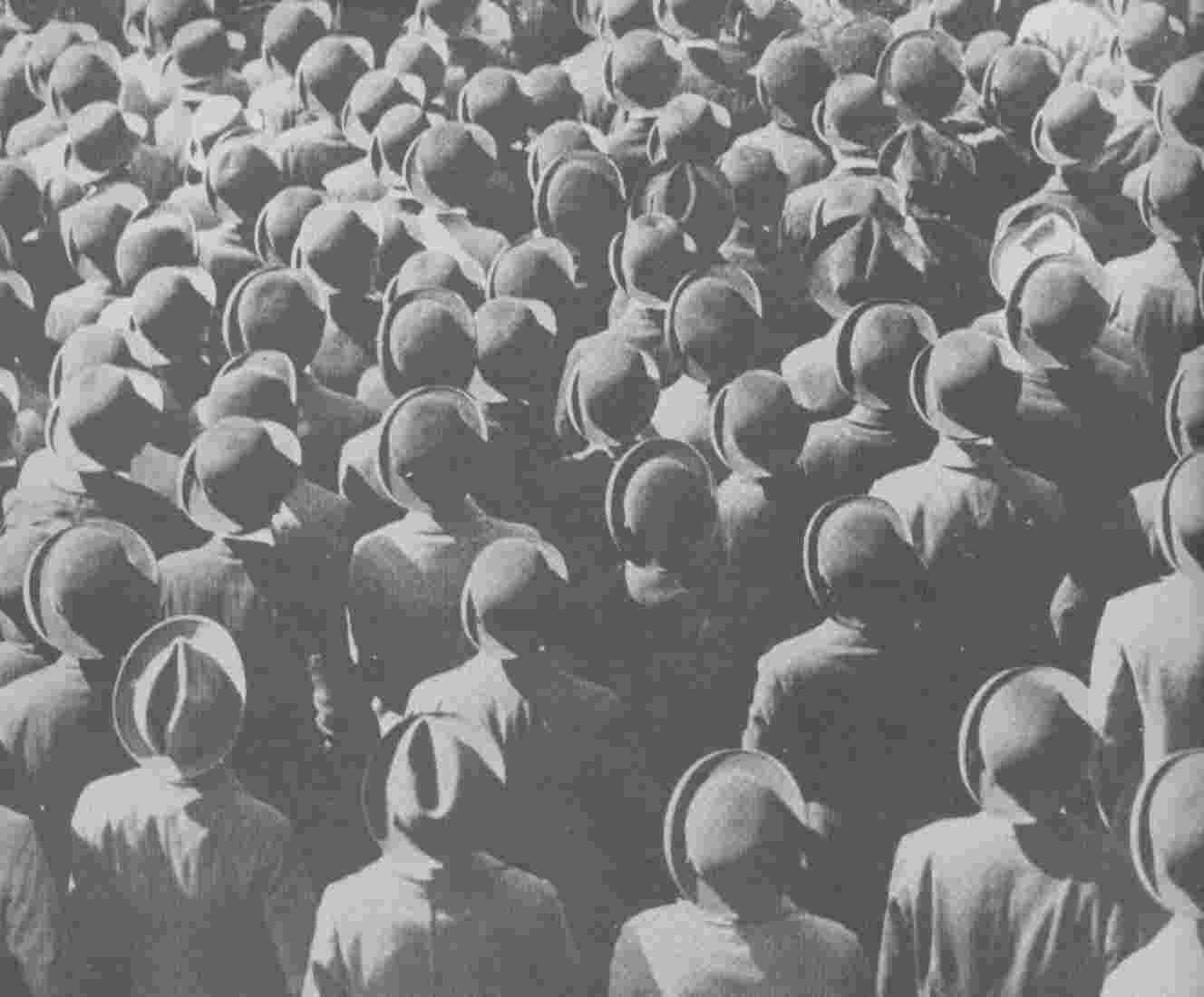
THE
END OF ST. PETERSBURG
(V.I.
Pudovkin, USSR, 1927) (F)
The
early Soviet cinema displays a strong sense of
plastic
and visual values, an emphasis on compo-
sition,
and a feeling for form and abstraction within
the
requirements of radical ideology. Here capitalists
crowd the stock exchange to watch their
war profits climb.
____________________________________________________________________________________________
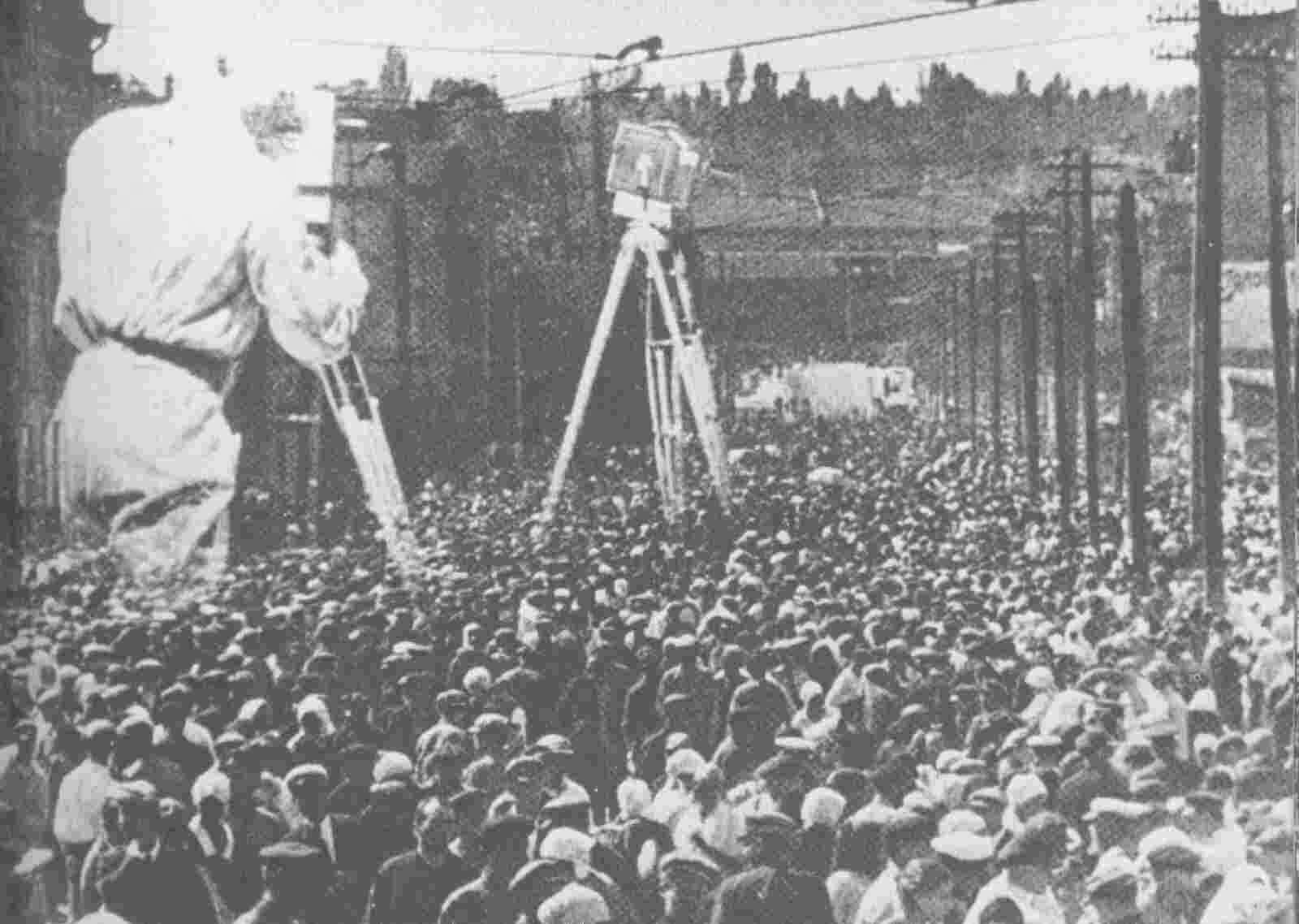
THE
MAN WITH THE MOVIE CAMERA
(CHELOVEK
A KINOAPPARATOM)
(Dziga
Vertov, USSR, 1929) (F)
The
cinematographer as God, hovering over the
multitude,
seeing all. Significantly, however, he seems
to
be photographing a camera which stands by itself,
as
if even the cinematographer had become dispensable
(anticipating what happens in the last
reel). In any case,
he is an
illusory God, the "real" cameraman -- the
one
who photographed him -- remains invisible.
______________________________________________
In
retrospect, the avant-garde poet Dziga Vertov emerges as one of the
most important influences in Soviet
Cinema. Vertov moved rapidly
from
the production of propagandistic newsreels to a full radical
aesthetic -- the Kino-Eye -- which found
its culmination in his
masterpiece,
The Man With The Movie Camera. Beginning with
his 1919 manifesto in LEF, the
avant-garde journal edited by
Mayakovsky,
Vertov condemned the story film and proclaimed
himself
disinterested in psychological explorations of character:
"Down with bourgeois fairytale plots
and scenarios -- long live
life
as it is!" The emphasis was to be on the "unplayed"
over the
plotted film, on the
substitution of documentation for narrative
and
mise en scene, on the destruction of the theatrical proscenium
(invisibly present in so many Hollywood
films) in favor of "the
proscenium
of life itself". This meant, as one Russian critic put it,
the "detection" of plot within
reality, instead of its "invention".
Hence,
the elimination of actors, lighting, make-up, studio, costumes,
and decor. It was with the "camera
eye" -- the "armed eye of the
director"
-- that the essence of reality was to be captured. In a
beautiful
and very filmic
statement, Vertov expressed this view succinctly:
"I
am the camera eye. I -- am the mechanical eye.
I
-- am the machine which shows you the world as only
I
can see it. From today on, I liberate myself forever
from human immobility. I am in
perpetual motion.
I
approach and move away from objects -- I crawl
beneath
them -- I climb on top of them -- I am even
with
the head of the galloping horse -- I burst at top
speed
into crowds -- I run ahead of running soldiers --
I
throw myself on my back -- I rise together with airplanes --
I fall and fly in unison with falling
and ascending bodies.
(1)
This
"liberation from human immobility" was to be achieved
by means of the most meticulous montage
-- an editing process
subject
to precise mathematical laws that determined the
number
of frames per shot, their duration and their order.
The
Man With The Movie Camera proved to be a veritable object lesson
of
Vertov's theories.
Though met at first with disregard, hostility, or bewilderment,
the film has emerged as one of the most
profound classics of the Soviet era.
Its
protagonist is the camera; its assistant, the cameraman; its subject,
film.
It starts and ends
with the camera eye. The visual pretext is a vivid panorama
of one day in the life of a city and,
simultaneously, the progression of life from
birth
to death. It is a film by a man drunk with the camera,
filled with the
most exuberant
pleasure in visuals "as such", a film that shows the
volup-
tuousness of life, the
rush and vitality of a city, the faces and preoccupations
of its anonymous inhabitants. A
true avant-garde work, it offers a brilliant
compendium
of filmic possibilities, original devices and visual associations.
______________________________________________
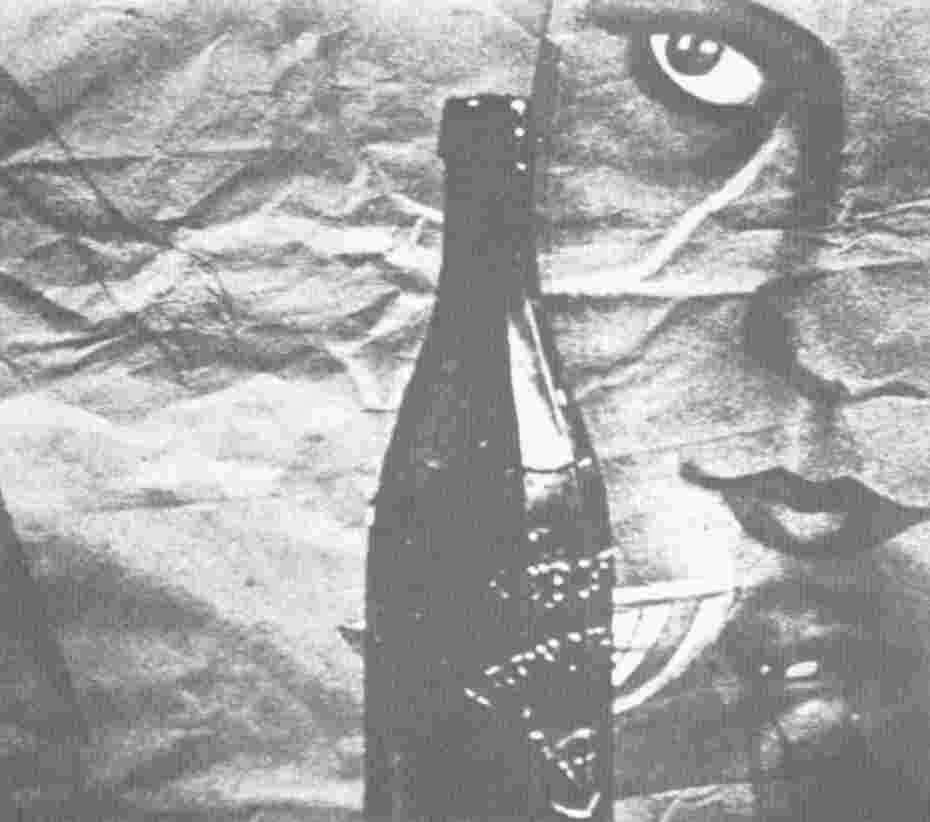
THE
MAN WITH THE MOVIE CAMERA
(CHELOVEK
A KINOAPPARATOM)
(Dziga
Vertov, USSR, 1929) (F)
The
origins of Godard. Vertov's obsessive delight in
mysterious visuals counterposes poster
and bottle,
their size and
compositional unity (shape of bottle
conforming
to that of woman's cheek) transforming
them
into huge reaffirmations of unknown mysteries.
______________________________________________
Though
its content can hardly be considered radical, it is its form that
stamps this as one of the most subversive
films of the Soviet classic era.
For
in scene after scene, and antedating the structuralist films of our
day
by almost half a century,
it intentionally and in the most calculated manner
reveals its artificiality and "calls
attention" to its synthetic, man-made
quality.
In a constant toying with reality as against illusion, it
persistently
destroys the
spectator's identification with itself by the introduction of a
roving
cinematographer into
the action, by the device of a film within a film, by the
sudden freezing, slowing or acceleration
of movement, the use of split-screens,
super-impositions,
and reverse action. The result, as Annette Michaelson puts
it, is an attack on the illusion of
art and a constant recall of the spectator to
himself
so as to disturb his equilibrium and to subvert him on deeper levels.
The
manner in which Vertov questions the most
immediately
powerful and sacred aspect of
cinematic
experience, disrupting systematically
the
process of identification and participation,
generates
at each moment of the film's
experience,
a crisis of belief.
(2)
The
most significant sequence involves the sudden introduction into the
film's
action of an
editing room in which strips of film -- their images necessarily
motionless -- are held out to us by the
editor: they also, however, immediately
precede,
follow, or duplicate the real film's live action, thus calling
attention
to the artificiality
of the cinematic experience itself. The editor holds a strip
of four or five film frames, with a
child's face, sideways or even upside-down;
next,
and entirely unexpectedly, the entire screen is filled with these
very
frames, in motion. This
juxtaposition of frozen images on actual, spectator-
seen
celluloid strips ("film") with moving images filling the
frame ("life") is
extremely
subversive, particularly since the device is used repeatedly and
in an unpredictable manner. Far
from being an academic exercise, this juxta-
position
of frozen and live images -- syncopated into a voluptuous rhythm --
represents the core of Vertov's deadly
serious attack on our conciousness.
A
similar philosophical point is made in the famed sequence of a
cameraman
in a moving car,
photographing a group of women riding alongside him in a
carriage. We continue seeing these
images and accept them as representations of
the
process of filming -- until, in a disturbing instant, we realize that
"of course"
the
"cameraman" is but an actor, in turn photographed by the
real and invisible
cinematographer.
Thus, in a cosmic and subversive pun, "the man with the
movie camera", though ubiquitous in
the film and almost continuously present
as
an actor, is in reality invisible; just as the film strips we "saw"
in the editing
room sequence
were themselves being photographed. Thus, in "revealing"
the so-
called "truth",
about the people in the carriage (their being photographed), Vertov
fools us. The presumed abolition of
illusion (the presence of a photographed
cameraman
within the action of the sequence) in itself leads to a new illusion.
This
repeated and intricate "breaking" of illusions represents
Vertov's search
for truth, as
he both creates and continually annihilates illusionary reality
before our startled eyes. It can be
found as well in his utilization of
unorthodox
dissolves (the lovely sequence of a woman's slow opening
of window shutters, photographed in
a rapid series of superimpositions,
each
slightly different), in his use of linkage (by visual association and
analogy), and of cross-cutting of
different actions in mounting rhythm
(one
occuring at such dizzying speed that the successive frames become
simultaneously visible as subliminal
flashes, creating superimpositions that
do
not exist in reality). Where most filmmakers remove us from ourselves
in
their effort to create a
new reality and force us into a suspension of disbelief.
When
The Man With The Movie Camera was first shown in 1929,
Stalinism
had consolidated its
power and commandeered the arts to its own purposes.
Ironically, however, the subversive
and anti-totalitarian implications
of
avant-garde aestheticism manifest in this film -- its questioning of
reality,
its call for the
liquidation of illusionism -- were not evident to the regime.
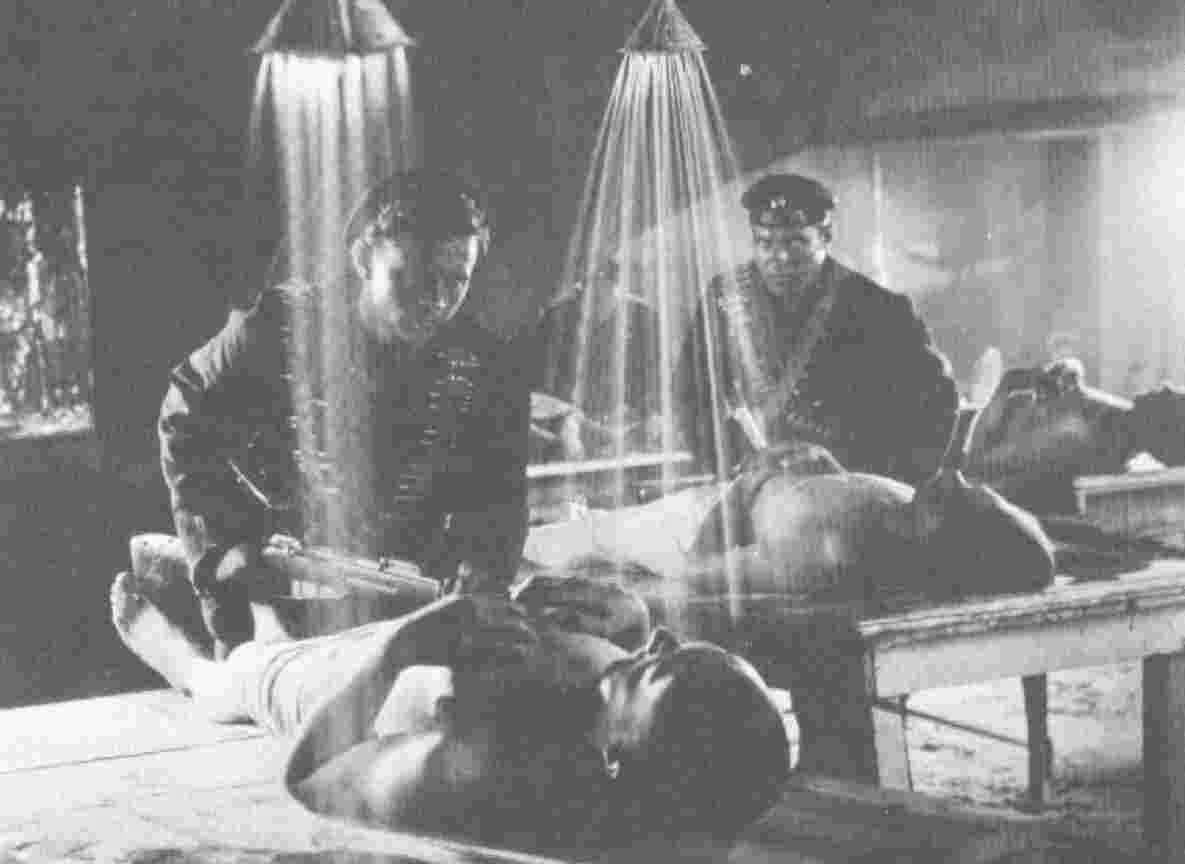
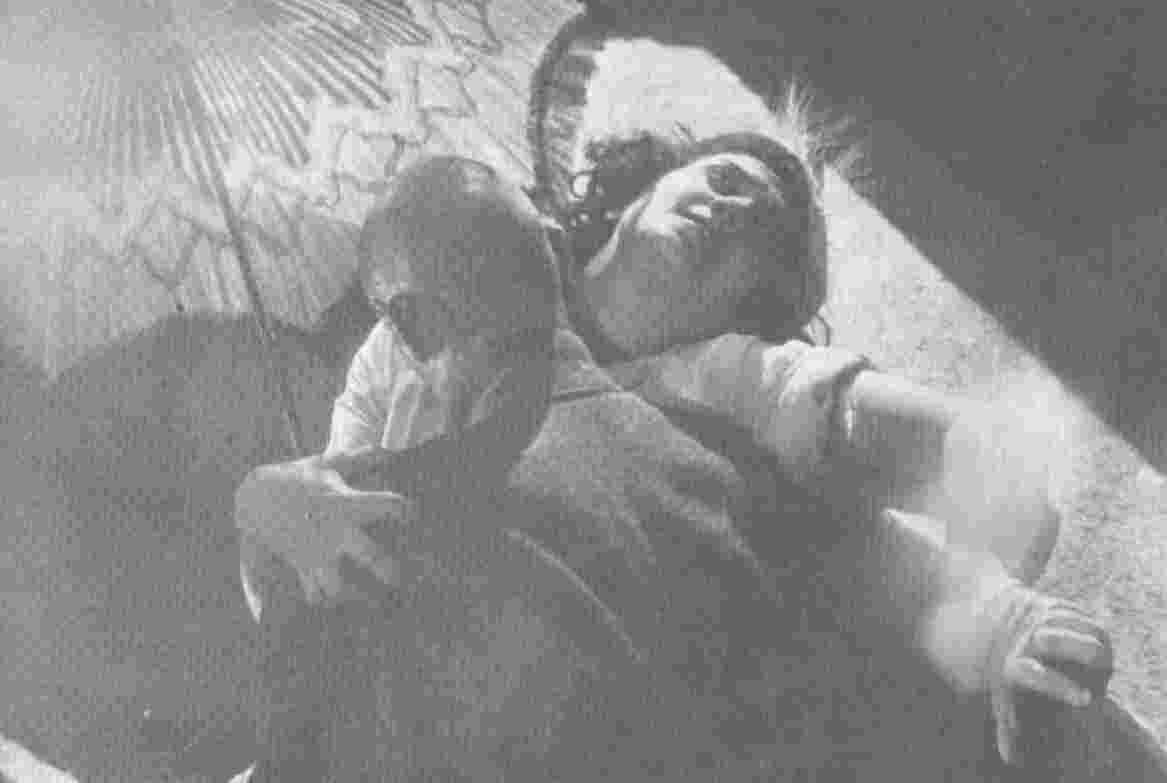
OCTOBER
(Sergei M. Eisenstein, USSR, 1927)
(F)
The metaphysical
aestheticism of Eisenstein --
rightly
condemned by the Stalinists as opposed
to
their simplistic "socialist realism" -- seen in
three mysterious, strongly Kafkaesque
shots
from his "official"
film about the 1917 Revolution.
______________________________________________
______________________________________________
REFERENCES
(1)
Translated by the author from Abramov / Vertov / Schub:
"Dziga Vertov --
Publizist Und Poet des Dokumentarfilms",
Berlin,
1960, as reproduced in Gregor-Patalas, Geschichte des Films,
Sigbert Mohn Verlag,
Germany, 1962. (2) Annette Michaelson,
The
Man With The Movie Camera, New York, Art Forum,
March 1972