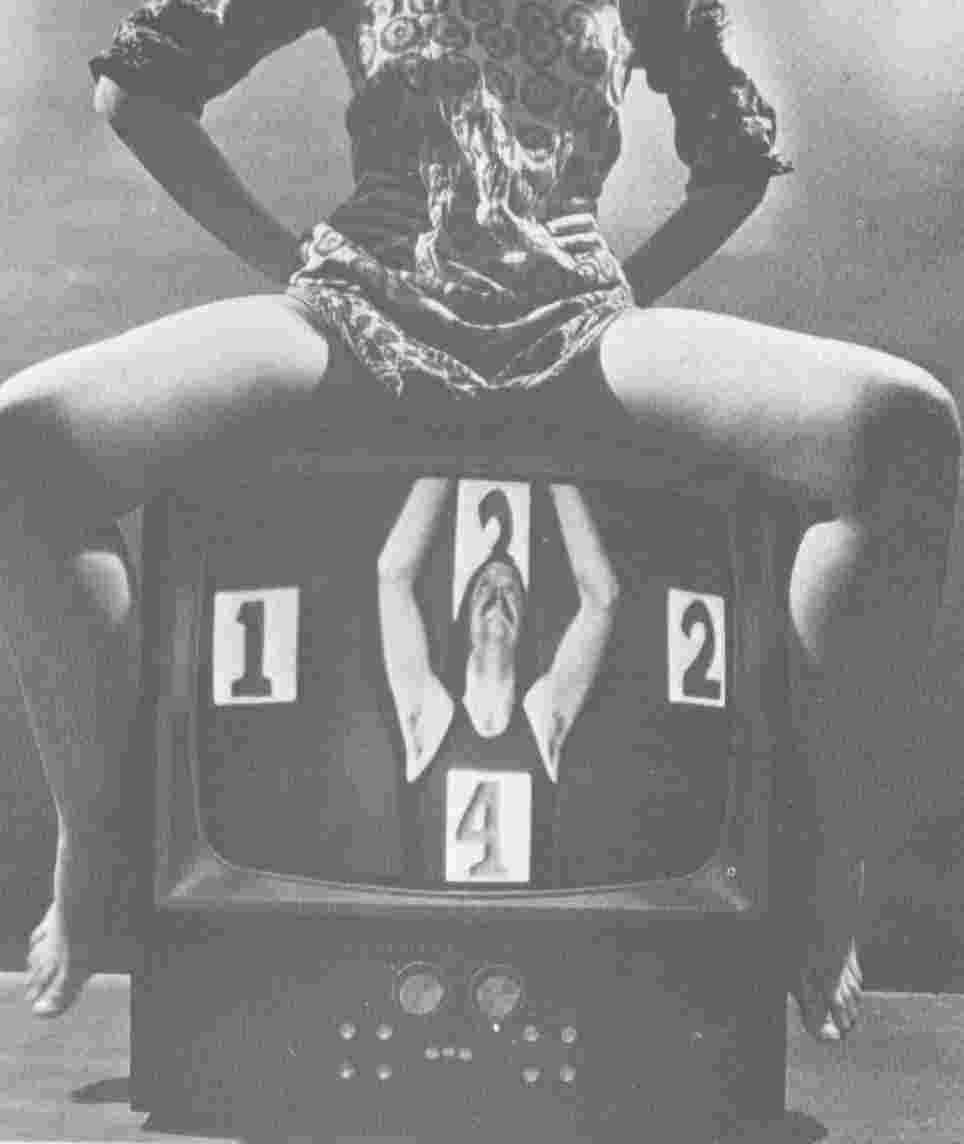
FILM
- AS A -
SUBVERSIVE ART
LIFE
WITH VIDEO
(William
Walker, USA. 1972)
A TV
personality, without leaving the set, makes
very
personal contact with a willing viewer,
finally
disappearing into her (via a ladder).
Being
told, in a muffled voice, that he will now
be
with her "always", she moans voluptuously,
her
confusion between TV and reality complete.
Do
we not all wish for similar confusion?
STRAINING TOWARDS THE LIMITS
THE ELIMINATION OF REALITY
A
beautiful and true story is told of the abstract painter Frank
Kubka. In the course of a walk, he
apologized to nature for
having
attempted to copy her and promised not to do so again. (1)
There
have always existed in the plastic arts tendencies towards
forms and images undefiled by
representations of reality. This can
be
seen in Neolithic abstractions, Egyptian designs and Indian
patterns, Byzantine artifacts and
Renaissance concerns with
structure
and design. In our day, having removed reality from
the image, attempts are being made to
remove the image itself.
In 1898,
the young Munich art nouveau
architect
August Endell foresaw this:
We
stand at the threshold of an altogether new art,
an
art with forms which mean or represent nothing,
recall
nothing, yet which can stimulate our souls as
deeply
as only the tones of music have been able to. (2)
There
could be no better definition of the aims and aspirations of abstract
art. It was an art, as Herbert Read
wrote, that was to echo basic laws and
structures
of the universe, "liberated from the tyranny of appearances";
an "objective" investigation of
colors, shapes, lines, and visual rhythms
in
order to create force patterns capable of evoking emotions and
feelings.
Elements
of three tendencies converged in abstract art; the surrealist and
dadaist heritage expressed in abstract
shapes related to the subconcious
(Arp,
Miro, Klee, the Eggeling-Richter films Diagonale Symphonie and
Rhythmus 21, and Jackson Pollock's
"automatic painting"): the romantic
realism of Gauguin, Matisse, and the
Fauvists which led to the "hot",
sensuous
abstractions of Kandinski; and the cubist attempts to
reduce objects to their essence, which
connected Cezanne, Picasso,
and
Braque to the "cool", meticulous abstractions of Mondrian.
It has
proven difficult to maintain the objective stance of abstract
art in practice: even the simplest
lines exude psychological vibra-
tions
or else come dangerously close to symbolism. Piet Mondrian
found it entirely "comprehensible
that some abstract artists have
objected
to the name Abstract Art. Abstract Art is concrete and,
by its determined means of expression,
even more concrete than
naturalistic
art." (3) And it was Rudolf Arnheim who called non-
objective patterns "the very elements
of visual comprehension,
the
building stones of the composition the artist creates in order
to represent the structure of the world in
the way his temperament
makes
him see it". (4) It is thus possible to refer
to abstract artists
as the true
realists of our technological period, who, far from retreating
from the world, have merely stepped back
for a fuller view. But reality
came
under attack in other ways: the cubist "reduction"
extended
to collages of found
objects and photo montages, cut up and
degraded
until reality was atomized or no longer recognizable.
___________________________________________________________________________________________
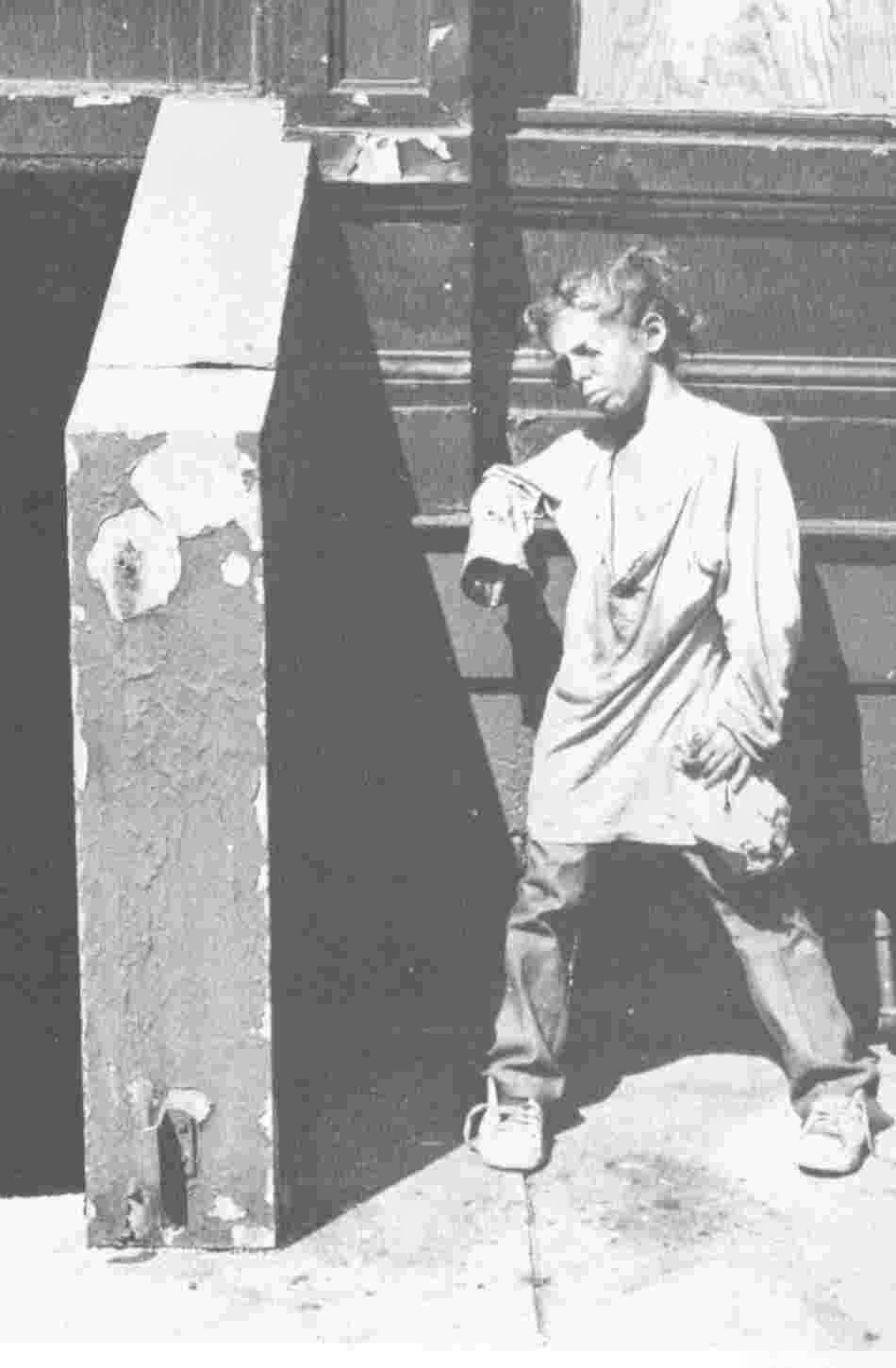
FOR
EXAMPLE
(S.
Arakawa, USA, 1971) (F)
A
feature-length documentary of a boy drunkard,
photographed on New York's Bowery, as a
coldly
detached camera records
his daily life in the streets.
Does
it matter if he is "real" or "only" an actor?
There
exists, says the
filmmaker, a child such as this some-
where
and his life can be documented before he is found.
______________________________________________
This
work by Arakawa, the Japanese conceptual artist responsible
for Why Not, is equally original
and even more subversive. Here
reality
itself -- the truth of the image -- is insidiously called into
question. Feature-length, this is a
coldly objective record of
a
7-year-old child derelict, totally alone, living as a drunkard
on New York's Bowery. The ruthless
yet compassionate camera
explores
his world, often in oppressive "real time", following
his every degradation and defeat
(including his attempts to stop
indifferent
passers-by) until a traumatic, catatonic seizure in a
telephone booth; a searing, terrifying
sequence. But the metaphy-
sical
twist is still to come: the documentary is not a documentary,
the child drunkard "only" an
actor. But, says Arakawa, there exists
a
child such as this somewhere; hence his portrayal in real streets of
such blight that they resemble
cityscapes destroyed by war, is "true":
"This
is a willful switch from the documentary as a 'truthful' account
to a new form, one which employs the
weight of evidence, the pace
of
reality only as an impetus or format for the onset of a cinema of
investigation,an investigation which the
filmmaker has willed
to
exist. As such, it is as much a new reality as a new "story".
___________________________________________________________________________________________
THE SUBVERSION OF ILLUSIONISM
If the
arts subvert by providing "illusionist" representations of
revolt or perfection, there is no reason
why the illusion of art
cannot
itself be subverted. It is here that the structuralist cinema
of our day makes its most disruptive
contribution: it forces the
artwork
to reveal its own superficiality, drawing our attention to
its hitherto jealously concealed,
"fraudulent" character. Vertov's
The
Man With a Movie Camera, with its manipulation of different
levels of reality, may have initiated this
in cinema; the contemporary
structuralist
avant-garde continues it. In their works, we often see
the real photographer and his equipment,
actors "stepping out of role"
to
address the audience, clapboards and mikes, academy leaders, splice
marks and sprocket holes, in direct
violation of the illusion of film space.
___________________________________________________________________________________________
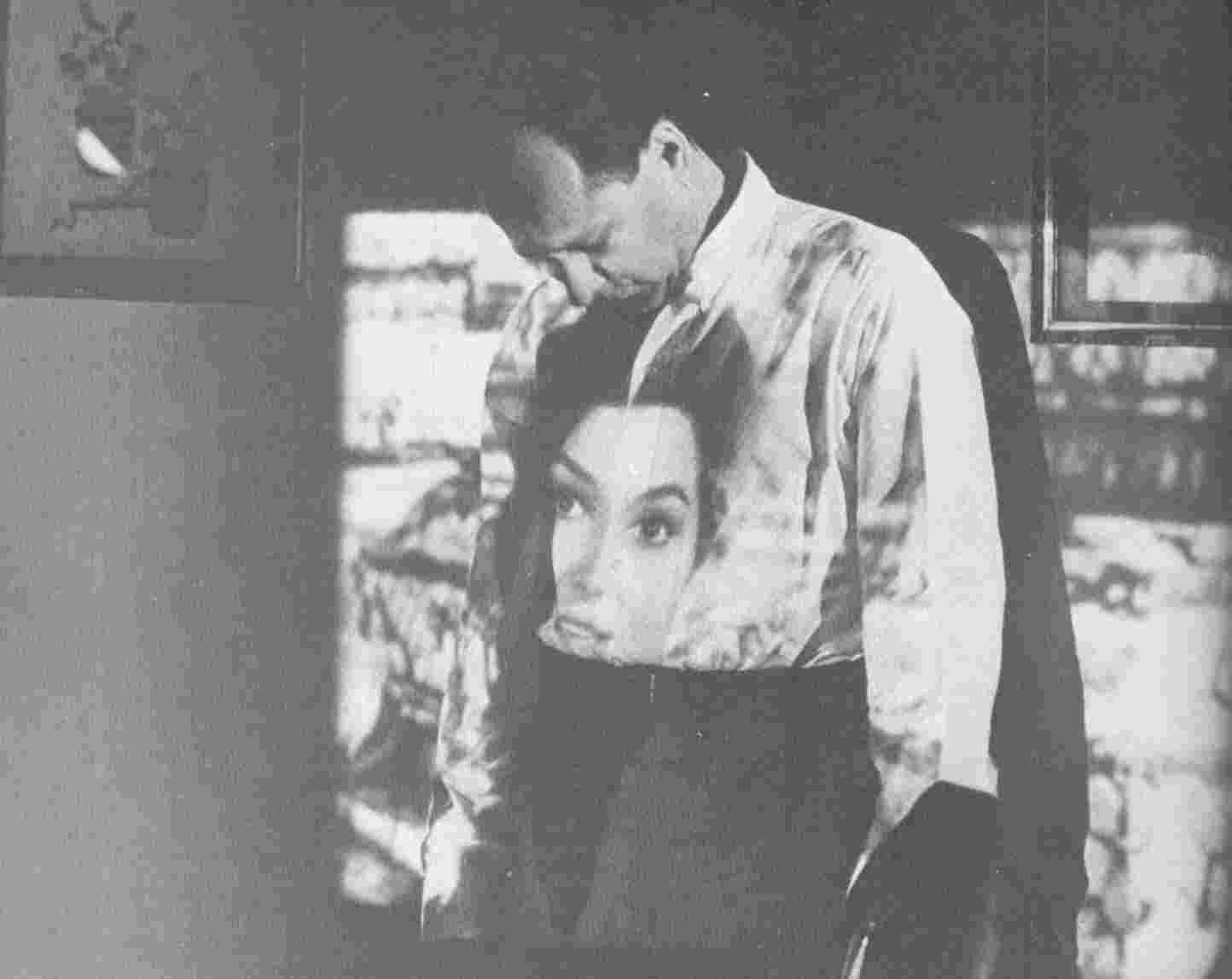
VIRGINITY
(Roberto Rosselini, episode in Rogopag,
Italy, 1962) (F)
The
"reality" of the flat, two-dimensional screen --
secret repository of our deepest dreams
-- is here
revelled in by a
love-struck man who projects
moving
images of his beloved onto his body and
attempts
to caress them; but films come to an end and
there
is pathos in his unrequited, twice removed passion.
___________________________________________________________________________________________
THE ELIMINATION OF THE IMAGE
The
silent cinema -- entirely dependent on images --
created
works of sublime visual intensity: it was
perhaps
inevitable that subversive artists of our
day
should attack the notion of the image itself.
Contributing
to this trend has been the increasing incursion
of
brief (then longer) scenes of darkness or light into experi-
mental films, accompanied by sound or,
more potently, silence:
extreme
pop-art collages that shred reality into fragments:
and
the preoccupation of abstract artists and minimalists with
vision and pure light. The
elimination of the image in the films
of
Kubelka, Sharits, and Conrad has led to the study of light
as the "subject" of art,
paralleling investigations of pigment
and
surface in conceptual painting. But by robbing a visual
art of its visuals, these artists are
revealed as subversives.
___________________________________________________________________________________________
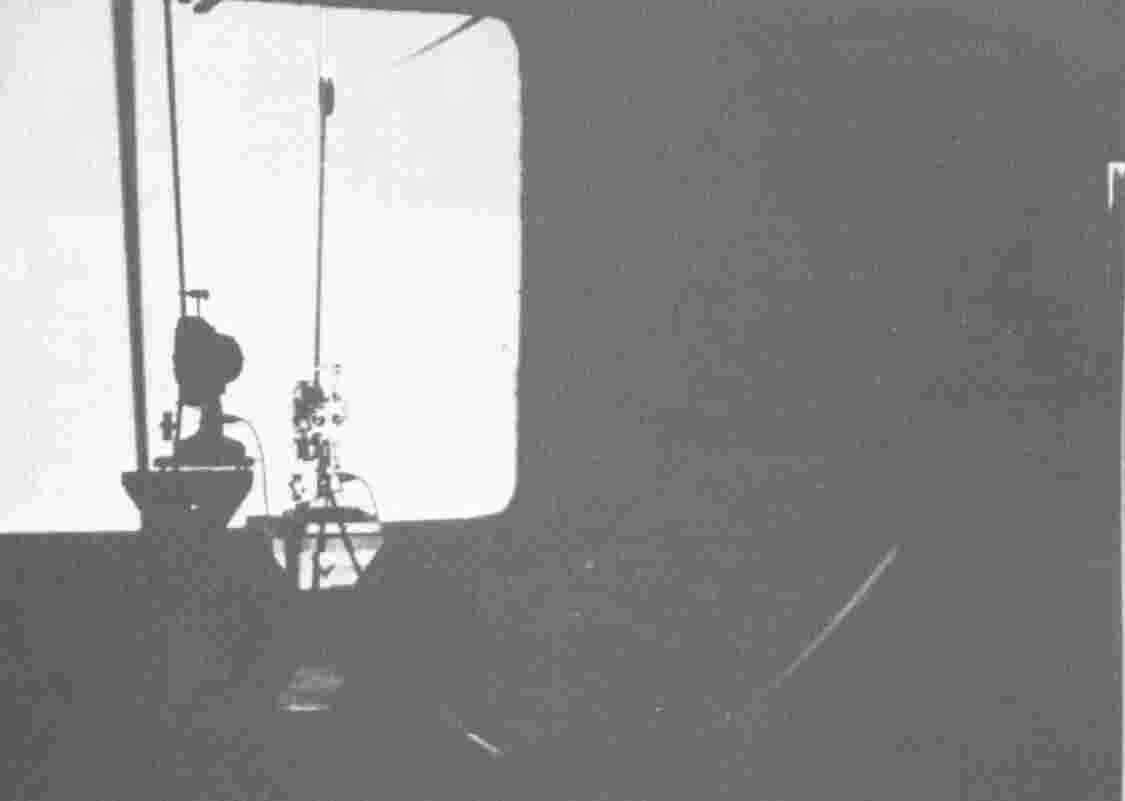
DEAD
MOVIE
(Taka
Iimura, USA, 1968)
Projectors
and blank screen as metaphysical
monsters,
a performance of Iimura's Dead Movie --
face
to face projections of two 16mm projectors;
one
projects a white frame (without film),
the
other projects black leader in an endless loop.
___________________________________________________________________________________________
THE ELIMINATION OF THE SCREEN
The
conventional, two-dimensional screen surface of cinema's
first hundred years is also under attack
by holography,
a sensational
recent development in the visual field.
This
is the production of a 3-dimensional "image" in
space by means of a laser whose light-wave
emissions
(bouncing off the
subject being holographed) are captured
on
a photo-sensitive surface without passing through
lenses
and projected in space. (5) Short holographic films --
viewable without special glasses --
already exist. The future
presages
life-size 3-dimensional holographic motion pic-
tures,
through and around which the viewer will be able to
pass
-- a probably boon to film art as well as pornography.
Youngblood
points to the ability of holography to record
natural
phenomena beyond the range of human perception --
shockwaves, electrical vibrations,
ultra-slow motion events --
thereby
contributing to the experiencing of non-ordinary
realities beyond the range of conventional
cinema. (6)
___________________________________________________________________________________________
MOTHLIGHT
(Stan Brakhage, USA, 1961)
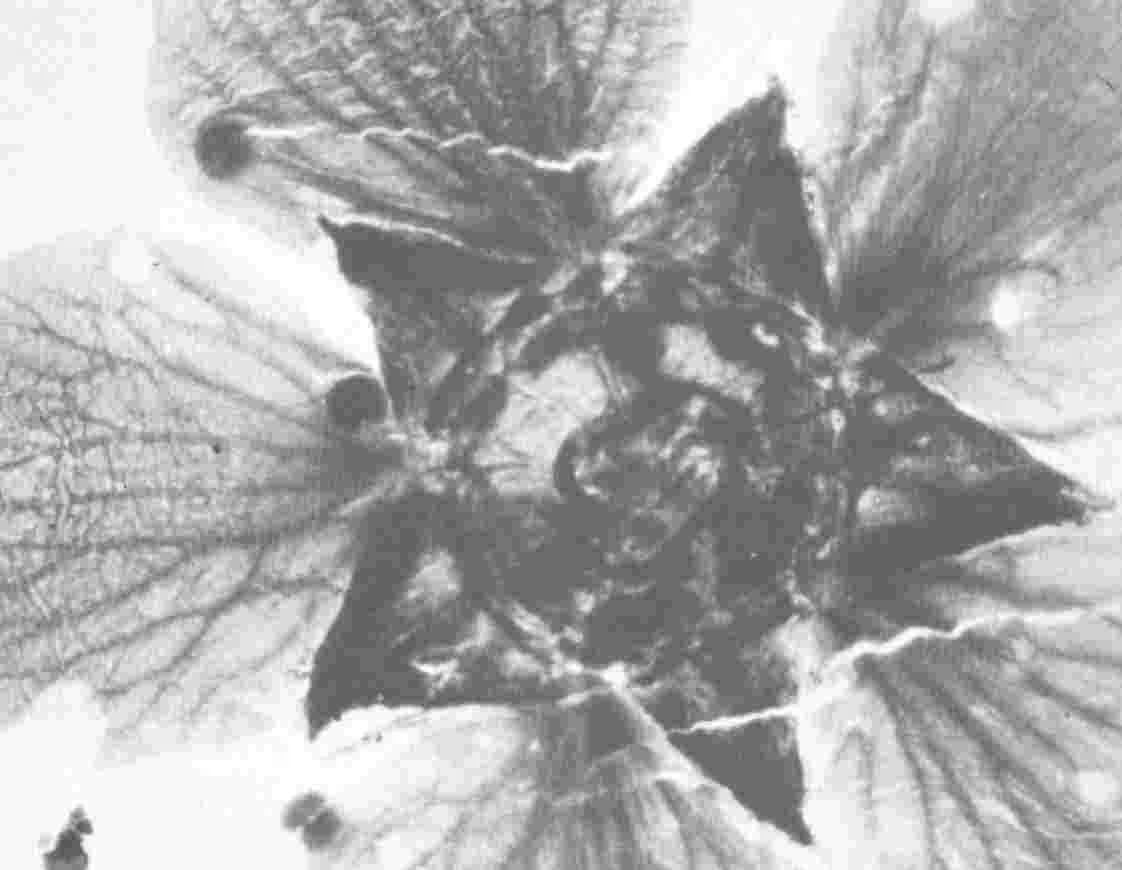
Limbs, wings, and other parts of moths,
laboriously "glued" to the film
strip with
mylar tape, become
a luxuriant, brown-
tinged
abstract animation during projection.
No
camera is use; the film is "built" from life itself.
SC
___________________________________________________________________________________________
THE ELIMINATION OF THE CAMERA
Another
development, primarily associated with Len Lye
and
Norman McLaren, has been the creation of films without
use of a camera. Based on the
painting or scratching of the
film
emulsion by the artist (or, as in Brakhage's Mothlight, the
glueing of extraneous materials to the
film strip), this technique
has
created many beautiful abstract works. In some, even the
sound is created without musical
instruments merely by "scratching"
the
soundtrack portion of the film strip in particular ways.
___________________________________________________________________________________________
OLYMPIAD
(Lillian Schwartz, USA, 1971)
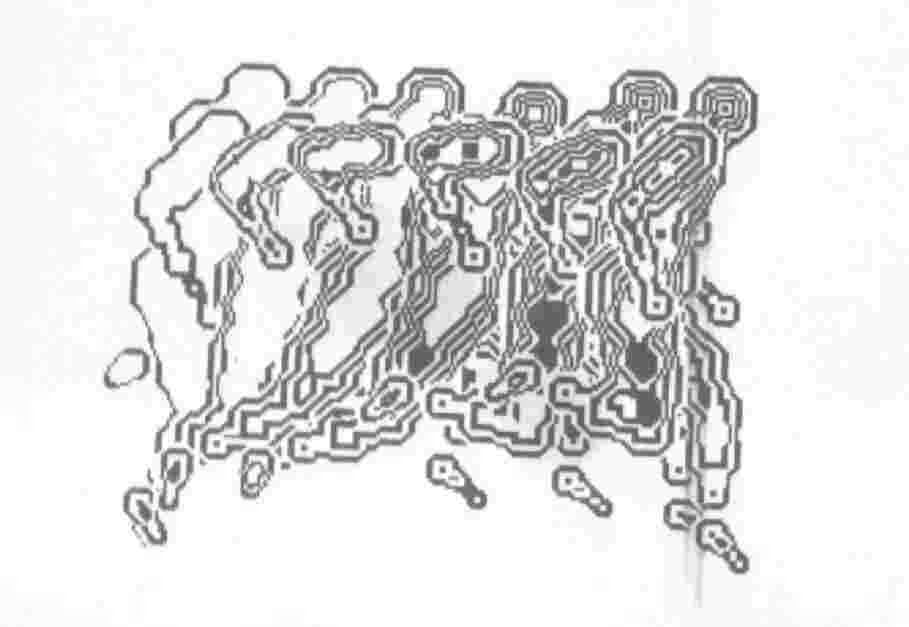
A computer animation: a single
drawing
(instead of the 24
different drawings per second
needed
in conventional animation) is stored in
the
computer's memory and then programmed
into
movement. Every frame and transfor-
mation
is done by the computer. The "result",
though
programmed, is not entirely predictable.
___________________________________________________________________________________________
THE ELIMINATION OF THE ARTIST
The
"unholy" convergence of early Soviet anti-individualism
(taken to extreme lengths by the
contemporary Chinese
campaigns
against "credits" for artistic accomplishments),
Duchamp's disappearance into reclusion,
Warhol's repro-
duction of
"originals" by factory methods, and the rise
of
radical artists' collectives seem to many observers
increasingly to imply the dispensability
of the artist.
The
recent development of computer-generated films
(although
programmed by humans) only serves to reaffirm
this
possibility: for at the very beginning of this curious new
art form, it is already clear that from
initial programs and
memory
banks computers can create (indeed, already have
created)
orchestrated systems of aesthetically pleasing patterns
or realistic representations which arise
before us in combinations
and
complexities beyond our productive or absorptive faculties.
Equally
startling are A.M. Noll's computer-generated films
of
a 4-dimensional hypercube (mathematically projected
down
into 3 dimensions and then projected in superimposition)
which, with slightly different picture for
left and right eye,
create a
powerful 3-dimensional effect without glasses. (7)
REFERENCES
(1)
Michel Seuphor, Abstract Painting, 1964 (2)
Frank Whitford,
Expressionism,
1970 (3) Piet Mondrian, "A New Realism", in
Plastic Art
and
Pure Plastic Art, 1945 (4) Rudolf Arnheim, Toward a
Psychology of Art, 1966 (5)
Gene
Youngblood, Expanded Cinema, 1970 (6)
Youngblood (7) Kenneth Knowlton,
"Computer-animated
Movies", in Cybernetic Serendipity, 1969
FILMS
RAZOR
BLADES
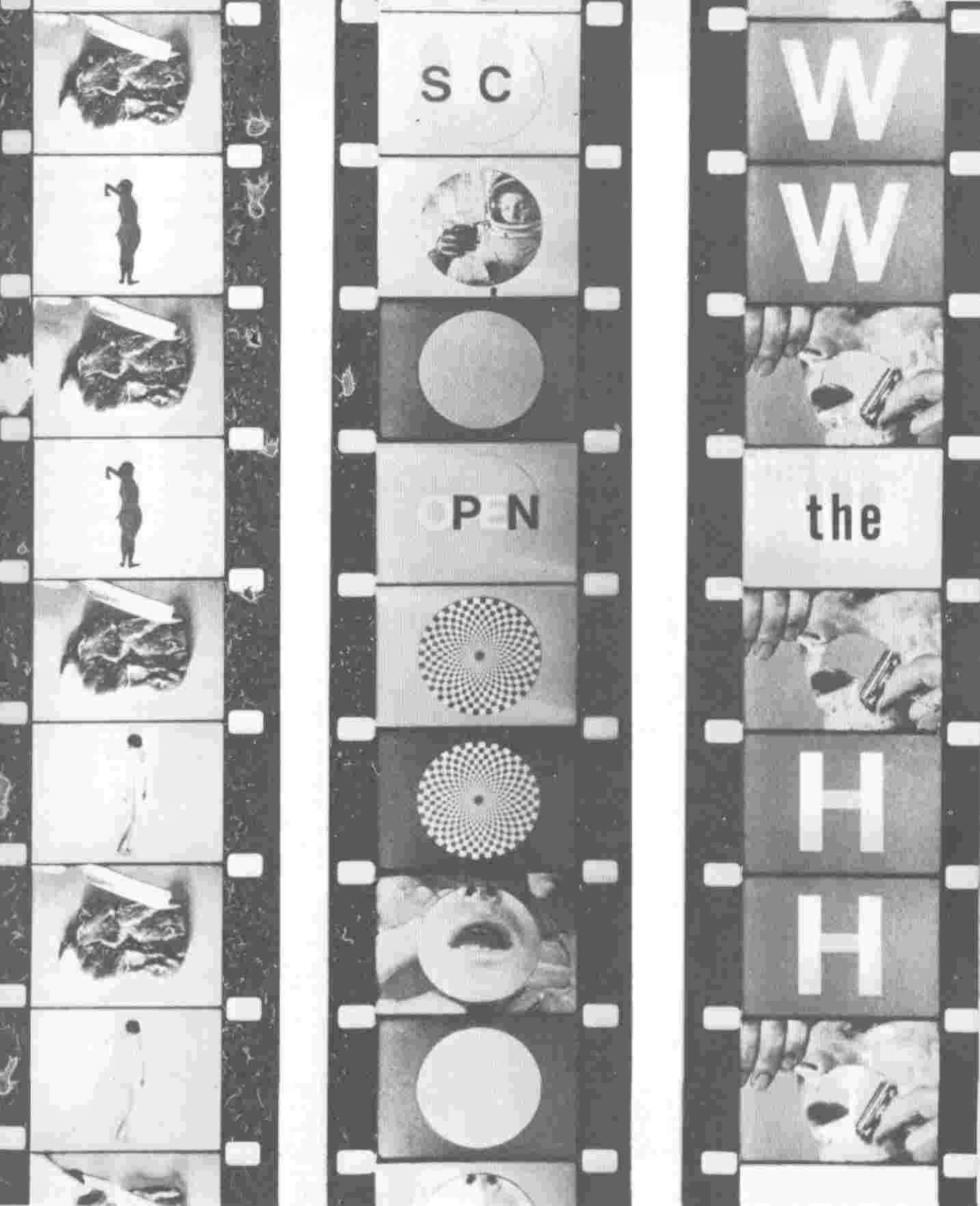
(Paul
Sharits, USA. 1968)
Hypnotic
multi-screen avant-garde film, consisting of
unrelated,
compulsively recurring images, a few frames
in
length, interrupted by irregularly-spaced blank or color
frames or lettering. A powerful
rhythm and stroboscopic
flicker
is created by insistent alterations of image and blank
frames. Each frame shown here is visibile
for only 1/24th of
a second,
inducing subliminal absorption of image clusters.
______________________________________________
This
complex and controversial experiment utilizes two screens and
the simultaneous projection of two
separate films working in tandem.
Each
consists of unrelated, compulsively recurring images, not more
than a few frames in length, interrupted
by carefully-spaced blank or
color
frames. A powerful overall rhythm and stroboscopic flicker is
cre-
ated by the irregular but
insistent alternations of image and blankness.
The
result is a powerful subliminal barrage of strong sensory impressions
probing the audience's physiological and
psychological limits. Related
to
neo-dada and pop, the film is strongly structuralist and reductive in
its avoidance of "meaning" or
"plot", yet offers the satisfaction of pure
response to color, pattern, and --
particularly -- rhythm. The images,
though
intentionally without logic, are frequently "hot" and
endlessly
repetitive: a fetus,
a nude woman (with a razor passing over her), a penis
(flaccid or erect), some ambiguous toilet
activity; equally ritualistic is
the
repeated appearance of single, senseless words printed over some
of the images. An agitated, monotonous
electronic sound accompanies
the
swiftly moving, constantly changing visuals and flicker patterns.
___________________________________________________________________________________________
ARNULF
RAINER
(Peter
Kubelka, Austria, 1957)
This
is the first frame-by-frame
abstraction
that entirely dispenses
with
the image and consists solely of
carefully
orchestrated alternations
of
blank black or white frames.
___________________________________________________________________________________________
BALLET
MECHANIQUE
(Fernand
Leger, France, 1924)
Leger's
only film, an avant-garde classic, fully anticipates
several preoccupations of the
contemporary underground:
use
of representational materials, while their documentary
aspects are destroyed by eliminating
logic or plot; "subliminal"
images
(only a few frames each); compulsive repetition of action
(almost ten times); the beauty of the
fragmentary; and the
abstraction
of objects by close-ups, thus lending them a
new
identity. Representational reality is left far behind.
___________________________________________________________________________________________
BELLS
OF ATLANTIS
(Ian
Hugo, USA, 1953)
A magical
voyage into the subconcious in search of
"the
lost continent" of first human memories. Based
on
Anais Nin's prose poem, the film provides a visual
equivalent in subaqueous, drifting
imagery taken
from reality but
entirely transformed into a
new
and sensuously poetic universe. Excellent
electronic
score by Louis and Bebe Barron.
___________________________________________________________________________________________
LOOPS
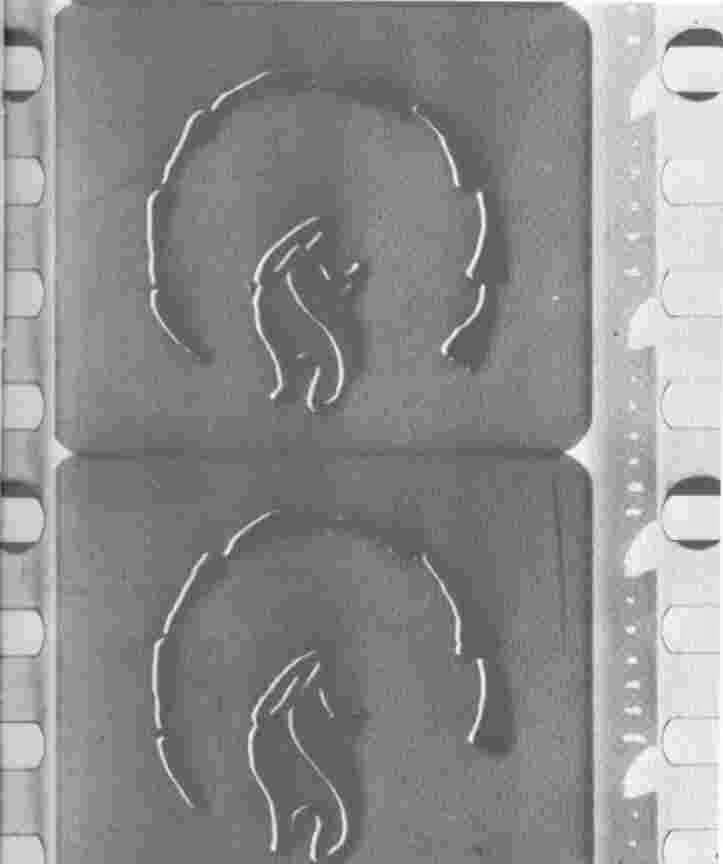
(Norman McLaren, Canada, 1948)
A color, sound film made without camera
or musical instruments. The images
are hand-
painted onto 35mm
film a frame at a time; so is
the
sound (dots running along edge of filmstrip,
size
and thickness of dot determines its itch).
___________________________________________________________________________________________
BEYOND
THE LAW
(Norman
Mailer, USA, 1968) (F)
Mailer's
outrageous film is a sardonic, mysterious drama
of
detectives and suspects, locked in obscene and unequal
combat in a night-lit, not-so-mythical
police station.
Suffused with
implied or explicit violence, it poses a
daring
triple paradox: the brilliant capture of "reality"
through improvised dialogue and
Pennebaker's cinema
verite
photography; its almost instantaneous unmasking
as
a fabrication (Mailer's appearance as an Irish police
lieutenant); its re-emergence as "social"
truth. As an
involved
protagonist, Mailer (similar to his role in "The
Armies of the Night") both
participates in and changes
the
event. The (fictional) police lieutenant's marital
squabbles with (fictional) spouse are
convincingly
portrayed by the
real Mailer and his (then) real wife
in
a further twist of the reality-illusion theme.
The
gamblers, murderers, perverts and innocents
include
Michael McClure, George Plimpton,
Rip
Torn, and Jack Richardson. A further
(and
significant) chapter in the Mailer saga.
___________________________________________________________________________________________
BLAZES
(Robert Breer, USA. 1961)
4000 frames of film, featuring 100 basic
images
in breathtakingly rapid
sequence produce a single
kinetic
impression. As in Vertov's experiments,
two
different images immediately following
each
other on consecutive frames create
superimpositions
that do not exist in reality.
___________________________________________________________________________________________
BLACK
TV
(Aldo
Tambellini, USA, 1969)
Videotape
is used here as a personal and artistic medium:
documentary television images of today's
violence are
distorted into
rapid-fire, black-and-white abstractions,
Robert
Kennedy's assassination, police brutality,
murder,
infanticide, prizefights, and Vietnam
become
blurred insistent symbols of today's horrors.
___________________________________________________________________________________________
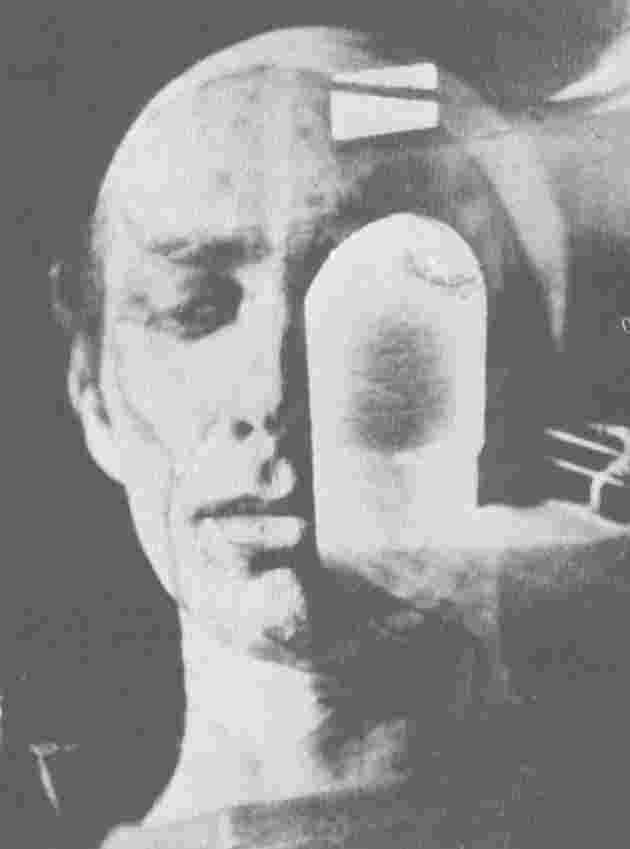
BETWEEN
TWO WORLDS
(Sam
Kaner and Guy Cote, montage sequence
by
Val Telberg, Great Britain, 1955)
The
conventional image is exploded as super-
imposition
achieves a magical look-through effect
which
destroys the one-dimensional flatness of film,
creates
a new universe beyond, and hints at death.
___________________________________________________________________________________________
DAMON
THE MOWER
(George
Dunning, Great Britain, 1971)
An
original work of animation art. Tacked onto a wall
are two sheets of drawing paper, on which
appear, in
rapid, mysterious
permutations, strange hand-drawn
images
-- constantly undulating, exploding, reforming.
A
recurrent motif -- a mower with a scythe -- adds a
somber touch. The images, we are told,
are in synchro-
nization with
an inaudible poem removed from the
soundtrack.
The effect of confining all "reality" in the
film to the sheets of drawing paper is
extremely unsettling.
___________________________________________________________________________________________
FLICKER
(Tony Conrad, USA, 1966)
This
film contains no images at all. It's subject is light
and its absence. It consists of
combinations of alternating
white
and black frames, flashing by in constantly changing
patterns and causing a continuous
stroboscopic flicker effect
of
great complexity. Whether its frequency is momentarily static
or changeable (it ranges from 24 flashes
down to 4 flashes per second
throughout
its 30 minute duration), the effect is literally hypnotic.
This concerted "overload"
of retina and nervous system provokes an
endless
variety of changing shapes, patterns and, most surprisingly,
colors, whose nature differs with each
viewer (even varying from
performance
to performance). The electronic soundtrack was
generated by relays and components
carrying different types of infor-
mation;
the various frequencies are orchestrated by the director.
This "pure" film
deals with perception itself; its hallucinatory
effect
-- despite absence of image, content,wor meaning --
reveals an unsuspected congruity with
deep emotional needs. SC
___________________________________________________________________________________________
H
2 0
(Ralph
Steiner, USA, 1929)
Though
entirely based on elements of reality -- the
rhythms
and patterns of light and shadow on water --
this
classic study by the well-known documentary
filmmaker
and still photographer approaches
pure
abstraction, as the camera becomes
increasingly
absorbed with textures and design.
___________________________________________________________________________________________
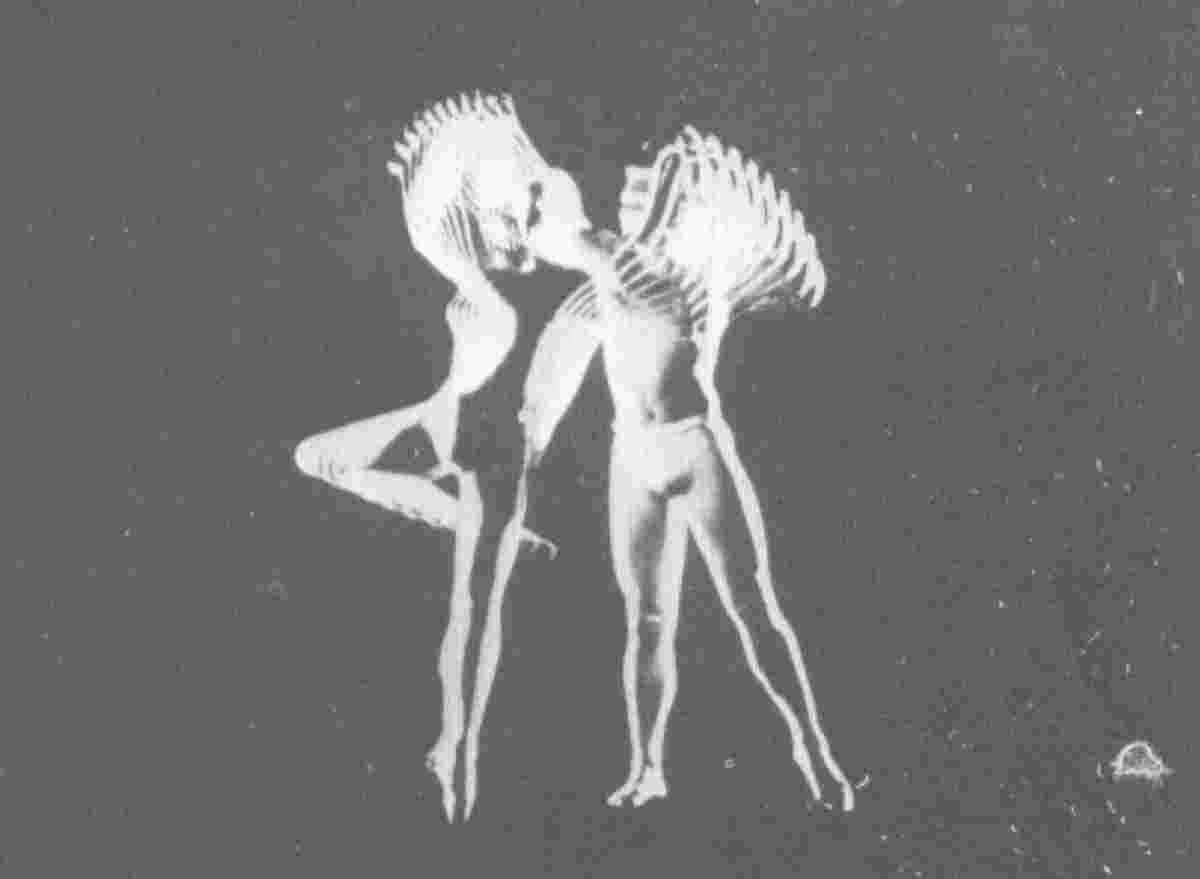
PAS
DE DEUX
(Norman
McLaren, Canada, 1968)
By
printing the negative in multiple images,
each
frame reproduced up to eleven times,
McLaren
captures movement past and yet to
come
in a rhapsodic flow of ineffable grace.
The
simultaneous reproduction of consecu-
tive
movement fulfills an age-old dream.
The
dancers, in white and lit from behind,
move
in slow-motion on a totally black stage.
___________________________________________________________________________________________
INNOCENCE
UNPROTECTED
(NEVINOST
BEZ ZASTITE)
(Dusan
Makavejev, Yugoslavia, 1968) (F)
The
director of WR-Mysteries of the Organism in this earlier
film created a provocative and original
collage which combined,
with
subtle irony, the first Serbian sound film ever made ("an
outrageously naive melodrama of lecherous
lust vs. true love" -
Sunday
Times) with Nazi newsreels and 1968 interviews of
participants in the original production.
The original 1942 Serbian
film
was directed by its star, Dragoljub Aleksic, famed real-life
acrobat whose stunts -- seen in the film
-- included changing
from
flying planes by his teeth, transporting Belgrade ladies from
rooftop to rooftop by high wire, and
bodily stopping motorcars
driven
at top speed. It deals with his hair-raising adventures
in
saving an orphan
heroine from the clutches of shameless and
repulsive
characters after breathtaking feats of daring. A sly and
loving film, it forces us to take this
persistent man and his bizarre
values
almost as seriously as he does, thus making us more humble
about our own. It successfully
destroys conventional concepts
of
time and reality in its mingling of two films -- from different
periods -- one fictional, the other
non-fictional -- with the
actors
of the former constantly breaking its illusion by
appearing in the latter in real-life
portraits 20 years later.
___________________________________________________________________________________________
INSTITUTIONAL
QUALITY
(George
Landow, USA, 1969)
An empty,
ordinary room in an apartment. There is furniture,
a lamp, a television set. No image
is visible on it, except the
changing
variations of light on its screen, indicating that
the
set is on. At the narrator's request, a large hand -- live --
enters the frame with a pencil and
numbers portions of what
is
now suddenly revealed not to have been a real room at
all, but a projected "image" of
a room, a film within a film.
The
sudden superimposition of a live hand over what we had
accepted as reality is one of the more
unsettling moments of
contemporary
minimal cinema. Later we see a young woman
threading
a projector, as instructed by the same invisible narrator;
suddenly a subtitle informs us (in terms
familiar on television)
that
this is a "re-enactment". Since the scene is by
definition a
fictional
portrayal of a situation and cannot be considered a "re-
enactment" (of what?) this
constitutes a subtle toying with levels
of
reality and an attack, as is the rest of the film, on screen
illusion.
___________________________________________________________________________________________
THE
MAN WHO LEFT HIS WILL ON FILM
(TOKYO
SENSO SENGO HIWA)
(Nagisa
Oshima, Japan, 1970) (F)
Aesthetic
and political rebel, Oshima is one of the most original
directors now working in Japan.
This is a metaphysical tale of a
radical
student filmmaker who succumbs to the illusion that he has
committed suicide and left a film as his
testament. Attempting to
"decipher"
this film and the "dead man's" life, he rapes his own
girl (who plays along with the illusion
to cure him) and retraces
the
"other man's" life by means of the film, only to find
himself in
his own
birthplace. The film testament proves incomprehensible.
He therefore refilms it, intending to
create a work superior to that
of
his illusory rival; but his girl, to save him, willfully interrupts
and
changes each scene.
He finally realizes that he must kill the dead
man
-- himself -- in order to be free. Several key episodes,
including
sex scenes, are
recreated by the protagonists in front of a screen
showing the film testament so that they
are projected onto their bodies.
Throughout,
the style is meticulously realistic, meticulously metaphysical.
___________________________________________________________________________________________
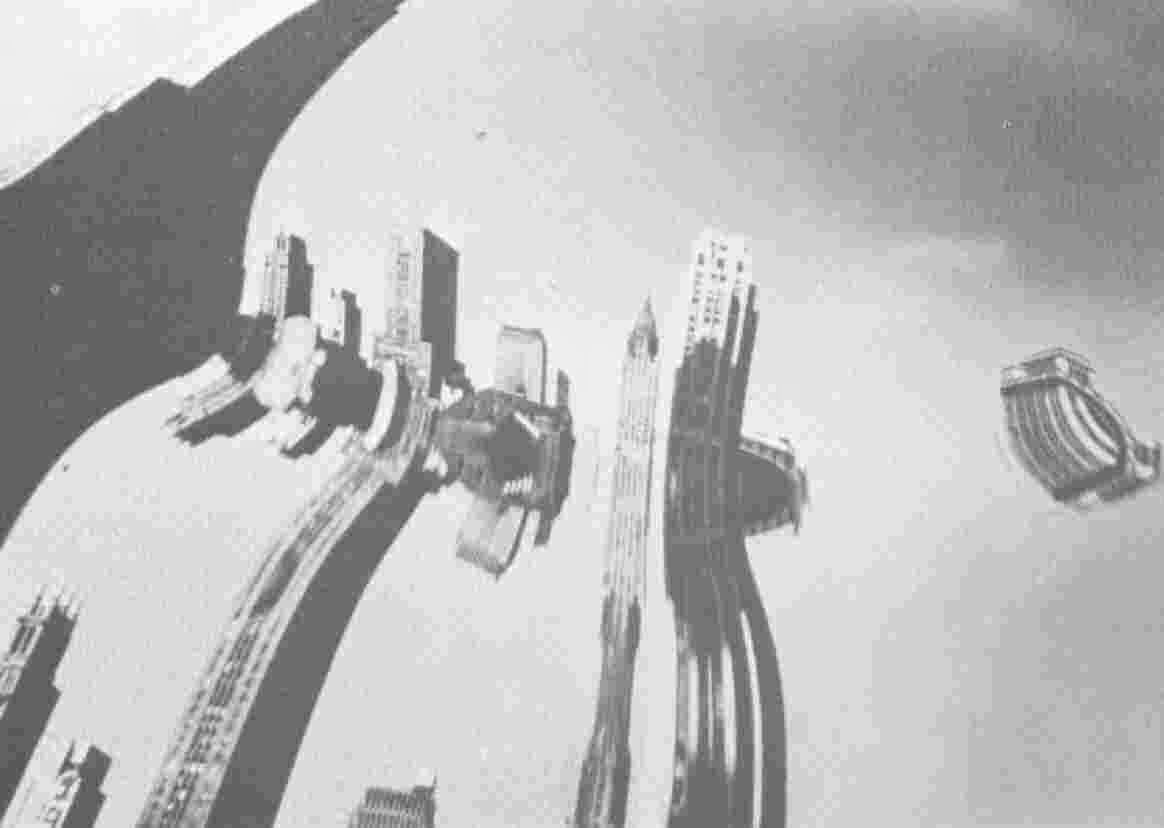
N.Y.,
N.Y.
(Francis
Thompson, USA, 1958)
Distortion
lenses, spheric and parabolic mirrors, and
prisms
create a semi-abstract, atomized, and sub-
jective
version of the city, in which buildings float in
space
and man has become an alienated, distorted
mass-being.
The effect is startling and disturbing.
______________________________________________
"An
admirable example of what may be called the
Distorted
Documentary -- a new form of visionary art.
In
this very strange and beautiful picture we see the city
of New York as it appears when
photographed through
multiple
prisms, or reflected in the backs of spoons,
polished
hub caps, spherical and parabolic mirrors.
We
still recognize houses, people, shop fronts, taxicabs,
but recognize them as elements in one of
those living
geometries which
are so characteristic of the visionary
experience.
I was amazed to see that virtually ever
pictorial
device invented by the old masters of
non-representational art makes its
appearance,
alive, glowing,
intensely significant." --
Aldous
Huxley, "Heaven and Hell"
___________________________________________________________________________________________
PERMUTATIONS
(John Whitney, USA, 1968)
A
brilliant computer-generated study by one of
America's
foremost pioneers of abstract cinema.
"It
is now known and amply demonstrated that computer-
graphic systems are useful in the
creation of a considerable
diversity
of abstract graphic forms. It can be shown that the
precision and detail of the graphics and
the power of the com-
puter to
repeated thousands of images, each one with the most
subtle incremental variation, makes for
an instrument with
superb
motion-generating capability. This power of the computer
to produce endless variations upon
patterns, which stems from the
basically
mathematical foundation by which all images are formed,
means that we have at hand an instrument
for graphics that is
analogous
to the variational power of all musical instruments and
the mathematical foundation of all
musical form." - John Whitney
___________________________________________________________________________________________
PERSONA
(Ingmar Bergman, Sweden, 1965-66)
(F)
"As the title tells
us this film is about reality and illusion --
the
persona of a person indicating the latter, the root of the
word being old Latin for mask.
Parallel to the story (perhaps
horizontal
to it would be a better description), Bergman also
shows
us that film itself (when it refers to itself as this one does)
is also about reality and illusion.
The illusion is the filmed story,
the
two women, their relationship, the husband of one of them, etc.
The reality (or a reality at
any rate) is the fact that it is a film we
are
watching. This is proved to us by the inclusion of film leader,
shots of a film lab, a shot of the
making-of-the-film itself, scenes
of
the film we are seeing running through a projector, and sections
where the film is apparently ripped,
where a frame apparently catches
fire
and burns. At the very end of the film (a scene which "proves"
it has been a film we are watching), we
see the arc-lamp of the
projector
going out -- a parallel to the first (and last) word that
the personified heroine speaks:
'Nothing'. " - Donald Ritchie SC
___________________________________________________________________________________________
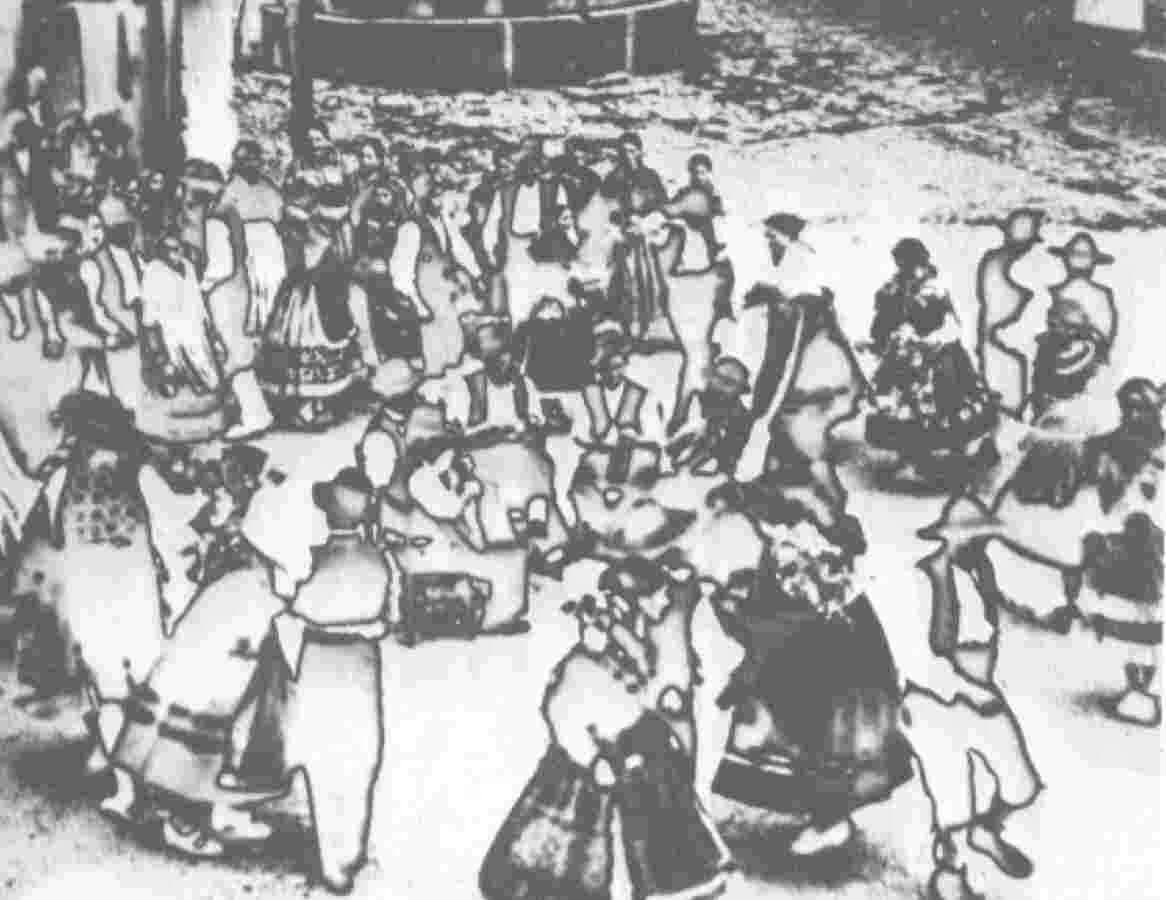
FANTASTIC
VISION
(Eugene
Deslaw, Spain/Switzerland, year unknown)
The
first solarized film ever made. The elimination
of
realistic detail and sharp outlines while preser-
ving
legibility creates a strongly poetic image.
The
contemporary avant-garde has returned to
this
device in a technologically more sophis-
ticated
manner with breathtaking results.
___________________________________________________________________________________________
THE
SECRET CINEMA
(Paul
Bartel, USA, 1966)
Through a
series of hilarious yet increasingly disturbing
incidents, a young girl becomes convinced
she suffers
from a paranoid
delusion that her life is being secretly
filmed
and projected in separate chapters at a local movie
house. In an extremely clever play
on illusion and reality,
she
-- and we -- discover that she is right. Beneath the
flippant facade an uncomfortable black
comedy unfolds,
as the
filmmaker deftly manipulates our subconcious;
for
the plight of the hapless heroine, confused, paranoid,
surrounded by people who seldom are what
they seem
to be, corresponds
to our own deepest fears. SC
___________________________________________________________________________________________
UFO'S
(Lillian Schwartz and Ken Knowlton, USA,
1972)
This film further
indicates that computer animation --
once
a gimmick -- is fast becoming a fully-fledged art;
the
complexity of its design and movement, its speed
and
rhythm, richness of form and motion -- coupled
with
stroboscopic effects to affect brain waves --
is
quite overpowering. What is even more ominous
is
that while design and action are programmed,
the
"result", in any particular sequence, is neither
entirely predictable nor under complete
human
control, being created
at a rate faster (and in conca-
tenations
more complex) than eye and mind can follow
or
initiate. Our sense of reality is thus disturbed not only
by the filmmaker by also by the machines
we have produced.
___________________________________________________________________________________________
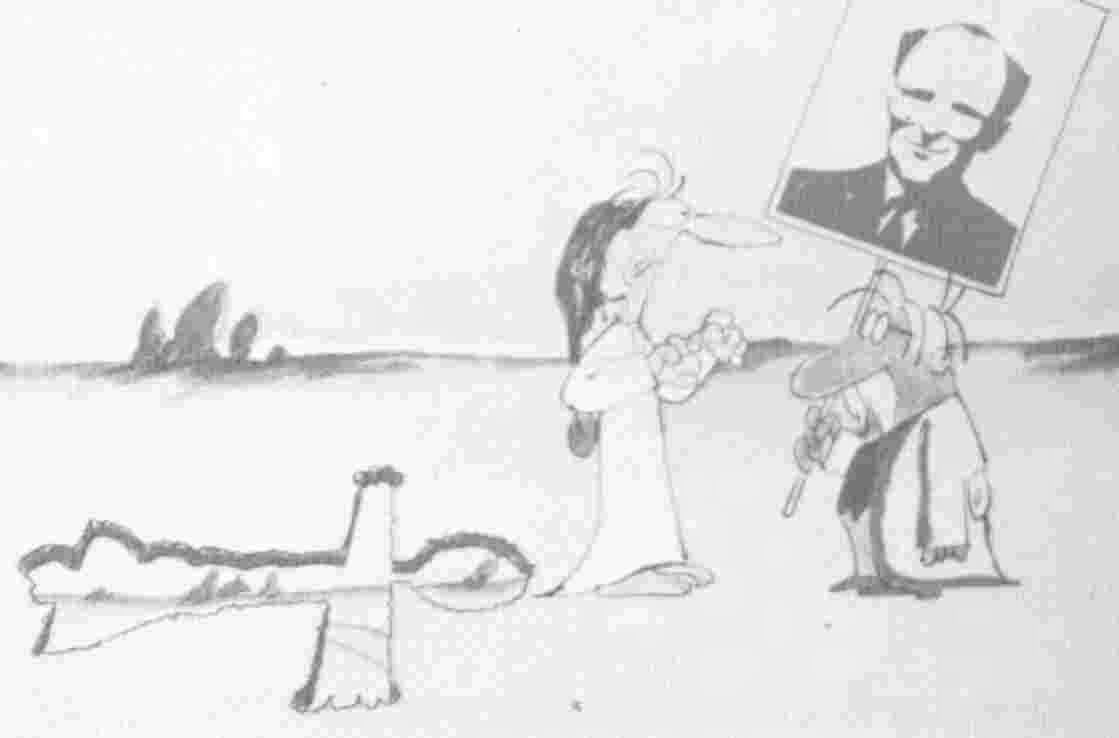
TUP-TUP
(Nedejlko Dragic, Yugoslavia, 1972)
An astonishing incursion of modern art
into the
animated film: one of
the characters "breaks"
through
to another reality, thereby subverting
the
illusionism of the image and calling into
question
what must never be doubted: the absolute
"truth"
of the image as the only existing reality.