FILM
- AS A -
SUBVERSIVE ART
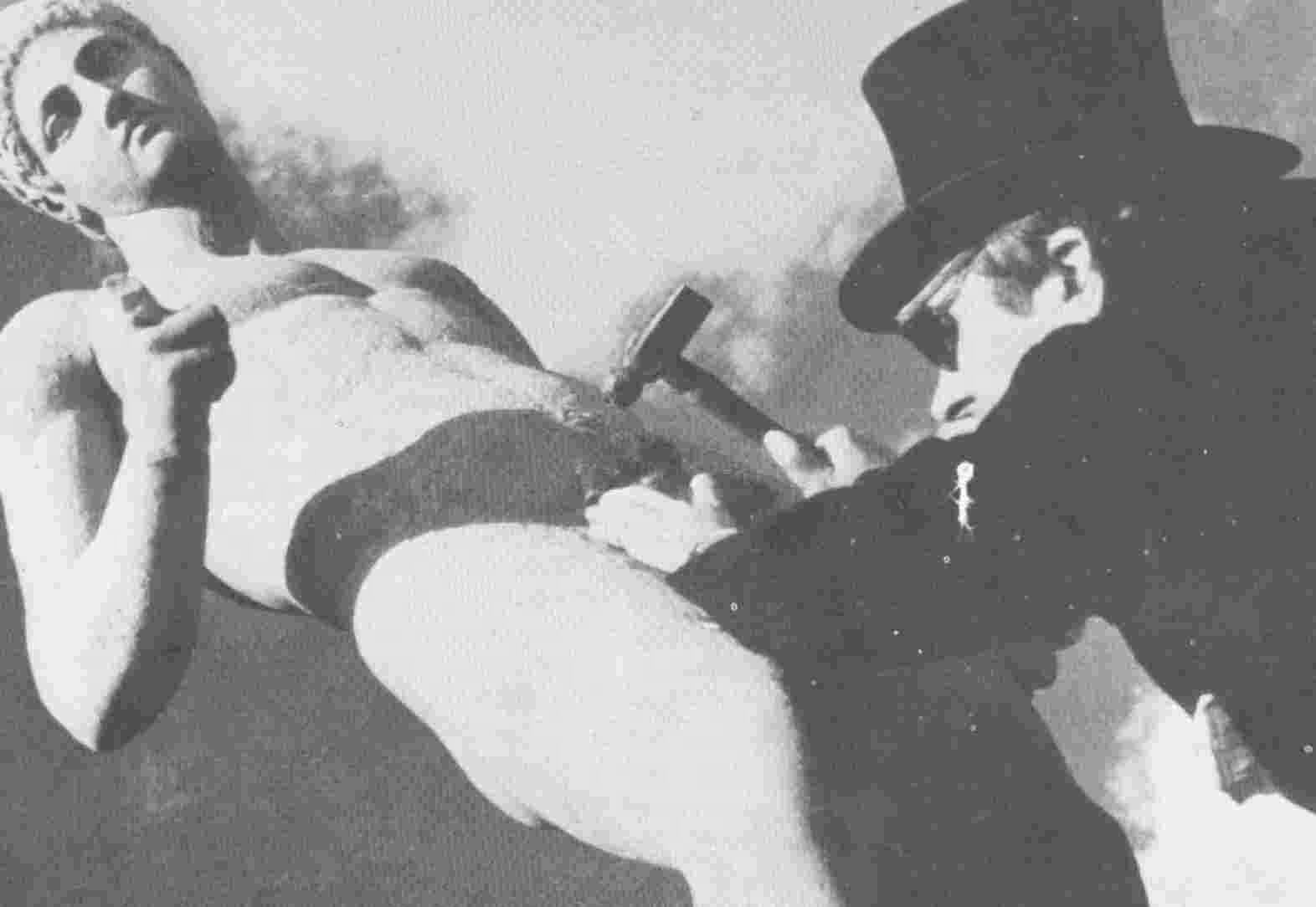
THE
PLEASURE GARDEN
(James
Broughton, Great Britain, 1953)
The
censor at work, forever attempting to fix the unfixable.
His task is unenviable, messy,
bottomless, and secretly
exciting.
Broughton's comic, yet ideological fantasy
celebrates
the victory of sensual pleasure and love over
prudery
and authoritarianism; but the clumsy "hammer"
(here even held wrongly) is nowadays
being wielded
more insidiously
by ever more repressive forces in
society
and the outcome is not necessarily pre-ordained.
THE
SUBVERSION
OF
SUBVERSION
It is in
the nature of subversion that its perpetrators should be
subverted in turn. For, in the wider
sense, any subversion is but
a
reflection of a material conflict within society, in which opposing
sides use both offensive and defensive
devices to protect themselves.
The
subversive artist, moreover, is always on the outside. If the
defi-
nition of subversion is
the attempt to undermine existing institutions or
value
systems, the operative word is "existing"; the subversive
attacks
something "in
control" and wishes to replace it by what does not yet exist
and has as yet no power. With the
growth of the technological state,
society's
methods for protecting itself against disruption and "anarchy"
have become increasingly effective.
The means of production, communi-
cation,
and distribution are firmly in the state's hands and without them,
the opposition cannot reach the masses
with its subversive message.
This
is a particularly serious problem for film, a technological art
requiring costly, complex tools and
special facilities for exhibition.
The
large number of films in this book may easily lead one to the
conclusion
that the subversive
film is well and thriving. Nothing could be further from the
truth. The majority of these films
will be seen by only small numbers of people;
their
effectiveness is thus extremely limited. Within the system
under attack,
the extent of
distribution of a subversive film stands in inverse relation to the
extent of its subversion. The
anti-American Hour of the Blast Furnaces -- though
a masterpiece of political cinema, or
rather because of this -- will not be given
wide
national distribution in America. The exhibition of an
anti-Vietnam war film
to
peace groups may evoke applause or tears among these already
converted
groups, but how is
one to reach the others? In America, a few political
distributors
(such as Newsreel,
American Documentary Films, and Tricontinental FilmCenter)
have come into existence and attempt to
reach larger and unaffiliated audiences,
but
their resources are limited and neither governmental art bodies nor
private
foundations (themselves
part of the power structure) subsidize their activities.
It is precisely because the American
Establishment knows that these groups are
of
no real danger to it that allows their existence; in so far as they
might become
more dangerous,
they are "contained" by "democratic" devices too
numerous
to mention in detail
such as tax harrassment, fire laws, and legal interference.
Significantly,
the United States, though moving in the direction of a more
authoritarian state, still has the most
developed national network for the
non-theatrical
exhibition of films, including practically all those discussed
here, at film societies, universities,
public libraries, churches, and civic or
political
organizations, operating with 16mm equipment of often surprisingly
professional quality. Prints can
also be bought or leased; this enables public
libraries
and colleges to own their own collections. More than a thousand
lend
films free, as they do
books, upon presentation of a library card; those in larger
cities often own some of the "subversive"
titles, to the discomfort of local conser-
vatives.
Political censorship is legally non-existent, though sometimes
attempted
against particularly
radical films. Previously, such action was more readily
taken against sex films, and despite the
changed attitude of the last few years,
it
is safe to assume, however, that Muehl's Sodoma could not be
shown in much of
America, and
that the overall situation will considerably worsen as a result of
the
pro-censorship 1973 Nixon
Supreme Court decision. In any case, although the non-
theatrical distribution and exhibition
network propably reaches a potential audi-
ence
of several millions, this still represents only a fraction of the
total American
audience.
Nevertheless, given its composition -- students and organized groups
--
the political and cultural
influence of this audience exceeds its actual size.
The
American situation is not reproduced elsewhere, though Western
Europe,
Scandinavia and Canada
possess growing non-theatrical markets. In the Eastern
countries, no individually initiated
showings or programming can take place and
the
importation of films is strictly limited and centralized at the top.
A few foreign
political films
will be bought each year, provided they subvert the West rather than
the East. It is therefore clear that
the majority of the films in this book are not
readily
availablefor exhibition in most countries (except for the commercial
films
mentioned, from Fellini
to Kubrick to sex films, where they are permitted.)
As for
the international circulation of subversive films, commercial
distributors do not generally buy such
films of other nations and non-
commercial
distribtors cannot afford to do so. Many governments control
the export of films, thereby preventing
international circulation of unpleas-
ant
works. The majority of subversive films are in 16mm which
cannot
properly (or at all) be
shown in many countries. However, several national
television networks now buy independent
"subversive" films of other
nations;
in this way, certain important American underground and political
films have been more widely seen in West
Germany than in the USA.
The
extent to which art affects society needs to be further investi-
gated. The surrealists did not, as
had been their intention, succeed
in
transforming capitalism. It was only when they began to
intervene
as citizens
(politically) and not merely as artists (aesthetically) that
some were able to help bring change.
Bunuel bitterly complained
that
Un Chien Andalou had been misunderstood as a dream instead
of a murderous attack.
Eisenstein's films were not popular with the
Russian
masses. By definition, subversive filsm of quality do best
at congregations of the faithful or at
international film festivals,
as
the assembled filmmakers and critics are largely disaffiliated
oppositionists themselves (in spirit, not
always in body).
The new
sexual revolution has not yet transformed relations between
the sexes and is, in fact, at times
attacked by the new feminists as
male-oriented.
Hardcore sex has created new millionaires and
driven
art films from many cinemas (though permitted lonely men
to improve their masturbational fantasies
and couples their sexual
performance)
but it has not yet changed a sexually repressive
civilization. The rapid
liberalization of sexual mores in an other-
wise
not noticeably freer society may indeed be partially suspect;
much evidence points to an increase in
mechanical sexuality
at the
expense of eroticism, growing commercialization of sex
in
the guise of sexual freedom, and the availability of instant,
guiltless sex to help ensure the smooth
functioning of society.
Significantly,
American films have simultaneously grown
increasingly
apolitical and less concerned with moral issues.
There
is, in fact, every reason to agree with Marcuse's pessimistic
confirmations of present-day capitalism's
ability to absorb, pervert
and
subsume opposition; and to transform the oppositional product
itself (be it politics or sex) into a
commodity. If it is not too radical,
it
can even be publicized, thereby robbing it of its cult appeal
while simultaneously neutralizing it
ideologically by apparent
acceptance.
In this sense, the latitude granted to independent
showcase to exhiibit whatever they wish,
implies that they
serve as a
safety valve for the draining off of radical impulses.
The
production of subversive films remains as uncertain and precarious
as ever. In the East, the Russians
have proved how, once opposition
reaches
a certain degree of danger as in Czechoslavakia, it is possible
to snuff out, literally overnight, an
entire film movement of international
importance;
these directors now do manual work, or are employed in areas
not connected with the cinema, or drink
themselves to death (this exactly
describes
the situation of the most talented and promising filmmakers of
China in the courseof the Cultural
Revolution). Other oppositional directors
of
the East (Polanski, Skolimowski et al) have gone to the West,
meeting
defeat or integration
into the commercial industry. (Borowczyk, Lenica,
and Kristl are exceptions, partly because
their work is not sufficiently
enticing
to commercial interests.) In the West, significant numbers of
new
independents constantly
arise, make a few films, meet with limited or no
distribution, and then graduate into
the industry or disappear. The
larger
figures have their own problems; Bertolucci seems to be on the
way towards becoming the bourgeoisie's
darling, Godard stubbornly
flounders
in isolation and ineffectuality, and the Czechs Forman, Kadar
and Passer, Glauber Rocha, and others are
men without a country.
After I
Am Curious Yellow, Last Tango in Paris, A Clockwork Orange,
or Straw Dogs, it is becoming
increasingly difficult to shock the
bourgeoisie,
who now accept all insults with a benign smile,
secure
in the knowledge that their pockets are not being
picked
simultaneously. When danger of this does arise, the
smile disappears and power reasserts
itself, for instance, by
wiping
out the leading cadre of the Black Panther party in
intricate ways, driving underground the
radical left, or encou-
raging
it by means of agent provocateurs to blow itself up.
Somewhere between the smile and its
absence, a brief attempt
is
made (not always unsuccessful) to buy off the oppositionist
by four-color covers in national magazines
or by extensive TV
exposure at
peak hours (by which, between six commercials,
he
believes himself to be advancing the cause of revolution).
Nor
should we forget those discredited minions of law and order, the
censors, another cog in the generalized
web of gentle suppression.
Since
it is their duty to conserve and that of the artist to "go
beyond",
they are forever
at odds with him and, more importantly, forever
lagging
behind him. They are always shocked anew by yet further
descents into unspeakable immorality and
political unorthodoxy,
disregarding
the historical fact that yesterday's outrage is
today's
truth (or cliche) and that the elimination of taboos
is
the order of the day in all fields of human endeavor.
As for
the censoring of the presumably subversive, it is universal
and seems to operate equally perniciously
under all systems.
There are
Russian films by young filmmakers that no one
outside
(or even inside) Russia has ever seen; the Russians
tried
for years to prevent Andrei Roublev from being shown
abroad. Americans may not see films
from Cuba; Eastern
Europeans
are prevented from viewing Western political films,
unless critical of the West; Arabs may not
see Israeli films
and Israelis,
until a few years ago, could not see German ones;
France
did not permit The Battle of Algiers to be shown and
then prohibited the left-wing 1968
"cine-tracts". American
experimental
films sent to festivals abroad have been confisca-
ted
upon return, as the repressive American customs law has
no objection to their export but will not
allow their re-entry
(presumably
with the piquant theory that it is legitimate
for
Americans to corrupt foreigners but not themselves).
Swedes can see sex films, but not films of
violence. Americans,
until
1974, could view pornographic films in regular theatres
provided they were American-made; European
pornographic
films -- or even
films featuring only frontal nudity -- cannot
be
imported. Brazil banned Prato Palomares, France banned
Do Not Deliver Us From Evil,
Yugoslavia banned WR - Mysteries
of
the Organism, the Czech pre-Dubcek government attempted,
in vain, to "recall" Jan
Palach (film record of the young Czech
martyr's
funeral) from abroad. Every country has its own
favorite subversive, without whose
suppression it presumably
could
not continue to exist. Further, apart from direct political
suppression of films, there exists an even
more efficient system
of
"censorship" prior to production; this consists of the mere
with-
holding of private
financing in the West, or of state financing in the East.
It is
therefore important not to confuse the quality of particular
subversive
films with their
effectiveness. Many of the most important films in this
book -- The Blood of the Beasts, Hour
of the Blast Furnaces, Fata Morgana,
Kirsa
Nicholina, Red Squad, Andrei Roublev, Our Lady of the Turks, La
Revelateur, Viva La Muerte -- even
more widely seen works such as WR -
Mysteries
of the Organism or Weekend -- have had only very limited
distribution.
Subversive
cinema, in precise delineation of its precarious, largely powerless
role vis-a-vis the state, is left
with a host of unanswered questions, ranging
from
the paradoxical to the unpleasant. It appears that the less
subversive
a film, the wider
its potential audience; and the more conventional in form,
the more people it might hope to attract,
but the fewer will be affected.
It
appears that it is possible for Kubrick to tone down A Clockwork
Orange
after its release to
obtain a (literally) more profitable "rating", and that
the sodomy scene can be cut from Last
Tango in Paris to allow the film's
presentation
in England; if such climactic scenes are not considered
important enough to keep in, why were they
put into the films to begin
with?
It also appears that Bunuel's Discreet Charm of the Bourgeoisie
is distributed by Twentieth Century Fox;
is the company unaware of
its
seditious implications or are these too weak to matter? The makers
of Red Square were molested
by police and FBI during and after its
production;
but they are "at liberty" (their names securely listed in
some master file) and continue as
before -- as does the Red Squad.
Certain
oppositional films from the East were "allowed" pro
forma one-
week runs in one
or a few theatres in the countries involved, permitting
them to announce their democratic
liberalism while keeping the fabric of
suppression
firmly intact. The directors of the subversive cinema are often
serious theoreticians and fire fellow
intellectuals and critics with their fervor.
BUT
THE REAL QUESTION REMAINS: HOW TO REACH THE MASSES "OUT
THERE" WITH FIVE HEAVY CANS OF 35mm
FILM AND NOWHERE TO SHOW
THEM?
This is the meaning of the tragic quest of Godard, the reason why
respect must be paid to the man even if
one lacks confidence in his direction.
In the
last analysis, however, subversive cinema has on its side two factors
of such fundamental significance that they
justify both its role and the
writing
of this book; the inevitable creation of new injustices and horror
by the existing power systems (cumulative,
in the age of technology
and
atomic power) and the concomitant rise of ever new cadres of
rebels in every generation -- another way
of saying that subversive
cinema
could not exist without its enemies. Any pessimism regarding
the failure of one talent or the co-option
of another is outweighed by
the
spectacular flow of new generational talent and fresh, hot anger.
With confidence in the inevitable crimes
of one side and the inevitable
reaction
of the other, one can therefore look forward to future contests,
their outcome by no means predetermined,
since problems that seem
insurmountable
today will yield to the more complex intelligence
of
children still playing ball in the parks of the world.

2001:
A SPACE ODYSSEY
(Stanley Kubrick, Great Britain, 1968)
(F)
Cult film of the young,
this is a manifesto of the new sen-
sibility;
a nostalgic elegy to innocence lost to technology,
a
vision of truths beyond understanding. It ends with
unforgettable images of the new star
child in space, facing
the
earth he must transform to make it human again. SC