FILM
- AS A -
SUBVERSIVE ART
MESHES
OF THE AFTERNOON
(Maya Deren, USA, 1940)
The
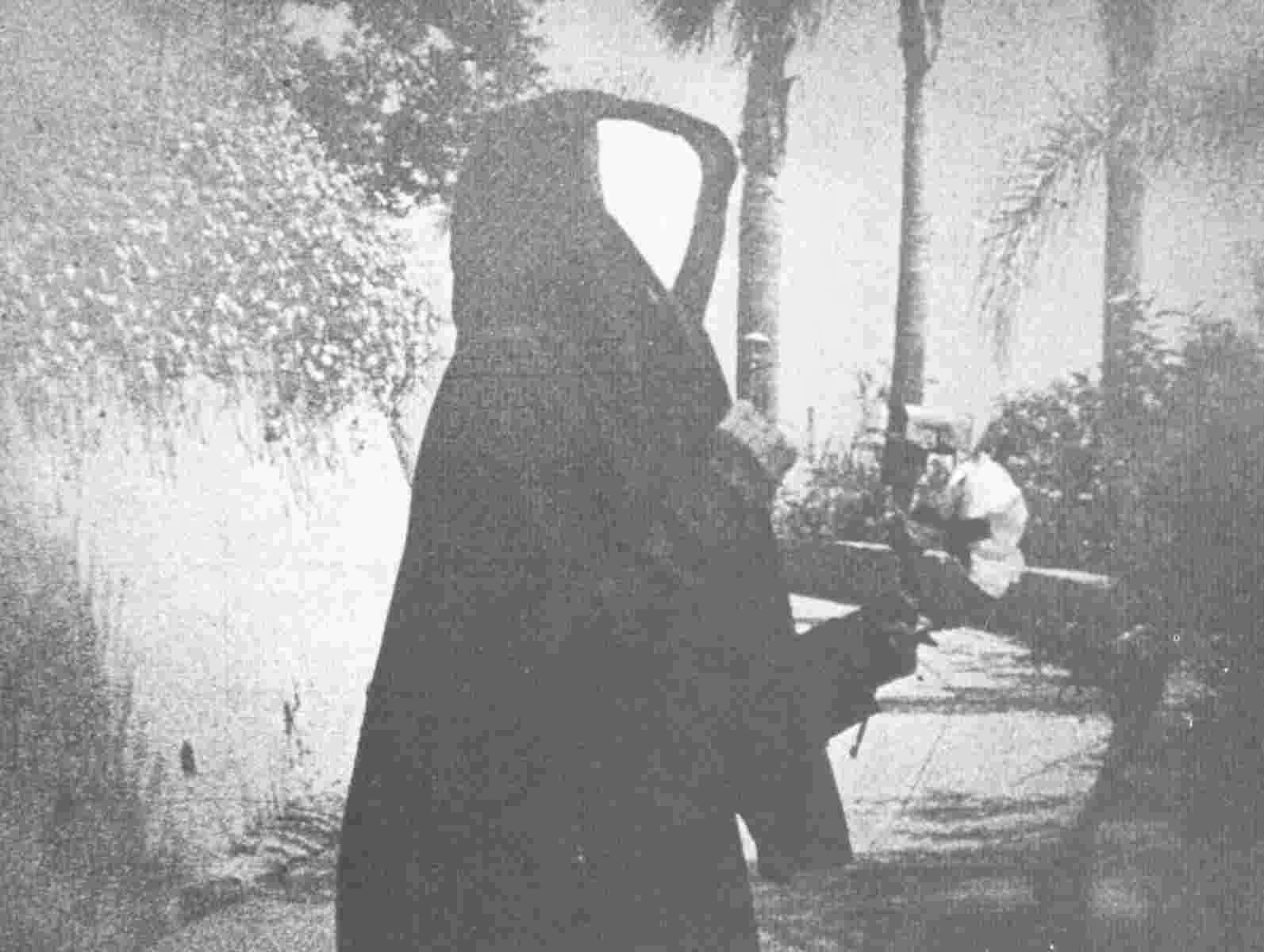
mirror that reflects nothing is an archetypal fear
of
man, even more appalling when used in place
of
a face, its white sharpness in sharp contrast
to
black robe and dull-toned background. SC
______________________________________________
A
decade before Resnais and Robbe-Grillet, Maya Deren --
catalyst and pioneer of the American
avant-garde movement --
creates
a work that distorts and intermingles past and present,
time and place, reality and fantasy until
they are seen as a
potential
or real continuum. An incident becomes the subject
of a fearful dream which, in the end,
intersects with actuality
and
destroys the heroine. Throughout, literal time and
actual
place are abolished,
as time is reversed, accelerated or slowed
and
actions are frozen, condensed, repeated, or expanded.
The
haunting and mysterious quality of the visuals, the poetic
montage and filmic rhythm -- proceeding
in utter silence --
create a
lasting classic of the international avant-garde, lyrical
in character, abstract rather than
narrative in structure. SC
THE
DESTRUCTION OF
TIME
AND SPACE
The
shattering of old concepts of time and space as
structurally separate, absolute categories
has found its
artistic
equivalent not merely in the discontinuities and
temporal
spatial ambiguities of Joyce, Proust, and Robbe-
Grillet,
but even more so in the works of modern cinema.
No other
art can so instantaneously and so completely
expand,
reverse, skip, condense, telescope, or stop time,
or
so suddenly change locale, abolish or accent perspective
or distance, transform appearances or
proportions of objects,
or
simultaneously exhibit spatially or temporally distinct
events. No other art can within a
fraction of a second and
with
no efforton its part change the audience's viewing position
and angle in the most radical fashion,
even transforming it from
onlooker
into protagonist by making it the eye of the camera.
The
cinema distorts space and time within shots (by accelerating,
slowing, moving toward or away from the
action) and between
shots (by
changing locale or temporal sequence). These "jump-
cuts" can be combined with very rapid
panoramic shots ("swish-
pans")
or with totally unrelated action. Instantaneous time travel
is possible by flash-forwards or
flash-backs. Segments of action
can
be repeated for emphasis or for the purpose of intentional
prolongation, and can be combined with
slowed or speeded-up
motion.
A scene can be viewed simultaneously from different
angles, or can be interrupted at will,
remaining incomplete
or taken
up again later; and life can be arrested or frozen.
Far from
being a realistic mode of art, the cinema creates an
entirely artificial paradigm of time
and space. It is the only art
form,
Cocteau said, that allows for the domination of both time
and space. (1) Cinematic time and space
are entirely under the
filmmaker's
control and need be neither contiguous nor continuous.
While in
everyday life space has unbroken continuity (even when
we
change position, it happens by degree), and is "unbounded"
(to the limits of our sense organs),
filmic space is confined to the
arbitrary
dimensions of the frame on which an entirely subjective
selection of images unrolls.
This space, thought flat and two-
dimensional,
conveys a four-dimensional quality of which time is part.
Though
the cinema's ability to destroy time and space had existed
from the moment film developed special
effects and creative editing,
the
commercial film industry's emphasis on realism precluded its wide-
spread use. Linear plots, with
their clear-cut progressions, required
contiguous
space and time. When time-condensation or elimination
of transitional devices (such as
dissolves) was allowed, it was only at
climactic
moments or so advanced the linear progression of the plot.
The
modern film has moved far beyond this. While in Balzac's
novels, says Robbe-Grillet, time completed
man as the agent and
measurement
of his fate, "in the modern narrative, time seems to
be cut off from its temporality ... it no
longer passes, it no longer
completes
anything." (2) In the discontinuities and incongruities of
modern cinema, filmic time again
approaches dream and memory;
for
memory, as Robbe-Grillet points out, is never chronological.
Film is
the only medium capable of portraying the
Einsteinian
space-time continuum and indeed simul-
taneously
constituting its very essence; for the image
and
its duration can never be rendered separately.
It was
Hauser who most forcefully realized the
fluidities
of time and space as constituting the very
essence
of cinema; the quasi-temporal character
of
space, the quasi-spatial character of time. (3)
The
discontinuity of plot and scenic development,
the
sudden emersion of thoughts and moods,
the
realitivity and consistency of time standards,
are
what remind us in the works of Proust and Joyce,
Dos
Passos, and Virginia Woolf of the cuttings,
dissolves,
and interpolations of the film.
(4)
As the
classicist form of film changes to the looser and
more
open structures of contemporary cinema, the distance
between the work and the spectator
lessens. The "visual
field"
of the art work (in cinema, the screen) is, as Sheldon
Nodelman points out, no longer the primary
field in which it
displays
itself; it expands to take in the entire space between
itself and the viewer, a space common to
them both. (5) This
new
fact promotes collusion between victim and perpetrator.
Far
from neglecting him, the author today proclaims his
absolute need of the reader's
cooperation, as active, concious,
creative
assistance. What he asks of him is no longer to
receive ready-made a world,
completed, full, closed upon
itself,
but on the contrary, to participate in a creation. (6)
As
always, it has been the avant-garde that has pushed
these
inherent potentialities of film to their very limit.
In
their shameless desire to possess the medium, they have
creatively desecrated time/space in order
to reconstitute
it in the glory
of their now guilty knowledge of its complexities
and
uncertainties. Experimentors such as Robert Whitman
or the Czech "Laterna Magica"
group have attempted literally
to
destroy the abyss between image and reality (Vertov's,
Eisenstein's, and Godard's dream) by
combining film with live
actors.
The Czechs had their live protagonists accompany the
film's action or invade it (in one
production, a live actor literally
jumps
through the screen); Whitman creates simultaneity and a
life-film continuum by projecting the film
on to the actor's body.
And
beyond Brakhage, Antonioni, Bertolucci, Richard Myers, Michael
Snow, and Warhol -- all of whom, in
various ways, intentionally
recall
us to the role and presence of time -- stand the single-frame
animators who give us truth twenty-four
times per second. Not to
be
confused with conventional cartoonists whose images move at a
slower rate and in intentionally
sequential progression, this total
destruction
of time and space -- twenty-four different images per
second -- reflects the dizzying speed and
cubist atomization of
contemporary
civilization. And even such "final" provocation has
already been surpassed in the production
of 2- or 3-screen films of
this
type, projected simultaneously. This sensory overload leads to
excited attentiveness,
disorientation, and heightened sensitivity.
These
magical devices of cinema -- themselves products of this
new technological art -- catapult the
filmmaker into modernity.
He
need not, as in conventional cinema, confine himself to orderly
progression of clearly defined stories
occuring in stable space
and
normal temporal continuity; the medium allows him to
enter 20th century art, to express
fully his new insights into
the
multi- faceted space-time continuum by mingling illusion
and reality, past and future, exterior and
interior universes.
By so
doing, however, the filmmaker is compelled to take
the
next step. This involves the dissolution of conventional
narrative and its reconstruction as an
ambiguous, complex
web of
atmospheric explorations and uncertain progressions
towards tentativeness rather than an
orthodox happy end.
REFERENCES
(1)
Dennis Dobson, Cocteau on the Film, 1954 (2) Alain
Robbe-Grillet,
For
a New Novel, 1965 (3) Arnold Hauser, The Social History
of Art, Volume 4,
1958
(4) Hauser (5) Sheldon Nodelman, "Structural
Analysis in Art and
Anthropology",
in Jacques Ehrmann, Structuralism, 1970 (6)
Robbe-Grillet
MOSAIC
IN CONFIDENCE
(Peter
Kubelka, Austria, 1963)
Mystery
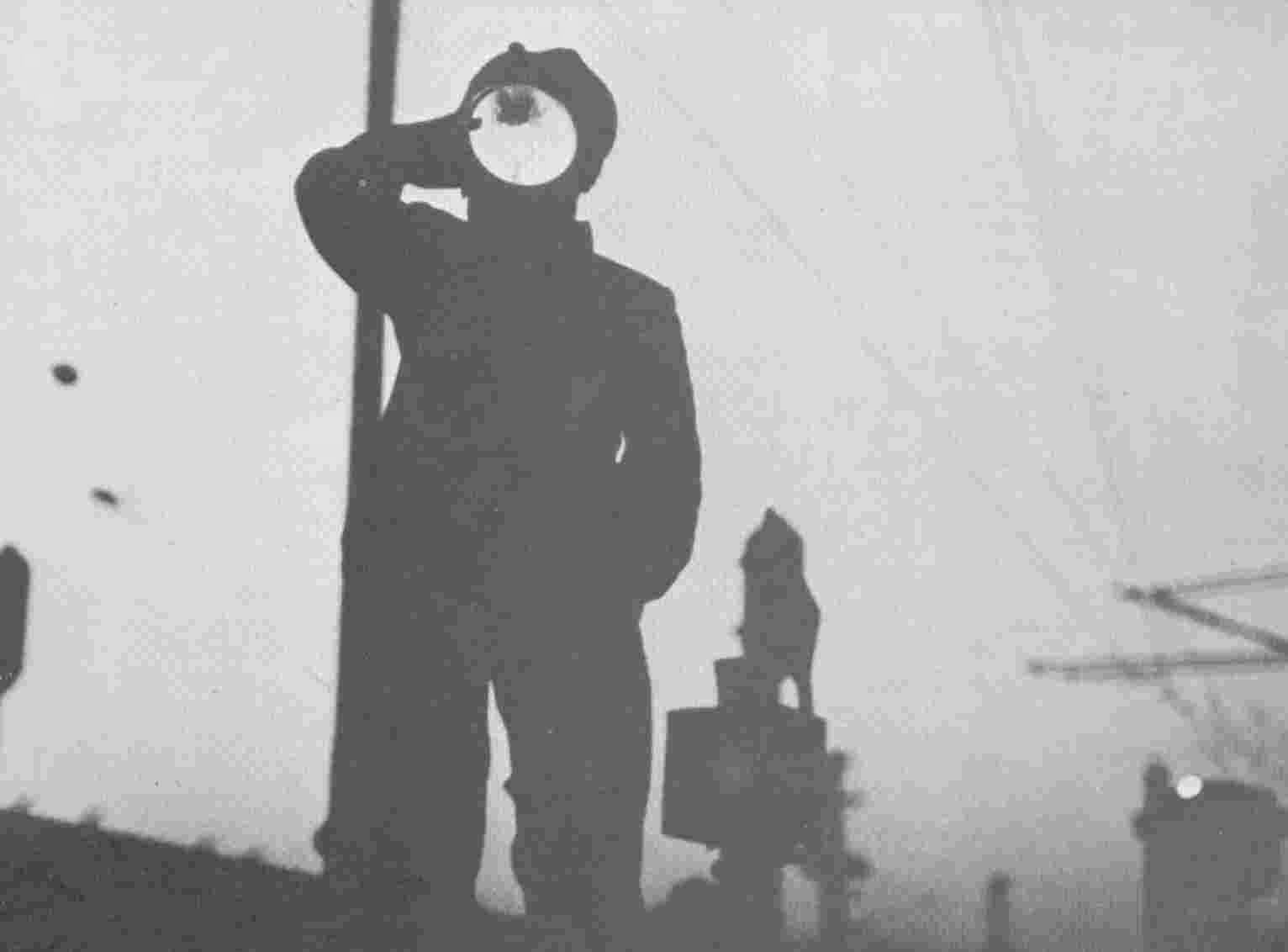
and alienation; there is reality, yet the effect
is
abstract, strangely sad. Most astonishing is the
reflecting circle that supplants the
face; it creates
a second
level of visual and psychological reality;
specific,
not mythological as in Meshes of the Afternoon.
FILMS
___________________________________________________________________________________________
AKTION
540
(Werner
Koenigs, West Germany, 1968)
From
a near-by balcony, an entire day's activities at
an
outdoor city market (from morning's installation
to
evening clean-up) are mercilessly recorded in the
space
of seven minutes by extreme time-lapse photo-
graphy.
Though tremendously speeded up, action
is
"continuous" while real time has been destroyed.
___________________________________________________________________________________________
CHINESE
FIREDRILL
(Will
Hindle, USA, 1968)
One of the
most technically proficient and talented American
avant-gardists creates a claustrophobic,
oppressive study
of a man in a
room or cell or universe. Instead of plot,
there
are memories, and attempts at order followed by
increased
anxiety that ends in chaos. Superimpositions
of
almost identical visuals, freeze frames, dissolves, image
manipulation by re-photography, are among
the devices
used to create the
semblance of a private, horrifying world.
___________________________________________________________________________________________
THE
DOOR IN THE WALL
(Glenn
H. Alvey, Great Britain, 1956)
The
most elaborate and consistent attempt to change size, shape,
and position of the screen within the
frame to fit the demands
of a
given story (here, a fantastic H.G. Wells tale) for atmosphere,
tension, and shock. The "Dynamic
Frame Technique" is achieved
by
two sets of movable mattes (masks) controlling height and
width of the screen area to be used.
A recent use of elements of this
technique
occurs in Richard Fleischer's The Boston Strangler (1968)
___________________________________________________________________________________________
MURIEL
(Alain Resnais, France/Italy, 1963)
(F)
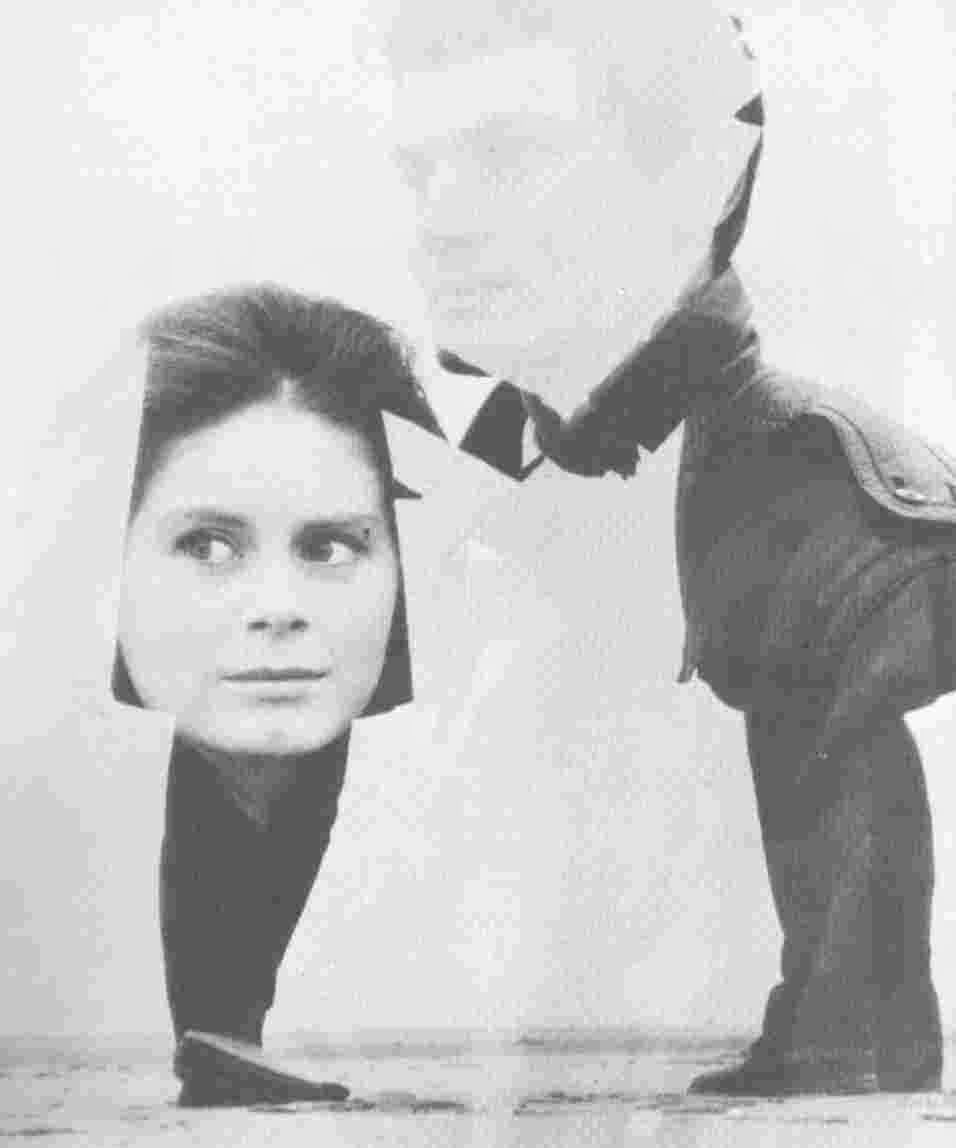
Resnais' bold
determination to express filmically the
relativity
of time and space, reality and illusion is
strangely
captured in this poetic superimposition.
The
couple exudes strength, beauty, and innocence,
as
young couples usually do; but context and
configuration
are now fragmented and problematic.
___________________________________________________________________________________________
GO
SLOW ON THE BRIGHTON
(Donald
Smith, Great Britain, 1952)
Stunning
application of time-lapse photography literally
whips
the spectator from London to Brighton at a speed
of
800 miles per hour, compressing an hour's journey into
4
minutes. The entire trip is seen, but the camera, positioned
in the locomotive's cab, only takes 2
(instead of the usual 24)
pictures
per second. Since projection is at the customary
24
frames per second, a dizzying illusion of extreme speed
is achieved. Authentic "compressed"
noise of bridges
and
overpasses rushing by accompanies the images.
___________________________________________________________________________________________
GOD
IS DOG SPELLED BACKWARDS
(Don
McLaughlin, USA, 1967)
3000
years of fine art in 4 minutes.
In
a joyous tour de force, the world's greatest
paintings
-- all schools, all periods -- flash by at
the
rate of eight per second; yet we are able to
recognize and retain most. Music by
Beethoven.
"Theoretically,
the world's greatest images,
combined
with the world's greatest music, should
produce
the world's greatest film." - Don McLaughlin
___________________________________________________________________________________________
HIROSHIMA
MON AMOUR
(Alain
Resnais, France/Japan, 1959) (F)
The
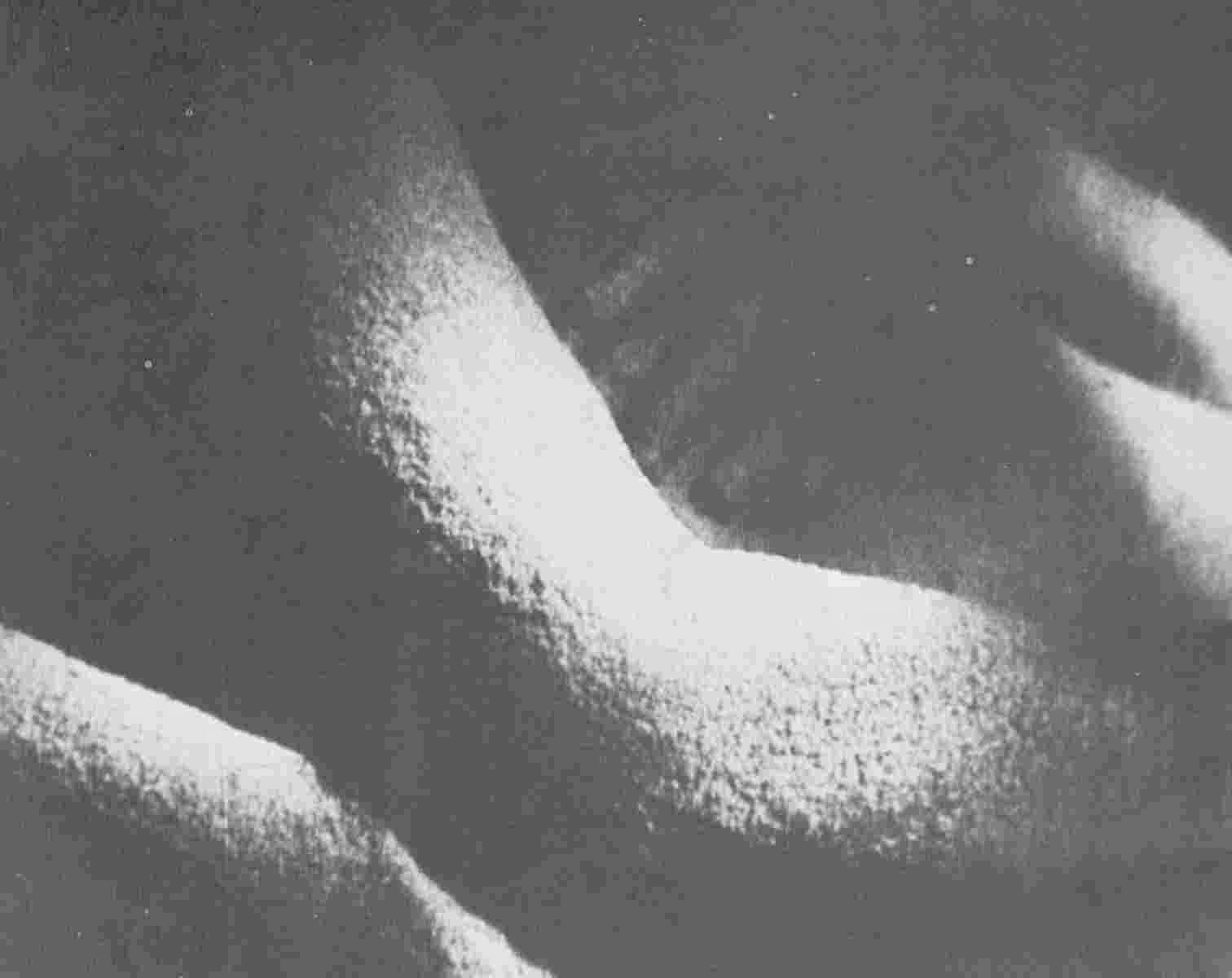
image is erotic, yet there are other
elements;
only parts of bodies are shown,
the
lighting is expressionist, and the lovers --
a
French girl and a Japanese in Hiroshima --
seem
covered with ashes from the atomic
explosion.
An image of love in our time.
______________________________________________
One of
the seminal films of the modern cinema. For the first time
a poetic fusion of past and present, of
different locales, of complex
counterpoint
between sound and image is achieved. Particularly
memorable is the twenty-minute opening, a
poetic documentary on
Hiroshima
and its tragedy, used as matrix for the talk and memories
of two lovers who attempt to relate their
individual fates to the col-
lective
tragedy of mankind caught in war. The connections between
the various themes, as Gavin Millar
points out, are made as much by the
editing
as by the dialogue or commentary. The paradoxes are
attained
by the stressing of
similarities between different time sequences. In fact,
montage and time/space linkage --
expressing the essence of the modern
sensibility
-- are at the core of the film, not (however artful) its excres-
cence. But it is the deep moral
passion of the filmmaker (seen also in
his
earliest concentration camp film Night and Fog) and his
bold break
with stylistic
conventions that mark this as oneof the most original
works of the post-war era.
The scenario is by Marguerite Dumas.
___________________________________________________________________________________________
THE
HOUSE (HET HUIS)
(Louis
A. van Gasteren, Netherlands, 1961)
The
methodical demolition of a sprawling Dutch mansion
becomes the core of an ambitious attempt
to fuse past and
present in
glimpses of the life of three generations presented
simultaneously. Continuously
disrupted by collapsing rooms
and
falling walls, half a century of turbulent European history is
condensed into a thirty- minute
impression. There is no looking
back,
since time never exists as a fixed point; everything is now.
___________________________________________________________________________________________
IN
MARIN COUNTY
(Peter
Hutton, USA, 1971)
A bizarre
comment on American civilization.
The
total demolition of suburban houses (to make
room
for a new highway), seen in strongly acce-
lerated
motion, transforms the stubbornly charged
bulldozers
into ominous, devouring monsters.
___________________________________________________________________________________________
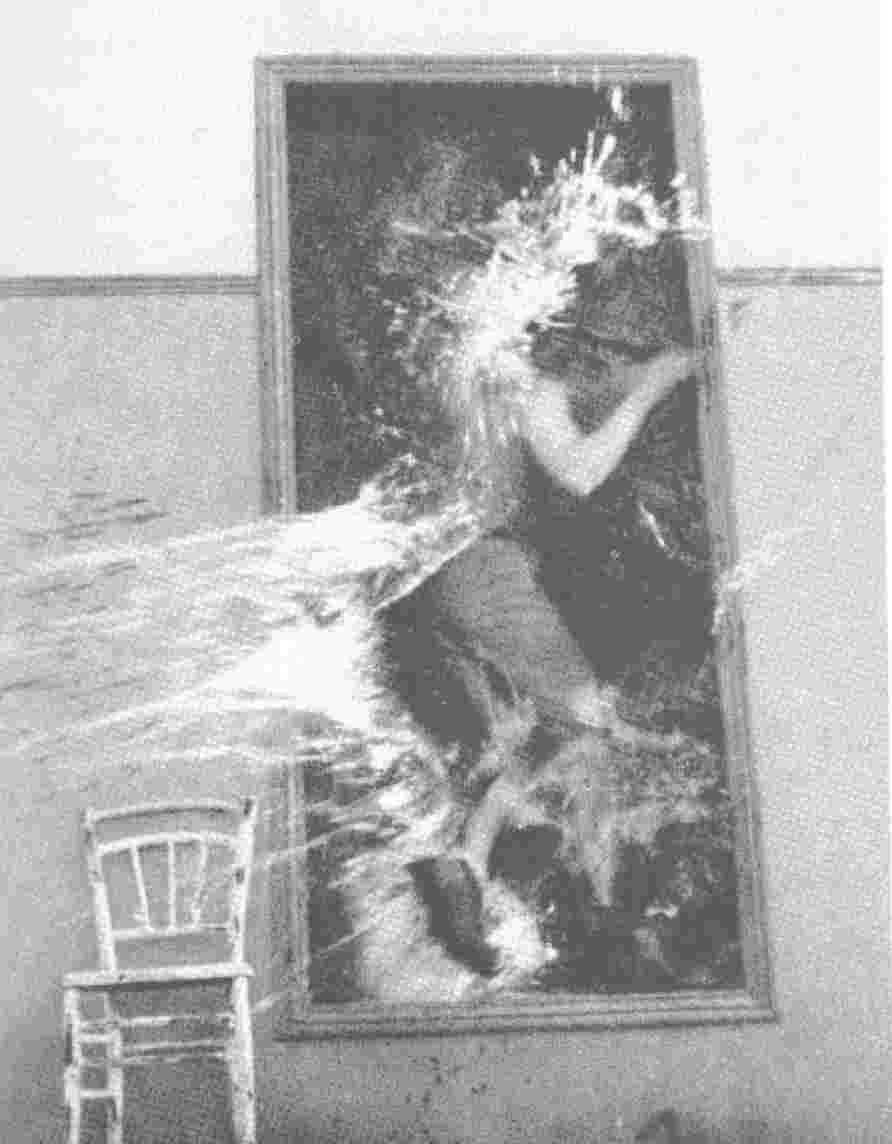
THE
BLOOD OF A POET
(LE
SANG D'UN POETE)
(Jean
Cocteau, France, 1930)
The
mythological passage through mirror into another
universe
-- one of mankind's haunting wish-dreams --
achieved
in a visual and poetic metaphor by submersion in water.
Our viewing position --
reinforced by chair and wall moulding --
erroneously
compels us to consider the "mirror" as vertical.
SC
______________________________________________
Often
mistaken for a surrealist work, this is a carefully constructed,
entirely conscious artifact, mingling
symbol and metaphor to
project
the anguish, apotheosis and corruption of the struggling
artist. It remains fascinating primarily
as an early example of
sophisticated
time/space destruction for poetic ends. This entails
the passing through the mirror into
another world, the fantastic
combinations
of unrelated events in space and time, and its brilliant
central metaphor: the dynamiting of
a huge factory chimney at the
beginning
of the work, interrupted in the middle by the film's action
and completed only at the end by its
total collapse; an intimation
that
the film represents the equivalent of a one-second dream.
___________________________________________________________________________________________
PRUNE
FLAT
(Robert
Whitman, USA, 1965)
The most
fully-realized work of the noted American mixed-
media
artist -- a desperate attempt to destroy the distinction
between film and reality. Live
actors perform with and in
front
of their filmed images which may or may not duplicate,
precede, or follow their actions. Most
fascinating is the
projection
of film on the actor's body -- such as nude
footage
of a dancer superimposed on to her dressed body.
The
complex orchestrations and inter-relationships
create
a mysterious, multi-dimensional sensory overload.
___________________________________________________________________________________________
POWER
OF PLANTS
(Paul
F. Moss and Thelma Schnee, USA, 1949)
Fascinating
time-lapse film of growing plants lifting
weights,
breaking bottles, moving rocks, tearing heavy
tinfoil,
with the camera set to take a single frame per
hour
for up to 60 days. The resultant film strip, projected
at
ordinary speed, provides continuous motion and
convincing proof of the power of
plants. A magical film.
___________________________________________________________________________________________
RENAISSANCE
(Walerian Borowczyk, France, 1963)
Animation-in-reverse reconstitutes from
the debris
of objects a
nostalgic, mysterious still-life. The principle
actors are the objects, or, more
precisely, their movement in
space
and time. Useless left-overs of different kinds attract
and find one another and unite to give
birth to a new world of
commonplace,
magical things. A haunting, disturbing work.
___________________________________________________________________________________________
SMOKING
(Joe Jones, USA, 1970)
A
man's face; smoke slowly, imperceptively
begins
to ooze from his mouth. Shot at 2000
frames
per second (instead of the usual 24),
the
simple act of exhaling smoke, expanded
by
nearly 100 times our normal perception,
becomes
a huge and endless event.
___________________________________________________________________________________________
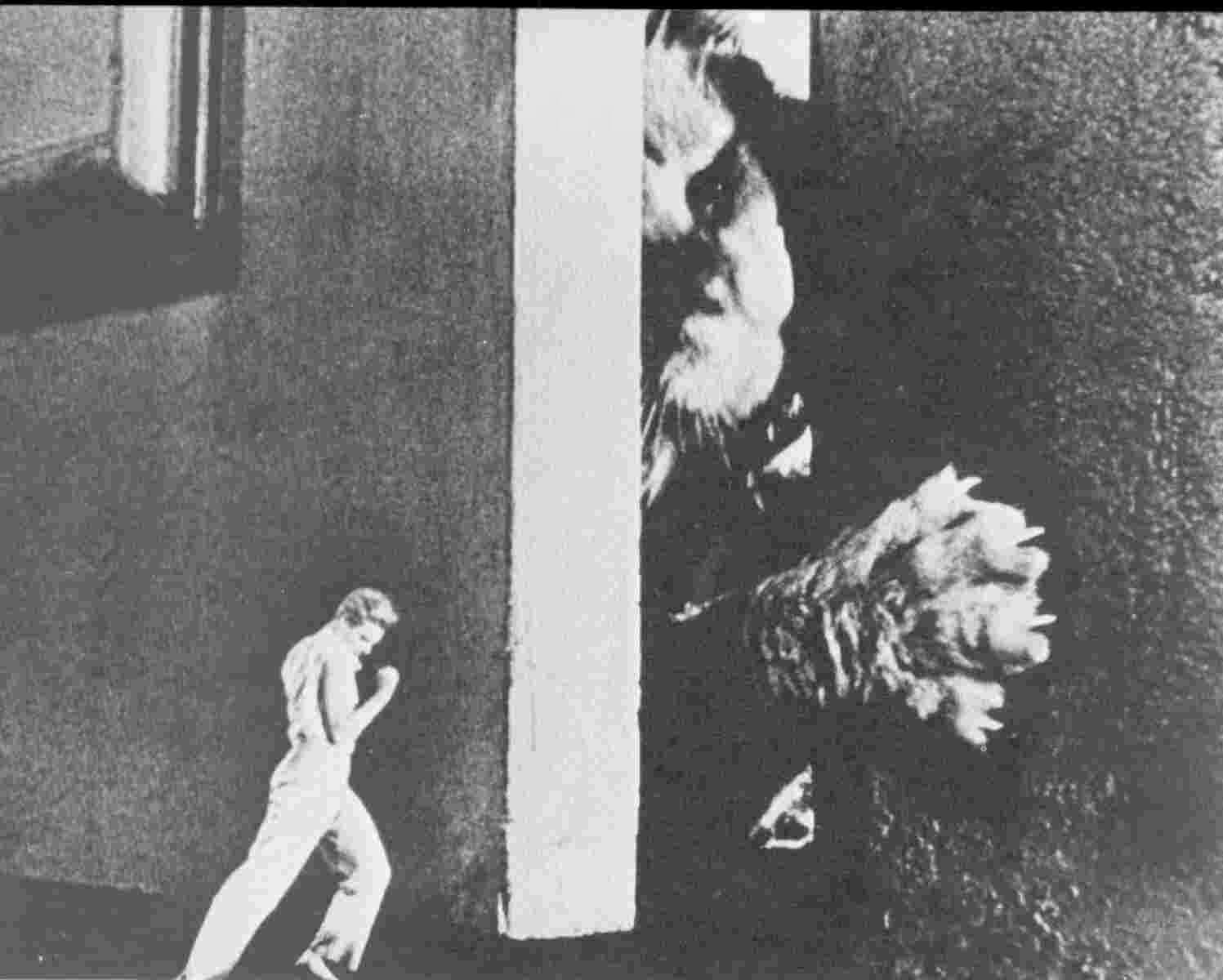
THE
INCREDIBLE SHRINKING MAN
(Jack
Arnold, USA, 1957)
The eye,
drawn to what seems a normal-size cat,
instantaneously
meets surrealist shock: spatial
disorientation,
disproportionate object size.
Ordinary
reality is transformed into a monstrous
universe
over which man no longer has control,
as
the protagonist -- forever shrinking --
passes
through stages of increasing terror.