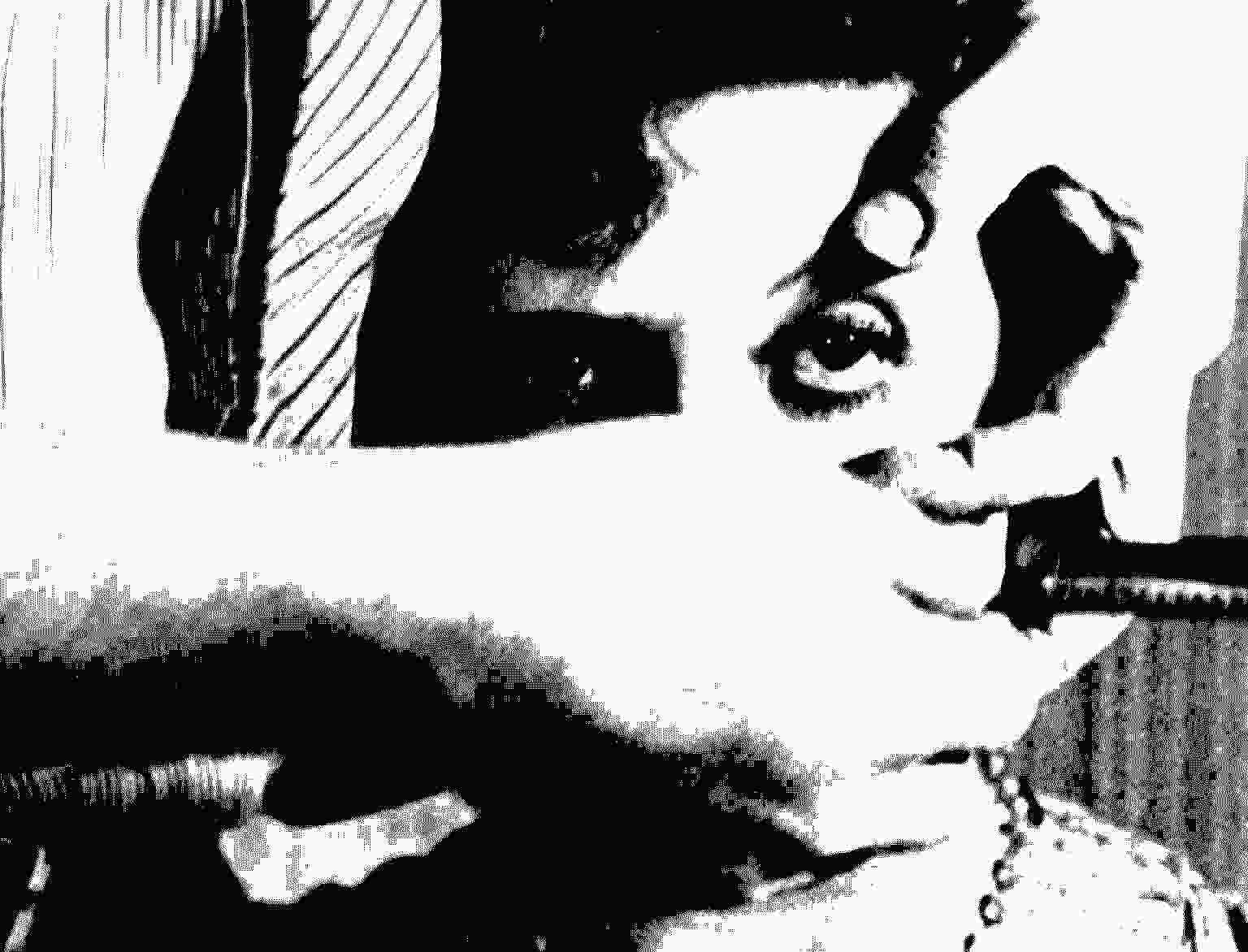
FILM
- AS A -
SUBVERSIVE ART
AESTHETIC
REBELS AND
REBELLIOUS
CLOWNS
The
three most subversive aesthetic tendencies of our century --
surrealism, expressionism, and dada
-- are anchored in the
reality
of a civilization in decline. They are gestures of defiance
against the chaos which is organized
society. The expressionist
Max
Beckmann, whose triptychs of torture and death prefigured
Buchenwald, Stalin's camps, and Vietnam,
wrote in 1919:
Just
now, even more than before the war, I feel
the
need to be in the cities, among my fellowmen --
this
is where our place is. We must take part in the
whole
misery that is to come. We must surrender
our
hearts and our nerves to the dreadful screams
of
pain of the poor, disillusioned people.
(1)
"We
must take part in the whole misery that is to come";
nothing can more movingly express the
social commitment of
the
artist, his understanding of a brutal present and worse future.
For the first time the stability of the
imperial and capitalist system
was
being called into question. The ravages of war and depression,
the corruption of values, the mood of
defeatism and alienation --
these
constituted the matrix within which the new arts germinated.
They
were nourished by the liberating poisons coming from the sciences
and philosophy. Reason and logic,
bright hopes of a previous generation of
intellectuals
and artists, were found to be wanting or else required to destroy
previous "truths". Time
was ripe for the subversions of Einstein and Freud.
Whatever
their differences, surrealism, expressionism, and dada were united
in their determination to declare war on a
corrupt society and its putrefied
values,
to dethrone academic art. Opening themselves to subjectivism
and the
unconcious they would
help transform the world by using art as a tool of revolution.
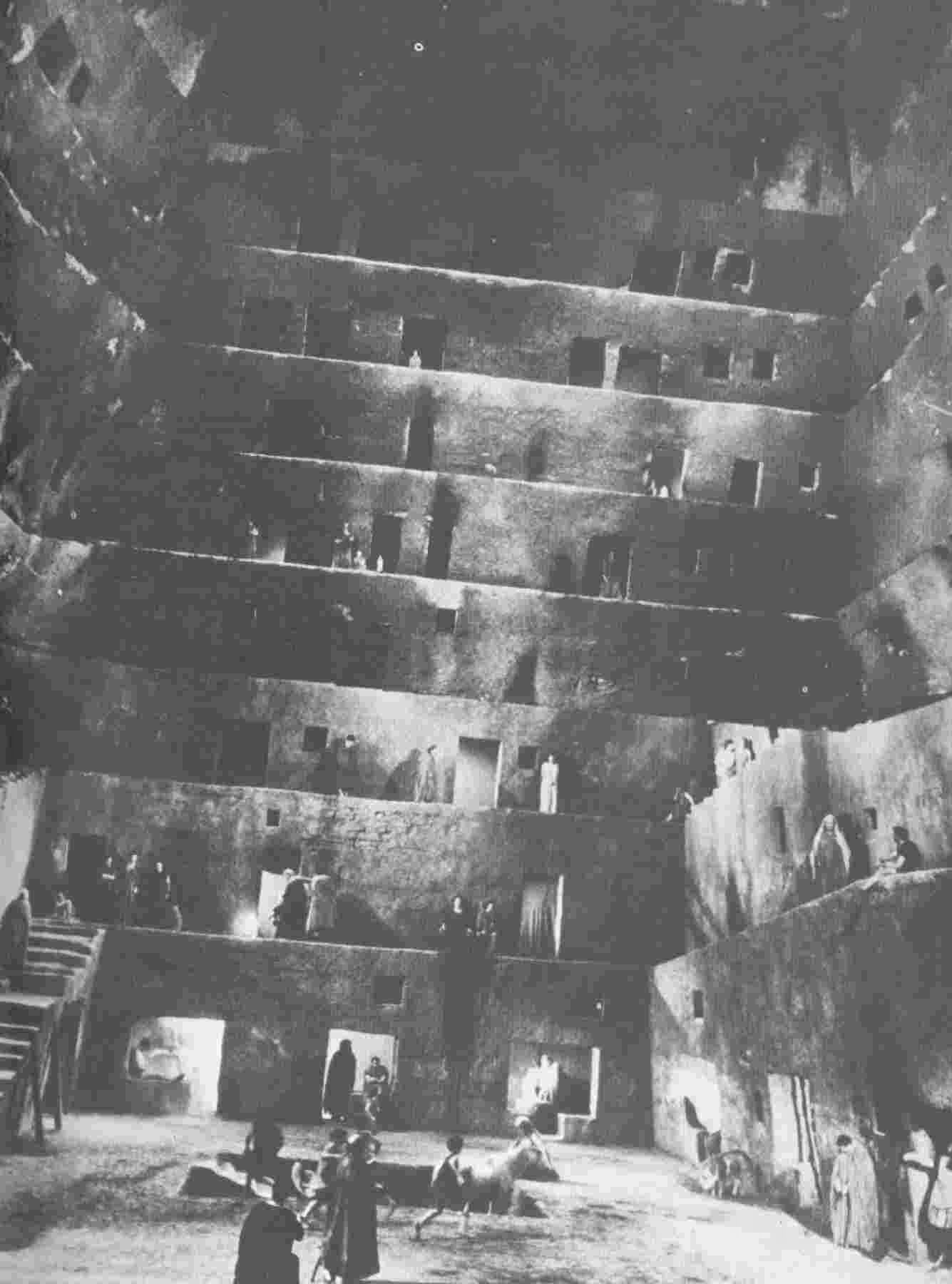
SATYRICON
(Federico Fellini, Italy, 1969) (F)
The return to expressionist decor in the
guise of
realist portrayal;
crooked, converging lines, a feeling
of
impending implosion, the play of selective light
and shadow, the submersion of the human
element
within threatening
architecture. Instead of
painting
the set as in Caligari, the filmmaker
had
the financial resources to build it. SC
EXPRESSIONISM: THE CINEMA OF UNREST
Eschewing
the delicate attempts of the impressionists to capture color nuances
or the pleasures of petty-bourgeois life,
expressionism feeds on dissonance,
excess,
violent emotion, the secret worm gnawing at the vitals of society.
In the works of Munch, Kirchner,
Kaiser, Marc, Klee, and Kandinsky,
"objectivity"
and perfection of form are sacrificed to intensity and shock.
The artist, no longer a
contemplative bystander, becomes an active participant:
The
artist does not see -- he looks;
he
does not describe -- he experiences;
he
does not reproduce -- he creates;
he
does not take -- he searches;
Today
there no longer exist chains of data
such
as factories, houses, illness, whores,
screams,
and hunger; today we merely have
them
in visionary form. The data has signi-
ficance
only insofar as the artist -- groping
beyond
it -- finds what there is underneath.
(2)
Beckmann, too, was driven by the same impulse:
What
I want to show in my work is the idea which
hides
behind so-called reality. I am seeking for the
bridge which leads from the visible
to the invisible.
This
ineffable, poignant straining towards the secret beyond appearance
is common to the surrealists as well.
For the expressionists, however,
the
"bridge" was to be formed by the distortion and
exaggeration of color
and mass,
character and decor, stylized into making the normal artificial.
The
expressionist stance is anti-romanticist. Its colors are
shrill, false
and vulgar.
Its angles and perspectives are distorted. The objects it
portrays are of abnormal shape or
proportions. The dynamism resulting
from
exposure to such psychological insults and shocks is meant to wrench
the spectator from the conventional and
open him to the radical new.
Obliqueness
is particularly important. To Rudolf Arnheim, it is "probably
the most elementary and effective means of
obtaining directed tension,
perceived
spontaneously as a deviation from the basic spatial framework
of the vertical and the horizontal.
This involves a tension between the
norm
position and that of the deviating object, the latter appearing
as striving toward rest, being attracted
by the framework, pulling
away
from the framework, or being pushed away by it". (3)
This deviation can involve both location
and shape.
The
emphasis on extremity and shock unites expressionism,
surrealism, and dada. Theirs was an
activist, transforming,
subversive
art, designed to eradicate the reactionary
values
of an establishment that had proven its bankruptcy.
EXPRESSIONISM:
THE CINEMA OF UNREST
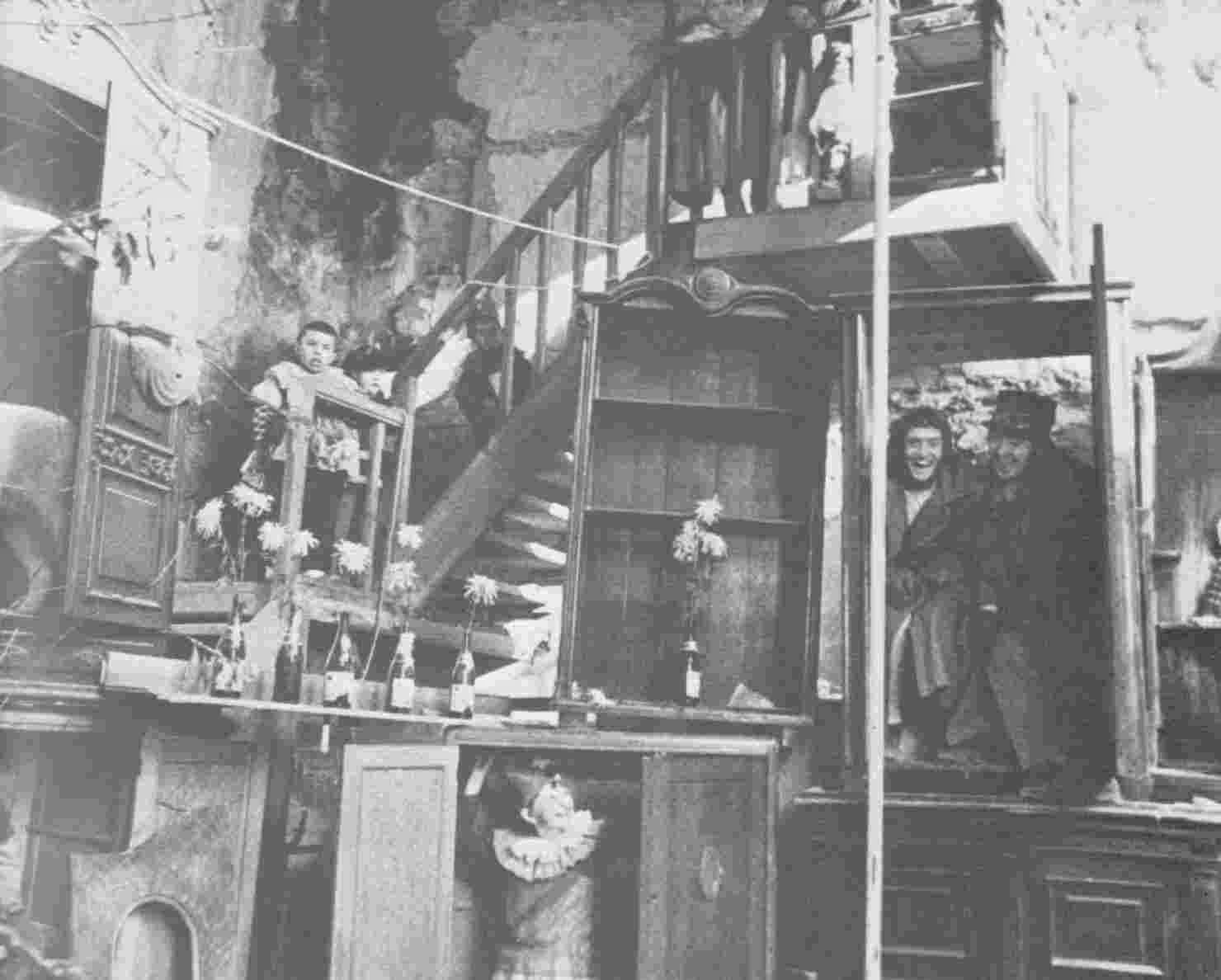
BIRDS,
ORPHANS, AND FOOLS
(Juro
Jakubisco, France, 1971) (F)
Staircases
that perhaps lead nowhere;
wardrobes
without backs; a clown that
may
be real; and a doomed attempt to live
a
life of freedom in a world of insanity
and
war. A message in a bottle from a
Czech
director temporarily in France.
SURREALISM: THE CINEMA OF SHOCK
Surrealism,
the most clearly political of the three tendencies, was
more an instrument of cognition than an
aesthetic movement. In fact,
its
aim was to destroy aestheticism. It meant to subvert the status
quo
of patriotism, church,
state, family, national honor, and bourgeois ideals.
It
rebelled against conformism and the false rationalism of bourgeois
art
and society, attacked
reassurance. Its aim: to destroy all censors and to lib-
erate man's libidinal, anarchist, and
"marvelous" impulses from all restraint.
Most
important, surrealism postulated a return to the irrational and to
the magic of dreams as a means of
revelation and personal (hence social)
liberation.
Drawing on Dostoevski, Poe, and Baudelaire, the symbolist-
radicals Mallarme, Rimbaud, and the
anarchist Apollinaire, the surrealists
proudly
proclaimed poetry (the subconcious) the supreme weapon of know-
ledge and conquest. Rationalism and
realism were insufficient precisely
because
they omitted instinct and the subconcious. Wallace Fowlie has
defined the realist as one who tells us
what he sees of the world, the
philosopher,
what he thinks of it, the poet, what he knows. (4) Poetic
knowledge is "truer" than
rational knowledge: the poet-artist is the seer,
possessing magic qualities which neither
he nor the spectator fully grasp.
("For
the first time in history," said Norman Mailer in A Fire on
the Moon,
referring to the
American moon shot, "a massive bureaucracy had committed
itself to a surrealist adventure, which is
to say that the meaning of the
proposed
act was palpable to everyone, yet nobody could explain its logic.")
Art here
is viewed as a magical incantation. Its creations and effects
are both
miraculous.
Socrates described the poet as "a light and winged and whole
thing;
there is no invention in
him, until he has been inspired and is out of his senses
and the mind is no longer in him."
To become a seer, the artist must give his
imagination
free reign by following the dictates of his subconcious and turning
himself into an "echo". (5) "Man
is not just the reasoner, but also the sleeper." (6)
For to work intuitively, without logic,
means to return to sleep and dream.
In
elevating the subconcious to the central role,
art
returns to its fundamental mystery:
The
profoundest works of art are those related to
the
most hidden intentions. The deeper the artist
plunges himself through
introspection, the further
he
moves away from the assurances of facts,
the
nearer he will approach the ambiguity
of
dreams ... What we want is the enigma, not
the
truth ... not clarity, but ambiguity rules art,
and
surrealism is the triumph of ambiguity ...
a
cult of the enigmatic adapted to a culture that
has
outgrown the rituals and sacraments of official
religions, heresies, and metaphysical
acts. (8)
It is
here that Freud most strongly influenced the surrealists. Hence
their
emphasis on
stream-of-conciousness, hallucinatory states, "automatic
writing", and absurd games; their
opposition to plotted narrative.
Only
the realm beyond logic was held to reveal truth and resolve the
false contradiction of dream and waking
life into the higher reality of
surrealism.
Said Andre Breton in the first surrealist manifesto in 1924:
Surrealism
is pure psychic automatism, by which it
is
intended to express, either verbally or in writing,
the
true function of thought. Thought dictated in
the
absence of all control exerted by reason, and
outside
all aesthetic or moral preoccupathions.
Surrealism
is based on the belief in the superior
reality
of certain forms of associations heretofore
neglected;
in the omnipotence of the dream and
in
the disinterested play of thought. (9)
These
"irrational" associations constitute the primary surrealist
weapon, the use of "shock".
This is attained by distortion of reality
or
the disjunction of objects from their usual context, resulting
in their transformation into "surrealist
objects". George Amberg
states,
in an unpublished paper, that the mechanism of intentional
shock causes a powerful, instant tension
discharge on the part
of the
spectator which is beneficial (pleasurable) rather than
traumatic, its aesthetic pleasure inverse
to its strength.
Examples
of the surrealist object are Dali's melting watches (a desecration
of our holiest symbol of truth and
objectivity, this picture could not have
been
painted before Freud and Einstein); Max Ernst's collages of old
engravings and incongruous pictorial
elements; Magritte's picture of
a
pipe with a byline reading: "This is not a pipe."
Illustrative of the
surrealist
sensibility are Lautreamont's definition of beauty as "the
classic
meeting on a
dissecting tableof a sewing machine and an umbrella"
or Di Chirico's realization that even such
ordinary transpositions as furni-
ture
on a pavement during moving (or the frightening displacement of
familiar objects following a burglary)
acquire an uncanny new meaning.
This
detaching of objects from their usual surroundings (chains),
Fowlie maintains, can be viewed as a
gesture of freedom from
the
rules of society, family, and state and represents the "limitless
possibility" of salvation through
dream, love, and desire. (10) Far
from
this salvation having taken place, perhaps the most "shocking"
aspect of surrealism is that its imaginary
nightmares and monstrous
projections
of the unthinkable have in our day become realities.
SURREALISM:
THE CINEMA OF SHOCK
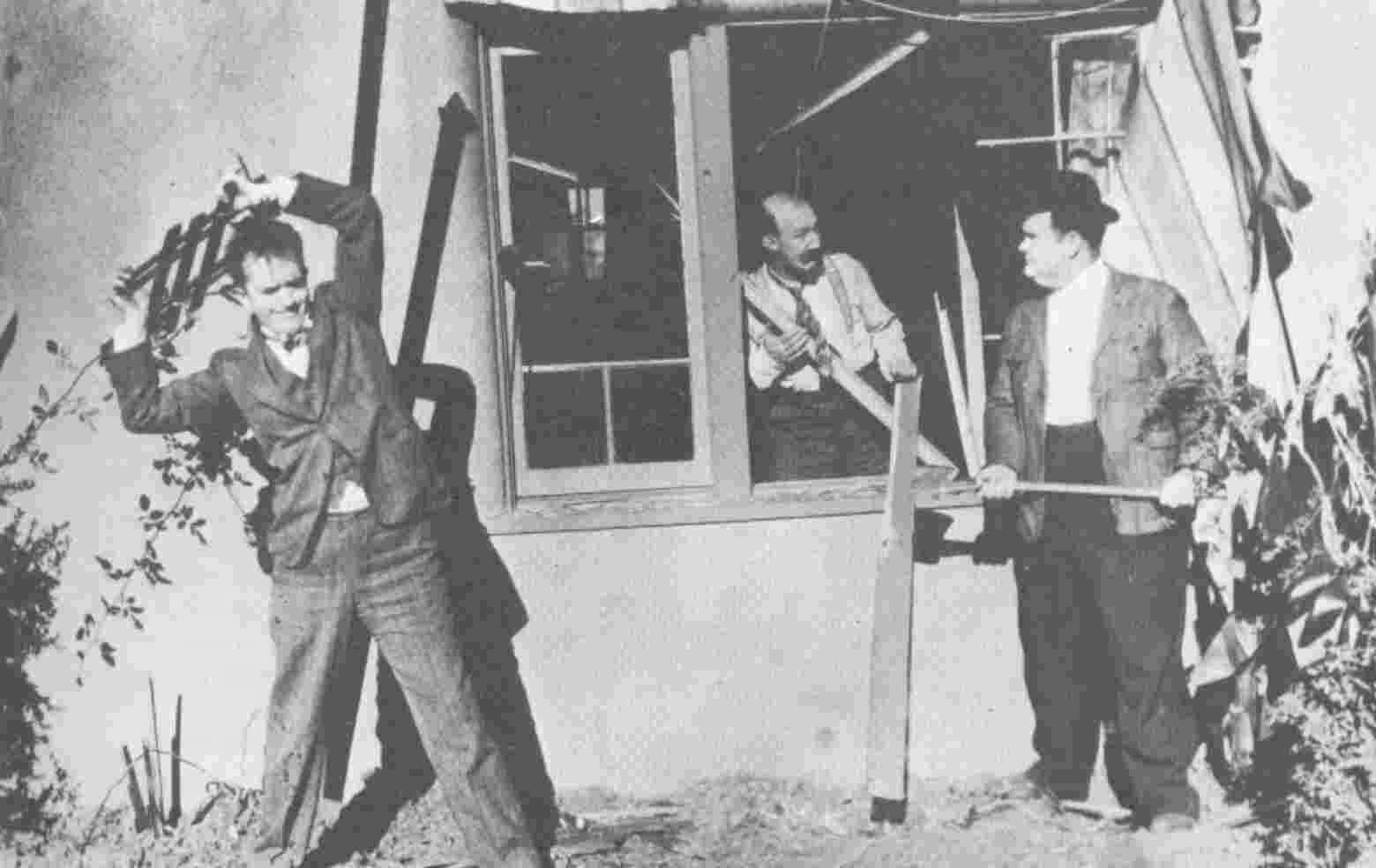
BIG
BUSINESS
(J.W.
Horne, USA, 1924)
Brilliiant
farce propels two ineffectual Christmas
tree
salesmen into a prolonged bout of savage
destruction
directed against a customer who
refuses
to buy. Mutual insults, tie snipping, and
small
violence escalate from controlled distur-
bance
to surrealist cataclysm, in which the
American
Home is leveled once and for all.
DADA AND POP: ANTI-ART?
The
renewed emphasis on objects and their juxtaposition also animated
the dadaists. Much later is was to
influence the present-day offspring
of
expressionism, surrealism, and dada -- the pop artists. In their
total
rejection of art, the
dadaists (destined to become "artists" in turn)
desecreted logic and objectivity.
They turned their attention to object
and
the micro- elements of reality the more thoroughly to destroy the
macro-structure. "Dada wished to
replace the logical nonsense of the
men
of today with an illogical nonsense." (11) Everything was
permissible
as regards
materials, subject matter, and placement. The more banal and
everyday the object, the better it served
its purpose. Duchamp turned a
urinal
into a work of art simply by isolating it from its usual environment
and function. Objects, states Alan
Solomon, were no longer neutral but
ambiguous
and arbitrary, their "meaning" dependent on the artist.
There are correlations between
Schwitters' changing found objects into
art
and Rauschenberg's cabled reply to a request to do a portrait of
Iris Clert: "This telegram is a
portrait of Iris Clert if I say so"; (12) or
Edward Ruscha's book of photographs, Real
Estate Opportunities in and
around
Los Angeles, merely showing views of undeveloped lots. In a
similar
vein are Jasper Johns'
hand-painted replicas of Ballantine Ale cans and Harvey
Stromberg's "permanent" Museum
of Modern Art Exhibition of his "works" --
photographic scale-reproductions of Museum
keyholes, light switches, and
wall
cracks, pasted on the museum walls and doors by the artist.
When
coke bottles, hot dogs,
and photos of parking lots become art, objects
once
again become magical, serving as icons to make us view reality
more closely and to question it.
This "tearing" of the illusionist surface
of
reality and of its customary acceptance as truthful and eternal,
is what constitutes the subversion of
Warhol or Tzara.
The
separation of object from environment can also
be
achieved by a change of proportions between them
or
by the suppression of background. Anticipating
Warhol
and minimal art, this was understood by Leger:
To
isolate the object or the fragment of an object
and
to present it on the screen in close-ups of the
largest
possible scale gives it a personality it never
had
before and in this way it can become a vehicle
of
entirely new lyric and plastic power.
(11)
Charles
Reich points out that pop artists, by presenting neon signs,
juke boxes, and other icons of a sterile
consumer society in an apparently
neutral
yet isolating manner, transcend these objects by creative use,
thereby regaining a measure of power over
their environment. (14)
Similarly
to surrealism, dada also stresses the significance of chance and
accident, delighting in their subversive
unpredictability. Dada accepts
neither
stricture nor dogma, mixes style and materials, and contradicts
and attacks itself. The very concept of
"original" art is questioned by
Warhol
and Duchamp; art has become reproduceable and expendable.
The
radical aspects of dada and pop art have been integrated into a style
of unconventional political action by
segments of the international New
Left
(particularly the American Yippies and the student movement).
This
may involve introducing
flowers into a situation of state violence, political
street theatre to disrupt opponents'
meetings, the distribution of dollar bills
to
New York stock exchange brokers, intentional disrespect for the flag
and
other patriotic symbols, or
exhortations to punch IBM-cards erratically to
disrupt
computer billing. Such actions return us to surrealist juxtaposition
of
related objects and
nose-thumbing dadaist disregard of their ordinary use.
It is
the very artificiality of the film medium -- its inevitable
"de-formation"
of
reality, implicit anarchist freedom from all logical restraint, and
inherent
subjectivity -- that
renders it an eminently suitable tool for these artists.
As the surrealist critic-filmmaker Jacques
Brunius maintained, in contrast to
the
Kracauer-school of film-theory, "the cinema is the least
realistic art." (13)
It
can distort shapes, colors, life; it can imitate dreams and free
associations
by transformations
of time and space; it can combine objects and background
(or have them collide) in the most
"objectionable" concatenations; it can
destroy
space, already rendered suspect by the surrealists, in a fraction of
a
second; it is able to portray
the subconcious or reveal the "automatic" artistic
activity of the filmmaker. The
shocking introduction of new objects into
the
frame, the explosive juxtaposition of conflicting images by means of
editing, the startling ability of the
medium to create even "impossible"
new realities by
superimposition, masks and other technical devices,
pointed to film as a perfect medium for
humanist provocation.
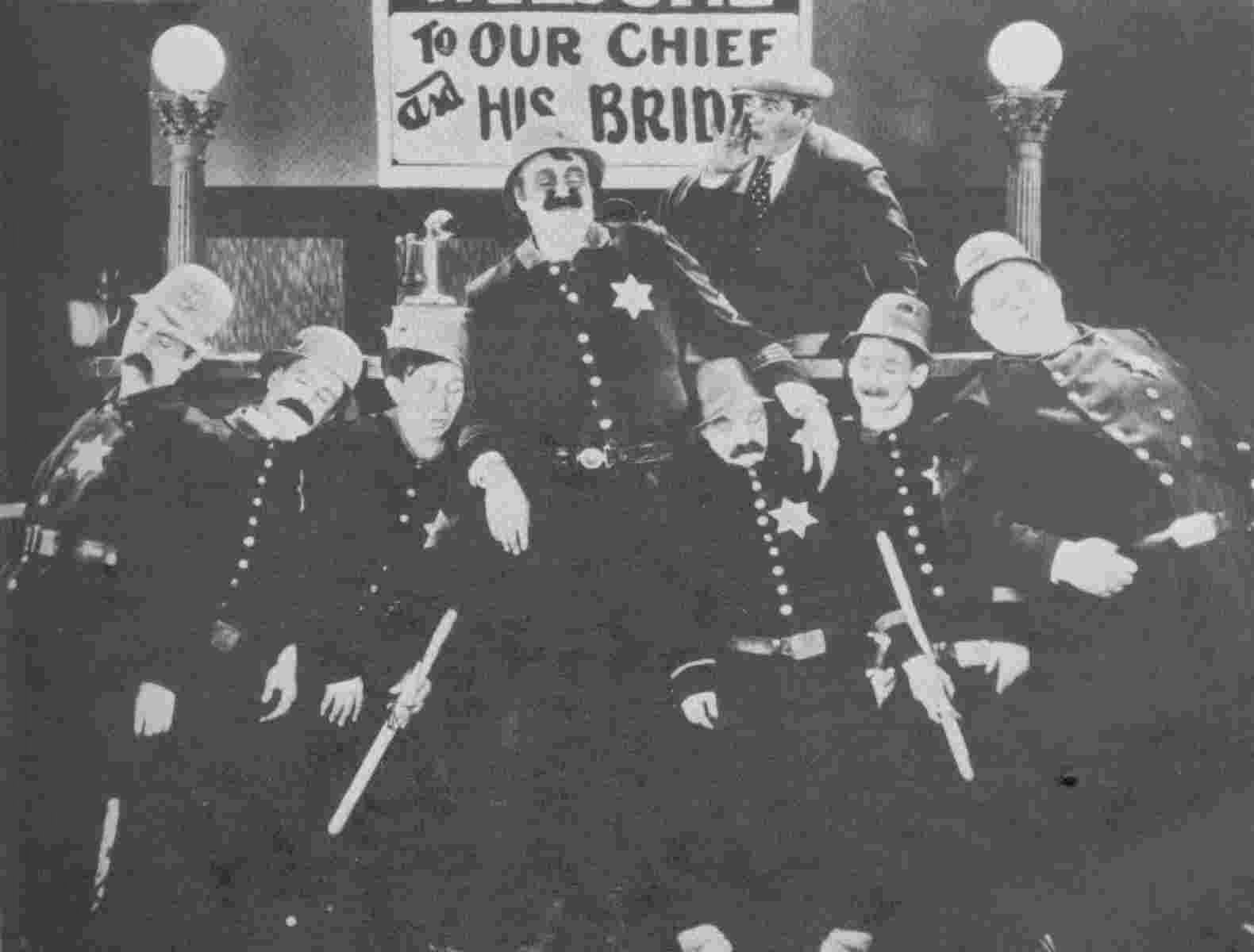
UNIDENTIFIABLE
KEYSTONE FILM
Circa
1915
The surrealist exuberance
of Mack Sennett's
universe --
its cataclysms of destruction, its
refutation
of common sense and logic -- involves
frontal
attacks on the bourgeois notion of a stable,
orderly
universe. No institution is safe, and every point
is made visually in cascading,
brilliantly-timed sight gags.
THE COMIC TRADITION
These
cinematic devices led surrealism, dadaists, and, in a different
manner,
expressionists, quickly
to realize the subversive potential of film comedy.
Sennett,
Fields, the Marx Brothers, Langdon, Keaton, and Chaplin make
a frontal attack, with exuberant madness
and in differing styles, on the
beloved
bourgeois notion of a stable, orderly universe in which appearance
equates reality, justice and law prevail,
the meek are accomodated, and ladies
are
safely married. The great film comedians in their endless cataclysms
of visual gags -- so beautifully wedded to
cinema in which the image was
supreme
-- befoul this myth in the most hilarious and offensive manner,
supporting it in paroxysms of seditious
defloration. Any symbol of the ruling
class
is subject to immediate attack. The rich and the powerful, anyone
in uniform -- judges, priests, society
ladies, policemen, emperors, and
presidents
-- are all stripped of their power emblems and pretensions
in systematic, large-scale assaults or
insidious guerilla attacks.
The
taboo of the state and its institutions, of organized religion and
bourgeois respectability is subverted by
sight-gags, pie-throwing,
pratfalls,
and savage satire: not even fire departments or woman-
hood are exempt as the demystification of
society is completed.
And it
is once again the cinema that is most capable of wreaking
this metaphysical, seditious havoc; for
action can be speeded up for
comic
effect; time and space can be scrambled; impossible accidents
created most realistically; editing can
provide an incessant tempo of
successively
heightened sight gags; wordless actions involving the
basic symbols of reality assume the
character of hilarious nightmares;
jump-cuts
or stop-motion animation irreverently combine what is never
combined in good society. Here the
inherent anarchism of cinema (so
beloved
by the surrealists) finds its true and perhaps ultimate expression.
An attack on a technology gone wild,
a cynicism regarding human motives,
a
tearing off of all veils, a total permissiveness that allows revenge
against
power and cant,
characterize this procession of masterpieces, one of
America's significant contributions to the
international subversive cinema.
Robert
Desnos, brilliant surrealist poet and ideologue killed
by
the Nazis, in a book significantly entitled Mack Sennett,
Liberator of Cinema, emphasizes the
essential:
We
well know the madness presiding over his scripts.
It
is the madness of fairy tale and of those dreamers
whom
the world holds in contempt and to whom
the
world owes what is delightful in life.
(16)
The
anarchists' revolt extends to all the symbols of bourgeois
good life, everything that is "holy".
Mothers are mercilessly
attacked,
baby carriages overturned, children despised,
sentimental
love satirized, last-minute rescues and happy
endings
made fun of, the sanctity of home and family
besmirched;
nothing is exempt from their laughter.
The
German historians Enno Patalas and Ulrich Gregor correctly
point to the inversion by Sennett of
Griffith's basic thematic materials.
Sennett
had worked with Griffith and referred to this apprenticeship
as his "university". He
used Griffith's editing methods and sentimental
plots,
however, not for realism and epic narrative, but to explode the
illusion of reality and narrative
continuity and he specifically satirized
the
master's style and plots in a number of films. (17)
Chaplin, the
most politically
concious of the comedians, combined pathos and an
essentially tragic view of life with the
most sublime visual imagination
and
physical dexterity. A similar pathos permeates both Keaton and
Langdon, a stoic pessimism (yet stubborn
resistance) to objects
as
well as institutions that forces us to laugh and simultaneously
cry in painful self-realization. At the
height of his power, it was
Ionesco
who best sensed the deeper significance of this movement:
I
have never been able to understand the difference
that
is made between the comic and the tragic.
As
the comic is the intuition of the absurd, it seems
to
me more conducive to despair than the tragic.
The
comic offers no way out. I say "conducive
to
despair", but in reality it is beyond despair
or
hope ... Humor makes us conscious with a free
lucidity
of the tragic or desultory condition of man ...
Laughter
alone does not respect any taboo;
the
comic alone is capable of giving us the
strength
to bear the tragedy of existence. (18)
In these
films, relativity and ambiguity -- hallmarks of the modern
sensibility -- reign supreme. No one
is what he seems, friend turns into
foe,
buildings collapse, innocent episodes turn into catastrophes
involving
mass destruction;
nothing is firm or eternal. The universe is presented
as an alien, hostile place, where only a
few, far-flung pockets of love exist
to
provide temporary relief from loneliness and alienation. Rare
humanizing
episodes can
only be found in Chaplin or the romantic entanglements
(however shallow) of Langdon or Keaton.
Love is never directed towards
the
Marx Brothers, Laurel and Hardy or W.C. Fields. Harpo,
the insane, joyful
satyr and
the ineffectual Stan Laurel only project a leering, anarchic
sexuality.
The
worldwide success and international acceptance of these masterpieces
is not only a tribute to their art and the
power of their images, but even
more
a recognition of the universality of the injustice and cant which
they opposed with diabolical laughter; it
is precisely this that endeared
them
to the aesthetic rebels of the first half of our century.
REFERENCES
(1)
Max Beckmann, quote in Victor Miesel, Voices of German
Expressionism, 1970
(2)
Kasimir Edschmidt, quote in Rudolf Kurtz, Expresionismus und Film,
1926
(3)
Rudolf Arnheim, Art and Visual Perception, 1965 (4)
Wallace Fowlie, Age of
Surrealism,
1960 (5) Fowlie (6) Maurice Nadeau, The
History of Surrealism, 1965
(7)
Nicolas Calas, Art in the Age of Risk, 1968 (8)
Calas (9) Andre Breton,
"First
Surrealist Manifesto" in Richard Seaver, Manifestoes of
Surrealism, 1971
(10)
Fowlie (11) Gabrielle Buffet-Picabia, in
Sears-Lord, The Discontinuous Universe. 1972
(12)
Lucy R. Lippard, Pop Art, 1966 (13)
Lippard (14) Charles Reich, The Greening
of
America,
1970 (15) J.H. Matthews, Surrealism and
Film, 1971 (16) Matthews
(17)
Ulrich Gregor & Enno Patalos, Geschichte des Films, 1962
Martin Esslin, The
Theatre of the Absurd, 1961