FILM
- AS A -
SUBVERSIVE ART
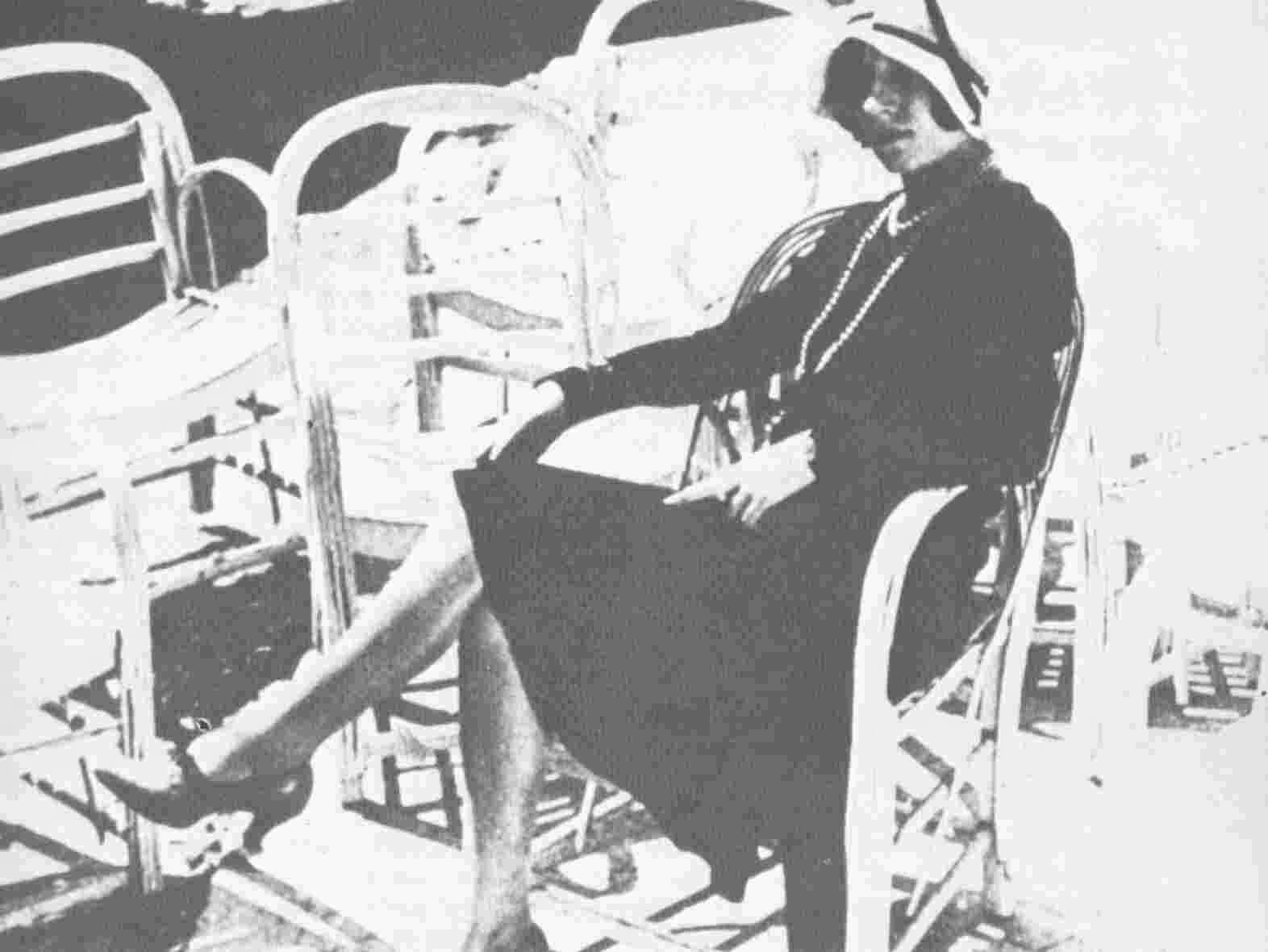
A
PROPOS DE NICE
(Jean
Vigo, France, 1930)
"A
Propos De Nice" is one of the most unconventional
documentaries ever made -- with irony and
bitterness
the camera explores
this center of middle-class decadence,
the
monstrous hotels, the amorous elderly women with their
ruthless gigolos, the stinking alleys and
grimy bistros filled
with
tramps, ponces, fences; a scathing contrast of the idle
poor and the idle rich."
(George Morrison, Sequence, 6)
INTERNATIONAL
LEFT AND
REVOLUTIONARY
CINEMA
The
subversion of existing value systems and social structures
in political cinema ranges from criticism
of particular issues to
propagandistic
attacks on a country or power bloc, from the subtle
to
the intentionally direct, from the reformist to the revolutionary.
The exposure of social ills or
injustice, the satirizing or demysti-
fication
of institutions and leaders, the recording of conflict or
disturbance, the exhortation to radical
violence or non-violent
revolution
-- these form the themes of political cinema.
All
these films, whether their intent is reformist or revolutionary,
aim to change the viewer's consciousness.
Considering the hundreds
of
dull, ineffectual films propounding laudable objectives, the question
of form arises once again, for the basic
problem of political subversion
is
whether bourgeois form can be used to advance radical content.
Surprisingly, many radical filmmakers cast
their works in a conventional,
often
dated mold, unaware of the far more profound impact of artists
attempting to fuse new content with new
form (Resnais, Marker, Solanas,
Franju,
Rocha, Herzog, Godard, et al). But if one trend in
political world
cinema is to
continue blindly in the use of outworn stylistic structures,
pedestrian realism or naturalism, or
pseudo-radical narration superimposed
on
indifferent and dead images, another is to use film as a tool to
change
the world, no longer an
"art object" existing "parallel" to the world.
This supreme attempt at subversion -- film
as act rather than creation --
represents
a desperate attempt to bridge the gap between life and art.
The first step is to denounce art itself
as a bourgeois deception,
thereby
echoing the surrealist, dadaist, and anti-illusionist stance.
Subversion, in this view, requires an
utilitarian tool (rather than
an
aesthetic medium) to advance the revolution; concomitantly,
the role of "art" is completed
once the revolution is achieved.
The
second step is to activate the spectator, bringing him closer
to the work, which at the same time
approaches him by becoming
more
life-like. For the completed work is but part of the final
equation; it begins to exist fully only
when confronted by an
audience
which brings to it its own associations and frames of
reference and accepts the communication
offered in a particular
and
subjective manner. It is only then that the process of
communication -- and in this case, of
subversion -- is complete.
The
continual dilemma of the subversive artist has always been
how to confer his subversion on his
audience. To the extent
that
modern art has constantly aimed at breaking down
the
invisible barrier between work of art and beholder --
in
the cinema, from Eisenstein and Vertov to Godard and
the
avant-garde -- it completes the circle of subversion,
and
indeed becomes a tool in the political struggle.
The
basis of politically and socially subversive cinema is the
tension that exists between society and
artist. This expresses
itself
in forms and subjects that vary from country to country,
resulting not from greater or lesser
artistic sophistication or skill
but
from differing stages of societal development, from political
pressure, from the absence or presence of
democratic tendencies
and the
degree of sharpness of social contradictions. In each
instance, however, the artist goes further
than his particular
Establishment
wishes him to. This "going beyond"
is
the precise characteristic of all subversive art.
___________________________________________________________________________________________
THE
WEST: REBELS, MAOISTS,
AND
THE NEW GODARD
Although
political films have been produced in all Western countries,
most of them are from the United States.
This is mainly due to
the
extensive use and high technological level of 16mm production
equipment and laboratory facilities, and
the relative absence, as
yet,
of censorship. Apart from the thousands of films produced by
students, independent filmmakers, or
political film collectives,
there
also exist distribution companies controlled by the New
Left (such as "Newsreel",
American Documentary Films, and Tri-
Continental
Film Center) which attempt to extend the area
of
political film exhibition. Recent developments in videotape
(the availability of portable, lightweight
equipment) and cable
TV (the
creation of "public access" channels, the programming
of which must by law remain uncontrolled
and open to everyone)
point to
a further increase in the production of such films.
The
end of the war in Vietnam and the deceptive quiet of the
country, however, tends, at least
temporarily, to inhibit their
creation.
Since the basic problems of race, class, or generation
conflict remain unresolved or, even worse,
are artifically papered
over,
the future will undoubtedly witness new wavs of radicalization.
The 1968
student revolts in Western Europe gave political cinema
there an added impetus, the abortive
"States General" of French
cinema
even calling for a restructuring of the industry based
on
collective self-management, elimination of the profit motive,
opposition to the star-cult, to
censorship, and private ownership
of
the means of film production, distribution, and exhibition.
But if this movement ultimately proved as
abortive as the revo-
lutionary
upsurge itself, it also contributed to the radicalization
of one of the great French directors,
Godard, and his raising once
again,
on an international level, the problem of revolutionary cinema.
If his previous work had appeared to
conventional (and even "liberal")
critics
and audiences so extreme as to be beyond the pale, Godard
now rejected it as being in itself
hopelessly bourgeois. "I wanted
to
conquer the fortress of French traditional cinema", he says in
one
of his fascinating
interviews of the period, "I did and now I occupy it
as its prisoner." And: "I
used to bang my dish on the bars of the cell.
They
let me make all the racket I wanted." There was therefore,
according to the new Godard, to be no more
seduction of the audi-
ence by
"art"; no more "art for art's sake" or films of
"consumption".
The
narrative cinema, even as modified by himself in Breathless,
Masculine-Feminine, and other
works, was hopelessly outdated;
the
"dictatorship of the director" had to be smashed and
replaced by
group filmmaking;
the work was never to be "finished" but remain
forever in flux; and the imperialist
inundation of the individual
with
worthless or manipulative pictures was to be replaced by
visual primitivism, the reduction of the
image to a few shots --
a
strengthening of Godard's earlier tendencies toward
minimal cinema, here combined with Maoism.
Unfortunately,
the resultant films -- from Meet You At Mao to
Tout Va Bien -- prove that to
"will" political cinema into being
without
the mediation of art is self-defeating. Despite brilliant
sequences (reminiscent of the "old"
Godard), these works are
visually
sterile, intellectually shallow, and, in terms of their
overbearing, insistent soundtracks,
didactic, pedantic, dogmatic.
The
"creative boredom" of minimal cinema may well constitute
a valid investigation of the medium's
potential from an aesthetic
viewpoint,
but whether the masses will be activated by a 10-minute
harangue on woman's liberation
monotonously delivered against the
background
of a young lady's navel (See You At Mao) is questionable.
As the minimalist directors and
theoreticians have properly pointed out,
they
are concerned with medium and work "as such", with an
exploration
of form and
structure devoid of meaning and message; an "aesthetic"
approach in total contradiction to
Godard's didactic preoccupations.
The
very emphasis on "word-film" as a political weapon is
debatable,
particularly when
compared to such masterpieces of subversive visual
cinema
as The Hour of the Blast Furnaces, Battle of Algiers,
and others.
Yet Godard's
obsessive radicalism and continued experimentation
has
had a positive, catalytic effect. It has already produced both
emulators and others exploring new paths.
Perhaps these late-
Godard
radical films will come to be viewed as primitive, important
forerunners of an ultimately successful
fusion of form and content in
the
service of revolutionary subversion. "In the service of";
for the
search for a cinema
that is itself "an act" rather than "an art"
is illusory. Even revolutionary
cinema ultimately remains
a
reflection of different intensities of light on a flat surface.
LEFT AND REVOLUTIONARY CINEMA: THE WEST
___________________________________________________________________________________________
SUBVERSION
IN EASTERN EUROPE:
AESOPIAN
METAPHORS
The
failure to extend the proletarian revolution to the West and the
subsequent degeneration of the Russian
revolution has tragically
transformed
the political system that promised man the widest
possible freedom into the world's most
efficient totalitarian regime.
In
the cinema as elsewhere, the state's complete control over the
means of productions and of communication
seems effectively to pre-
clude
opposition or dissent. Yet the spirit of freedom
surreptitiously
re-emerges,
particularly among the young of each new generation.
Symptomatically, just because this spirit
of freedom is directed towards
the
extension of democracy and, in the arts, towards the flowering
of different aesthetic tendencies, it
appears counter-revolutionary to
the
regime (which thereby unintentionally defines itself in action) and
new repressive measures are instituted, to
which the new pioneers re-
spond
with new tactics. This constant state of tension between
creative
artist and government
bureaucracy is basic to the eastern societies from
Eisenstein in Russia to Schorm in
Czechoslavakia, Skolimowski in Poland,
and
Makavejev in Yugoslavia. Unable to pose questions head-on, the
artist
is forced into allegory,
metaphor, and indirectness -- secret communications
to
be decoded by the viewer. These courageous filmmakers are the
moralists
of their society,
reminiscent of Diderot and the Encyclopedistes; for where
politics is inhibited, art tends to assume
its function and form and style --
not
merely content -- become ideologically charged. in this sense,
while
propaganda films are
lacking in Eastern Europe, poltical films are not.
Individual
works involving lesser or greater dissent can be found at
infrequent intervals in each of the
national cinemas of the East.
But
the emergence of an entire "school" has so far been limited
to
the short-lived Polish
experience of the Gomulka years of the fifties
and
the equally brief and brilliant Czech film renaissance, immediately
before and under Dubcek. Though now
only a glowing moment of history --
it
was destroyed by the Russian occupation of Czechoslovakia -- this
latter
movement and its works
stand as astonishing revelations of the hidden
trends
within the so-called monolithic ideological structures of the East.
To
Western eyes, this movement offered a challenge: the most
difficult
film to find in
Prague was a Communist propaganda film and the easiest,
a
humanist work in the idiom of modern cinema. The "socialist
realism"
of the past -- a
sentimentalized falsification of reality -- has been super-
seded by an attempt to confront truth and
uncertainty, experience and
doubt.
These Czech films deal with alienation, with anti-heroes and
the corruption, by terror, of
victims as well as executioners. Devoid of
"official" ideology, they are
filled with unorthodox compassion for people
as
they are and no longer, as in Stalin's times, as they should be.
The
astonishing, tightly knit group of young filmmakers represented
the values of the first post-Stalinist
generation. It was striking to note
how
similar their views were to those of the West's rebellious youth,
which, from a different starting point,
had also become engaged in a
search,
without illusions, for possible ideals and provisional truths.
It seemed that the world was perversely
backing into an enforced
brotherhood,
which would universalize such problems as individual
freedom in a bureaucratic society,
estrangement between generations,
the
failure of dogmatic ideologies, and eternal confrontations of
imperfect innocence as against the
corruption of so-called maturity.
Two
complementary tendencies dominated the young Czech cinema.
The realist camp (similar to the Italian
neorealists and "cinema
verite")
concentrated on the significance of the insignificant, using
non- professionals and actual locations
for greater authenticity.
Unlike
the Italians, however, the Czech realists (Forman, Passer,
Menzel) seemed less ideological,
sentimental and heroic. In providing
a
truth and spontaneity too long frowned upon, their films were as
radical as the elaborate creations of the
allegorical-symbolist wing.
This
camp (represented by Schorm, Nemec, Masa, Juracek, and Vera
Chytilova) was far more cerebral; its
scenarios were careful intellectual
constructions;
its settings and visual syles intentionally artificial; its
tone oblique, suffused with
existentialism. There was less of the smiling
optimism of the neorealist camp; a more
somber, even pessimistic, mood
obtained.
Stylistically, they tended to be allegorical, symbolist, or even
"absurd"; touches of Bunuel,
Fellini, Bergman abounded and the possibility
of
an underlying complexity too dense to be unravelled was hinted at.
However,
it ws the influence of Kafka that loomed largest. This modern
prophet of ambiguity, unidentifiable
nightmare, and sublime intimations
of
limited hope had finally become inescapable. The property of
the world,
he was at last
accepted in his own country as well. Following his ideological
rehabilitation at the end of the Stalin
era, his works instantly sold out and
entered
the intellectual and conceptual framework of the new generation.
The
Dubcek era, by modifying an artificial isolation from abroad of 17
years,
reconstituted the link
with Czechoslavakia's unique past, which predisposes
the
country toward the more modern cultural tendencies. Situated at
the
center of an age-old,
warring continent, always a minority within larger
empires, this unfortunate country has
perhaps been more frequently
subjugated
or "liberated" than any other European nation, as well as
subjected to the most sophisticated
cultural influences. Surrealism,
Cubism,
Dadaism were at home under Masaryk and Benes. Ironically,
Hitler forced into Prague an additional
group of outstanding emigre
exponents
of "decadent" modern art, and the isolation from world art
under Hitler and Stalin led to an
advantageous amalgamation of leading
Czech
elements in theatre, film, painting, and literature into one common
milieu, the inevitable nucleus for the
forces of cultural liberalization.
Despite
Russian destruction of this movement -- all the directors were
forced out of the industry or into exile
-- it has left its mark and, together
with
the Polish film renaissance under Gomulka (Polanski, Borowczyk,
Lenica, Skolimowski, Wajda, Kawalerowicz,
Has, and Munk), has set
standards
of thematic and aesthetic daring that have become prototypes
for filmmakers in other Eastern countries
as well. In vain does one
nowadays
look for "socialist realism", "positive heroes",
or paeans to
tractors; instead,
in their best works, there is a painful confrontation
of
the basic question of human freedom under a collectivized regime
without democratic controls, a positive
scepticism and rejection of
hypocrisy
which reveal a struggle for new values and new lifestyles.
These films are not
"counter-revolutionary", but rather attempt
to
clarify what the Czech reform movement used as its slogan;
"socialism with a human face".
They prove that arrogantly
exercised
power, alienation, and the corruption of both the
individual and society are as rife in the
East as in the West, and
that
the aspirations of the most progressive youth in both blocs
are identical: a more equitable
society, yet one that preserves,
indeed
extends, the best democratic traditions of the West.
LEFT AND REVOLUTIONARY CINEMA: THE EAST
___________________________________________________________________________________________
THE THIRD WORLD: A NEW CINEMA
The
cinema of the Third World is as young, varied, and amorphous
as the different political and geographic
realities it represents and
is
united only in its determination to liberate itself from the sway of
foreign domination; its subversion,
therefore, is primarily directed
against
a power elite which is alien and extraneous and a native ruling
class allied and subservient to it.
Perhaps the politically and aesthe-
tically
most developed Third World Cinema was Brazil's "Cinema Novo"
movement, one of the new "national"
cinemas to emerge in the last
decade;
it accurately reflected the social fervor and progressive
nationalist commitment of a new generation
coming to maturity in
a
stagnant, dictatorial oligarchy shored up by American capital and
based on poverty, oppression, and cultural
and political colonization.
This
group of young filmmakers attempted to develop an indigenous,
socially relevant Brazilian cinema, free
of domination by foreign,
particularly
American capital, drawing its themes and aesthetic
preoccupations from the country's heritage
and tragic need for
transformation;
but the political climate in Brazil has now,
at
least temporarily, put an end to its activities.
The
basic themes of Cinema Novo are those of Brazilian reality:
the archaic, cruel "sertao", the
sun-parched steppes that occupy
much
of the country's huge territory, in which, as in a primeval,
mythological landscape, the ultimate
tragedies of oppression,
lust,
heroism, and betrayal are played out; the exploits and
myths of the "cangaceiros"
and "beatos", anarchist and flamboy-
ant
bandit-rebels who redress social injustice by violence directed
against the rich; and the "favela",
Rio de Janiero's festering
shanty-town
slums. In these basic landscapes, Cinema
Novo
has placed characters tenaciously clinging to outworn
privileges and exorbitant rebels
determined to destroy them.
A
full-fledged, nationalized film industry entirely in the service
of the revolution has been developed in
Cuba, which produces a
significant
number of feature films by internationally recognized
artists, documentaries, propagandist
shorts and strongly political
newsreels.
Despite increasing pressures towards ideological
conformity, the Cuban films remain
refreshingly free of the
stultifying
"socialist realism" of the Stalin period in the East,
reaching levels of poetry (Gomez' First
Charge of the Machete) and
intellectual
sophistication (Alea's Memories of Underdevelopment)
that place this very young industry in the
front rank of the third world
production.
The "subversive" Cuban cinema, perhaps surprisingly,
is primarily found in the propaganda films
by Santiago Alvarez who
today
is one of the world's most prolific and notable political filmmakers.
A young,
but growing, film industry is emerging in Algeria, with
a
strongly political bent, emphasizing the fusing of nationalist and
radical elements so dominant there.
The features deal primarily
with
the still traumatic period of the anti-French struggle, both
fictionally and by the use of newsreel
materials; the shorts
frequently
exhibit a greater variety of subject matter; hardly any,
however, classify as either pure
entertainment or pure politics.
The
most strongly political work is probably Ahmed Rachedi's
The Twilight of the Damned, an
anti-imperialist history of Algeria.
Though
Chinese films have not been widely seen in the West --
a
situation that hopefully will now change -- there is no reason
to assume that a large new source of
subversive films will suddenly
emerge
from what by all accounts is a strongly ulitarian, conservative,
socially "positive" cinema, free
of aesthetic "frills" or even propagan-
distic
subversion either of its own establishment (unthinkable) or of
world imperialism (such films would
already be known in the radical
West
or the film festival circuit). It is entirely possible that the
most subversive Chinese film so far is
Acupunctural Anaesthesia
with
its cold, scientific demystification of the human body.
Some
political films have also come from North Vietnam,
Chile,
Mexico, Bolivia, and Senegal; and from Argentina,
probably the masterpiece of Third World
Cinema, the violently
anti-AmericanThe
Hour of the Blast Furnaces by Fernando Solanas.
Finally,
tribute must be paid to a type of political film almost unique
to South America and directly linked to
the nature of its political
systems:
the illegal film, produced (and distributed!) under the
most dangerous and trying circumstances,
the ultimate, if not
in film
art, at least so in personal revolutionary commitment;
chiefly these are exposes of social ills
or documentaries of other-
wise
unreported political demonstrations, strikes, and riots.
LEFT AND REVOLUTIONARY CINEMA: THIRD WORLD
___________________________________________________________________________________________
EAST GERMANY: AGAINST THE WEST
Some of
the strongest and simultaneously most questionable
political films of the post-war era have
come from East Germany.
Originating
in the works of Annelie and Andrew Thorndike,
continued
by Joachim Hellwig and, more recently, by Walter
Heynowski, these hard-hitting, tightly
edited films at
first aimed at
identifying West Germany with the Nazis,
establishing
a continuity of personnel if not ideology,
and
were later broadened to include West Germany's
imperialist ally, the USA. The
Thorndykes called their
series
of films The Archives Testify, and this proved to be
the ideological shape of all East German
films of this type.
Based on
archives, official legislation, secret orders, and
newsreels of the Nazi period, they
exposed, prosecuted,
and
convicted their victims on film by carefully chosen
visuals and sophisticated editing.
There is no doubt what-
soever
that in these films real Nazis and certain crimes
of
the West were indeed exposed; and to this extent, they
were not only subversive works par
excellence, but, due to
their
wide distribution, quite effective. Yet they raise the
most disturbing questions (if not, indeed,
parallels to Nazi
propaganda
films) in their crude simplifications, tendentious
pre-selection, shaping and even doctoring
of what may well be
valid
materials, use of political "amalgams" (the meretricious
cross-cutting of materials in reality
unrelated), and insertion
of
staged scenes (without even identifying them as such).
In
short, they are propaganda work rather than political films --
"trials" by camera and montage
-- and ultimately operate, despite
their
intellectual, factual gloss, primarily on an emotional level.
The
"subversion" of these films, all made prior to the 1972
detente
between the two
Germanies, was directed against an external foe
and
as such was in accordance with official East German foreign
policy of the time. No "subversive"
films exist in East Germany
directed
against its own establishment. It is not that there are
no social or political problems: it
is simply that the state owns all
motion
picture production, distribution, and exhibition. Neither
cautious, allegorical works (as in
Hungary, Czechoslavakia, and
Poland),
nor directly political films (such as Red Squad, The Murder
of Fred Hampton, and many more in
America) have so far been made
in
this most orthodox of Eastern countries. Perhaps their
fulminations
against Western
Nazis in high positions would sound less self-righteous
if there existed just one East German film
drawing attention to the
use of
former Nazi bureaucrats (or nuclear physicists!) in the East.
EAST GERMANY: AGAINST THE WEST
___________________________________________________________________________________________
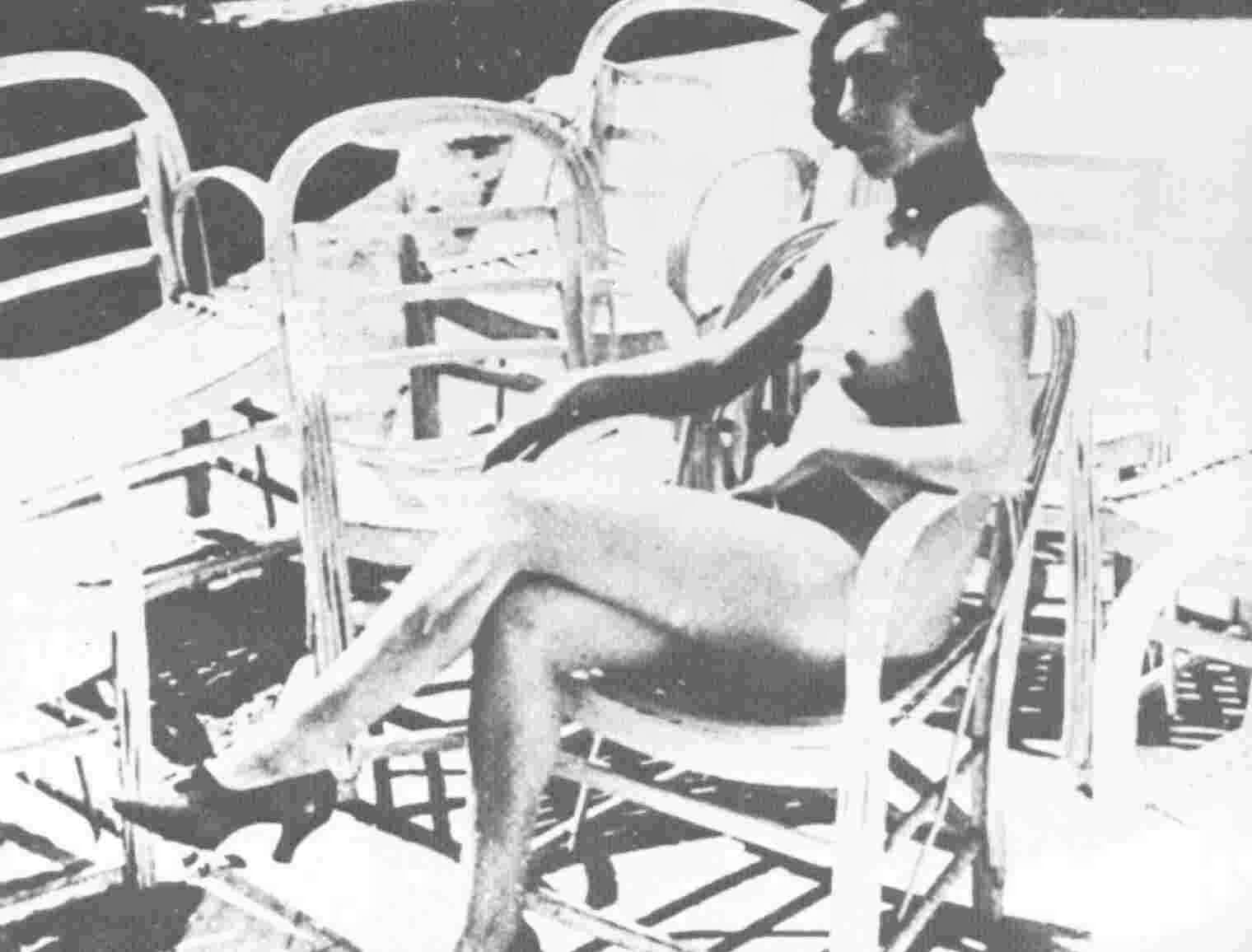
A
PROPOS DE NICE
(Jean
Vigo, France, 1930)
It also
commented visually on "the girls" in the
terrace cafes by simply juxtaposing two
images.